








The 1911 pistol is a mature platform. The sidearms have been in common use by military, law enforcement, and civilians alike for more than 100 years. Properly-trained gunsmiths know how to make them run reliably, and properly-trained shooters know how to employ them. The grip angle is just about perfect, and the single-action trigger can be one of the best in the handgun world. Sights have improved exponentially over the last century, as have magazines and the ammo that goes in them. Primary concerns for those using a 1911 on a regular basis are ammo capacity and price. Here, we have two imported 9mm pistols that we think address both issues.
Our first selection is the Rock Island Armory TAC Ultra MS HC Combo 56632 9mm Luger, $700, which makes great use of the high-capacity frame pioneered by Para-Ordnance in the mid-1990s. The company then added a modern Picatinny rail on the dust cover, an adjustable rear sight, and a fiber-optic front. This combo also included a second barrel for the 22 TCM cartridge, which we didn’t test in this comparison.
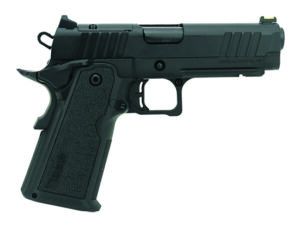
Our second selection is the Tisas 1911 Duty B9R Double Stack 12500017, $670, a Turkish hybrid model whose frame of steel and polymer was made popular by STI (now Staccato). The Tisas is also fitted with a fiber-optic front sight, but the small rear sight is adjustable for windage only. However, the slide in front of that sight has been milled for a red-dot sight, which is a nice option for a gun of this price. We tested using the iron sights on both pistols.
Tisas 1911 Duty B9R Double Stack 12500017 9mm Luger,
$670
Gun Tests grade: B (Our pick)
The Tisas brings frame technology a generation or more newer than the Rock Island. We liked the lighter-weight frame along with a slide that was already milled for a red-dot sight. We preferred it over the RIA pistol, albeit narrowly.
| Action Type | Single action semi-auto |
|---|---|
| Overall Length | 7.9 in. |
| Overall Height | 5.8 in. |
| Maximum Width | 1.46 in. |
| Weight Unloaded | 32.4 oz. |
| Weight Loaded | 43.4 oz. |
| Slide Material | Forged 4140 carbon steel |
| Slide Retraction Effort | 14.43 lbs. |
| Receiver Material | Forged 4140 carbon steel |
| Finish | QPQ slide, black Cerakote frame |
| Front Strap Height | 3.0 in. |
| Back Strap Height | 3.6 in. |
| Barrel Length | 4.25 in. |
| Grip Thickness (Maximum) | 1.32 in. |
| Grip Circumference | 5.75 in. |
| Magazines | Two 17 round |
| Rear Sight | Black, windage adjustable |
| Front Sight | Green fiber optic |
| Sight Radius | 5.8 in. |
| Trigger Pull Weight | 3.71 lbs. |
| Trigger Span | 3.1 in. |
| Safety | Manual thumb and grip |
| Warranty | 1-year limited |
| Telephone | (865) 604-6894 |
| Website | TisasUSA.com |
| Made In | Turkey |
This Tisas B9R Double Stack (DS) pistol is one of the latest batches of firearms being imported from Turkey. Once looked down upon (perhaps like “made in Japan”), the Turkish firearms industry has turned into a force to be reckoned with. Already adept at copying and improving legacy designs, we also now see new creations coming from their factories. The B9R is produced using much of the same machinery used in the U.S., but they do so using skilled, but much less expensive, labor. The simple question has to be, how well can a sub-$700 Turkish clone compare to U.S.–made pistols costing several times that much.
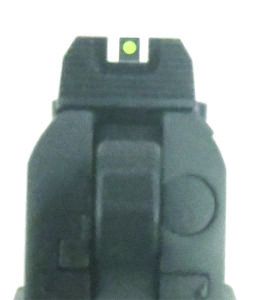
With the Tisas we have a pistol that starts off with a heavy top end. The slide has a fully contoured round top. It is full diameter for the full length except for a short bevel near the muzzle. It sports four diagonal grasping grooves near the muzzle and five more at the rear. The rear sight is short (because it has to leave room for the optics mount right in front of it) and machined to accept a Glock sight. It provides a wide rear notch as well as a flat forward surface handy for single-handed manipulation. The front sight is a green fiber-optic tube set in a dovetail mount. To access the optics mount, remove the protruding screws from the plate and lift it off. The slide appears to be cut for smaller sights like the Shield SMSc.
The Tisas makes good use of a bull barrel that adds more weight out front and doesn’t require a bushing. The single recoil spring wraps around a full-length guide rod and requires a reverse spring plug. The barrel, like on the RIA, is fully supported. Also like the Rock Island, the Tisas uses a retro/modern Series 70 firing pin system and passes on the separate firing-pin block.
The finish on the Tisas is a process called QPQ, which stands for “Quench, Polish, Quench.” Everything starts with a nitride bath. Parts are then polished and dipped again in another salt bath that adds a protective oxide layer and enhances corrosion resistance. The firearms industry has come a long way since simple Parkerized finishes.
As mentioned, the frame is reminiscent of the two-piece system developed by STI. With the exception of the mainspring and the magazine release, all of the working parts are attached to the steel cradle. We noted the weight of the cradle and compared that to the alloy cradle on the Staccato CS24 we have — 9.1 ounces for the alloy cradle on the Staccato and 14.4 for the steel version on the Tisas. The complete Staccato CS pistol, with a red-dot sight mounted, only weighs 10 ounces more than the lower receiver unit on the Tisas. That could come in very handy for someone who wants to shoot a lot, though the added weight could make it harder to carry.
We liked the control parts Tisas elected to use. The hammer is a slotted, Commander-style piece as is the Rock Island pistol’s. The beavertail was reasonably well fitted to the frame and brings a nice memory bump on the rear surface to help forgive a less-than-perfect grip on the draw. The magazine release has been slightly extended for easier reach. The trigger has a flat face with hooks at the top and the bottom. The effect is to center the trigger finger well for proper manipulation. The ambi thumb safety has been well designed. The sides are elliptical rather than rectangular. This allows the rear outside radius to be moved further forward so they don’t pinch your hand when the safety is pressed down. The upper surfaces are slanted down toward the outside edge, leaving them, we feel, much more comfortable to the thumbs. The Tisas comes complete with the Allen wrenches needed to disassemble everything, some extra fiber optic rods, and even a spare firing pin and spring.
The grip module is polymer, as expected, and attaches to the steel cradle with two screws through the side of the grips and two more through the front of the trigger guard. FYI, checking these screws for proper tightness should be part of your regular maintenance on this pistol. Both the front strap and the mainspring housing have been checkered for a more secure grip. The sides of the module — where the grip panels would be on a standard 1911 — has been stippled, though perhaps not as aggressively as we would prefer. The trigger guard has been squared (we’re not sure why manufacturers are still doing this), and the bottom of the guard has been well relieved to allow a higher grip. The magazine well has been beveled to provide for faster reloads of two 17-round polished magazines. In this case, the shell that Tisas uses for the grip frame is so similar to the size STI uses, the magazines for the STI 2011 pistols will also work with the Tisas. Even some 17-round magazines we have for the Springfield Armory Prodigy would fit and feed. We would need to do some extensive testing, though, before we could recommend those.
Feeding and function were perfect on this Tisas. We had no malfunctions of any kind through a couple hundred rounds in testing. The favorite load was the Black Hills HoneyBadger 100-grain bullets. Average there for five-shot groups was a mere 1.23 inches, with a 1.11-inch best group. The Speer Gold Dot 124-grain load came in a close second. First-shot times were very similar between the two pistols, with the Tisas holding a small edge. The Tisas had slightly better split times, while the Rock Island eked out a win in overall accuracy. Be aware that the time and accuracy differences were a few hundredths of a second or an inch.
Our Team Said: The Tisas had a very slight edge in our team scores, meaning both pistols did very well. We called it for the Tisas, but we think either would serve well.
| 9MM LUGER RANGE DATA | ||
|---|---|---|
| Shell Tech 65-grain Copper Polymer Fluted | Rock Island Armory A2MS-Tactical | Tisas B9R-DS |
| Average Velocity | 1577 fps | 1569 fps |
| Muzzle Energy | 359 ft.-lbs. | 355 ft.-lbs. |
| Best Group | 1.38 in. | 1.23 in. |
| Average Group | 2.08 in. | 1.39 in. |
| Black Hills HoneyBadger 100-grain CF +P | Rock Island Armory A2MS-Tactical | Tisas B9R-DS |
| Average Velocity | 1203 fps | 1225 fps |
| Muzzle Energy | 322 ft.-lbs. | 333 ft.-lbs. |
| Best Group | 1.11 in. | 1.68 in. |
| Average Group | 1.23 in. | 1.74 in. |
| Hornady Critical Defense 115-grain FTX 90260 | Rock Island Armory A2MS-Tactical | Tisas B9R-DS |
| Average Velocity | 1128 fps | 1106 fps |
| Muzzle Energy | 325 ft.-lbs. | 312 ft.-lbs. |
| Best Group | 1.91 in. | 1.68 in. |
| Average Group | 1.95 in. | 1.89 in. |
| Speer Gold Dot 124-grain GDHP 23618GD | Rock Island Armory A2MS-Tactical | Tisas B9R-DS |
| Average Velocity | 1136 fps | 1124 fps |
| Muzzle Energy | 355 ft.-lbs. | 348 ft.-lbs. |
| Best Group | 1.21 in. | 1.59 in. |
| Average Group | 1.48 in. | 1.81 in. |
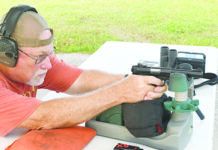
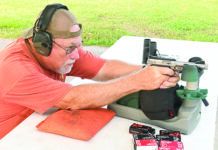
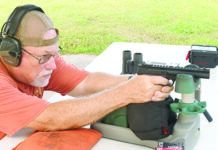
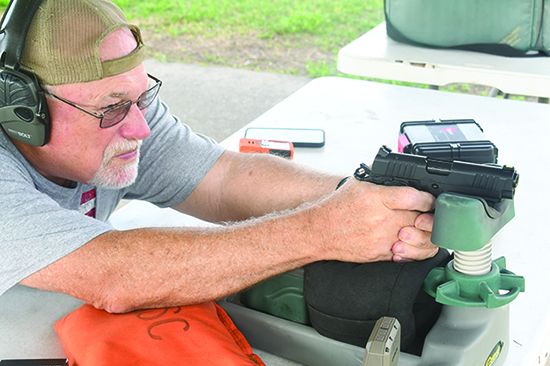
We tested at American Shooting Centers in west Houston. We fired for accuracy at 15 yards by shooting multiple five-shot groups from a well-sandbagged Caldwell Pistolero Shooting Rest (MidwayUSA.com 517357, $28) assisted by a Mini DRC Fortune Cookie from Wiebad.com ($75, MINIFC). We recorded velocities with a Garmin Xero C1 Pro chronograph ($600). CPF = copper polymer fluted. CF = copper fluted. GDHP = Gold Dot hollow point.
| DRILL NO. 1 DATA | |
|---|---|
| Pistol | Single Shot Average Time |
| Rock Island | 0.773 |
| Tisas | 0.754 |
Process: Fire one shot from low ready at a USPSA A Zone (5×11 inches) at 7 yards. Times in seconds are averages for 10 reps
| DRILL NO. 2 DATA | |||
|---|---|---|---|
| Pistol | 1st Shot | Split Average | Total Time |
| Rock Island | 0.757 | 0.203 | 0.955 |
| Tisas | 0.837 | 0.173 | 1.015 |
Process: Fire two shots from low ready at a USPSA A Zone (5×11 inches) placed at 7 yards. Times in seconds are averages for five reps.
| DRILL NO. 3 DATA | |||
|---|---|---|---|
| Pistol | 1st Shot | Split Average | Total Time |
| Rock Island | 0.78 | 0.198 | 1.061 |
| Tisas | 0.796 | 0.188 | 1.108 |
Process: Fire three shots from low ready at a USPSA A Zone (5×11 inches) placed at 7 yards. Times in seconds are averages for three reps.
Our speed tests are not designed to show how fast a firearm can be fired, but to use the same test on multiple guns fired by the same person to look for differences in the guns’ capabilities.
Written and photographed by Joe Woolley, using evaluations from Gun Tests Team members. GT