


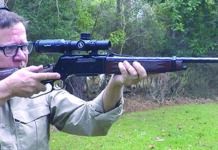








Few cartridges are as popular in this country as the 223 Remington. Much, if not most, of the ammo shot by rifles so chambered will be sent downrange by Modern Sporting Rifles. The 223 Remington round is easy to find, is relatively inexpensive, produces low recoil, and can be accurate, especially in a good bolt gun. Turnbolts tend to be more innately accurate and have longer barrels than gas semi-autos, and many have great triggers few semi-autos can match, which can also make them easier to shoot more accurately.
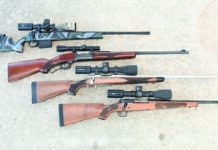
We decided to grab four samples of great bolt guns chambered in 223 Remington to see what they could do. The first is the Ruger Hawkeye Predator 17122, $1125, with a gorgeous laminated-wood stock, Ruger integral scope rings, and controlled-round feed. The second is the Savage Model 110 Varmint 57066, $775, complete with an AccuTrigger and adjustable AccuStock that makes it easy to adjust length of pull and comb height. Next is a Tikka T3x Varmint JRTXH312, $800, with a heavy 23.7-inch barrel, Tikka’s sturdy mount for a Picatinny rail, and the company’s superb trigger. Last is the much lighter and somewhat more affordable Winchester XPR 535700208, $640, with its composite stock and standard-profile barrel.
Ruger Hawkeye Predator 17122 223 Remington,
$1125
Gun Tests grade: A-
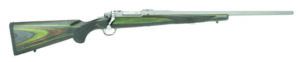
Heavy, but well balanced, the Ruger Hawkeye Predator would be a great choice for the shooter who likes the traditional look of a laminated stock.
| Action Type | Bolt |
|---|---|
| Overall Length | 42.0 in. |
| Barrel Length, Twist | 22.0 in., 1:9 |
| Overall Height w/o Scope Mount | 6.25 in. |
| Weight Unloaded | 8.06 lbs. |
| Weight Loaded | 8.24 lbs. |
| Sight Radius | NA |
| Receiver Finish | Brushed stainless steel |
| Receiver Scope-Base Pattern | Ruger, integral |
| Barrel Finish | Brushed stainless steel |
| Magazine Capacity | 5 |
| Magazine Type | Internal |
| Stock Material | Wood laminate |
| Stock Drop at Comb | 0.5 in. |
| Stock Drop at Heel | 1.0 in. |
| Stock Bedding | None |
| Stock Buttplate | Rubber |
| Stock Length of Pull | 13.5 in. |
| Trigger Pull Weight | 1.96 lbs. |
| Safety | 3-position wing |
| Warranty | None written |
| Telephone | (336) 949-5200 |
| Website | Ruger.com |
| Made In | U.S. |
Introduced in 1968, the Model 77 Ruger was intended to incorporate the best features of the 1898 Mauser and update it for modern production methods. Ruger’s design used a derivative of the famous controlled-round feed, in which all cartridges rising out of the magazine would be grabbed (controlled) by an integral extractor claw and fed smoothly into the chamber. The Model 77 also used cast parts where possible and proper, changed the safety to a tang-mounted version, and employed coil springs.
The 1989 version went to a real controlled-round feed, a blade ejector, a three-position safety on the rear of the bolt, and an improved trigger. They called the new variants the Varmint, Lightweight, and International versions. The year of 2006 saw a few more improvements with a redesigned stock and, once again, an improved trigger. The latest iteration is the Hawkeye, tested here.
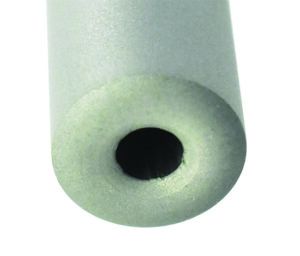
Our Hawkeye starts with a 22-inch stainless-steel barrel. The medium-contour tube has been hammer forged to create very precise, but affordable rifling. This profile leaves a slightly muzzle-heavy feel, with the rifle balancing just in front of the forward action screw, meaning it should be easy to carry in the field. The target-crowned muzzle measures 0.65 inch in diameter.
The receiver is typical Ruger. As expected, the top of the open bridge action sports two integral scope mounts. The rifle ships with stainless-steel 1-inch rings. Because we wanted to mount a scope with a 30mm tube, we provided our own larger rings, easily obtained from Ruger.com and many other sources. These rings clamp firmly to the top of the receiver bridge and also provide their own recoil lug. We’ve found them to be very secure over the years.
As mentioned, the extractor is a non-rotating claw that grabs the cartridge as it rises out of the magazine. The case rim slides under the claw and is controlled all the way into the chamber. The ejector is a pivoting blade that rises into a slot in the bolt and engages the empty case as the bolt is drawn to the rear. The safety is a three-position wing unit on the right side of the bolt shroud. Forward is Fire. The middle position locks the sear but still allows the bolt to move. All the way to the rear locks everything. The bolt release is a lever on the left rear of the receiver.
The Ruger Hawkeye does not have any bedding, but then it does. The original Mauser action used twin vertical action screws to mate the action to the stock. That tended to be brittle, and split stocks were not uncommon. One solution was to glass-bed (or some similar process) the action to the stock. That was also time-consuming and expensive, so Ruger opted for a different solution. The front action screw on our Hawkeye is slanted to the rear. Tightening the screw pulls the action firmly down into a mortise in the stock. The process leaves plenty of meat in the stock, so splitting is not an issue and brings everything into solid contact without requiring hand fitting. That’s a win-win.
The bottom metal on the Hawkeye really is metal — as in stainless steel. The hinged floorplate has the Ruger logo engraved on it and is activated via a lever in the front edge of the trigger guard. While very secure, it was easy to reach and activate as long as we didn’t tighten down the action screws too much. The trigger is an adjustable, two-stage design. Our sample measured less than 2 pounds on our Lyman Digital Trigger Gauge — right where we like it. Trigger compression was very smooth, with very little creep or overtravel.
The Hawkeye uses a system for feeding the short 223 cases, some version of which we found common to all of our test rifles. Two of these rifles are true short-action builds (the Tikka and Winchester XPR are both long actions, but more on that later) that are designed to handle cases in the 308 Winchester class. That maximum length is about 2.81 inches, while the 223 usually maxes out at 2.26 inches to make them compatible with modern sporting rifles, aka AR-10s. Without alteration, that extra half-inch plus of unneeded space can create some problems with feeding. The solution is to sleeve the magazine in some way. Three of these rifles just use a standard-length mag with a rear stop plate that moves the cartridge well forward. The Ruger, with its internal magazine, fits a shorter box inside the stock and solves the same problem. The followers, of course, are sized to fit.
Our Hawkeye uses a third-generation stock that was very pleasing to the eye and the hand. The laminate shows grey, green, and brown colors for an attractive look. The slender stock is rounded at the fore end, yet it provides a flat just in front of the magazine to help in shooting off bags. The checkering on the fore end and the pistol grip provides plenty of grip without being too aggressive. Overall, the pattern was good, but the pressed-in diamonds did show some cross checkering.
Sling swivel studs are provided on the stock fore and aft along with a thin, rubber recoil pad. The expected Ruger logo shows on the pistol-grip cap. Inletting on the stock was well done, with good wood-to-metal fit. No free-floating on this barrel; contact of the barrel to the fore end was solid.
The Ruger Hawkeye fed and cycled everything we tried. Just remember to run all cartridges from the magazine of controlled-feed actions. Don’t just lay them on top of the follower — that forces the extractor to snap over the case rim and can be hard on the extractor. The average three-shot group size for the four ammo types tested was 0.854 inch. Not bad at all. The Hawkeye’s favorite fodder was the Federal Gold Medal Match — something that we have seen happen many times — at a 0.627-inch average. Least favorite was the Speer Gold Dot, which seemed to be common across three of the four platforms tested. Group-size average there was 1.26 inch — still not too shabby, just not what we expected.
Our Team Said: We liked a lot about the Hawkeye Predator from Ruger: a good, solid laminated stock, sub-MOA shooting performance with three of four test ammos, and a pretty good trigger. Downsides are the price and the weight.
| 223 REMINGTON RANGE DATA | ||||
|---|---|---|---|---|
| Hornady Superformance 53-grain V-Max | Ruger Hawkeye | Savage 110 Varmint | Tikka T3x Varmint | Winchester XPR |
| Average Velocity | 3396 fps | 3467 fps | 3420 fps | 3420 fps |
| Muzzle Energy | 1357 ft.-lbs. | 1415 ft.-lbs. | 1377 ft.-lbs. | 1377 ft.-lbs. |
| Best Group | 0.61 in. | 0.67 in. | 0.28 in. | 0.79 in. |
| Average Group | 0.82 in. | 0.77 in. | 0.62 in. | 0.92 in. |
| Speer Gold Dot 62-grain Soft Point | Ruger Hawkeye | Savage 110 Varmint | Tikka T3x Varmint | Winchester XPR |
| Average Velocity | 2924 fps | 2922 fps | 2809 fps | 2904 fps |
| Muzzle Energy | 1182 ft.-lbs. | 1176 ft.-lbs. | 1087 ft.-lbs. | 1161 ft.-lbs. |
| Best Group | 0.97 in. | 0.32 in. | 0.98 in. | 0.76 in. |
| Average Group | 1.26 in. | 0.68 in. | 1.12 in. | 0.91 in. |
| Federal Gold Medal 69-grain MatchKing | Ruger Hawkeye | Savage 110 Varmint | Tikka T3x Varmint | Winchester XPR |
| Average Velocity | 2847 fps | 2846 fps | 2735 fps | 2837 fps |
| Muzzle Energy | 1242 ft.-lbs. | 1241 ft.-lbs. | 1146 ft.-lbs. | 1233 ft.-lbs. |
| Best Group | 0.31 in. | 0.69 in. | 0.40 in. | 0.47 in. |
| Average Group 0 | .63 in. | 0.72 in. | 0.59 in. | 0.60 in. |
| Black Hills 77-grain OTM | Ruger Hawkeye | Savage 110 Varmint | Tikka T3x Varmint | Winchester XPR |
| Average Velocity | 2885 fps | 2910 fps | 2796 fps | 2884 fps |
| Muzzle Energy | 1423 ft.-lbs. | 1448 ft.-lbs. | 1337 ft.-lbs. | 1423 ft.-lbs. |
| Best Group | 0.36 in. | 0.48 in. | 0.50 in. | 0.59 in. |
| Average Group | 0.71 in. | 0.62 in. | 0.60 in. | 0.68 in. |
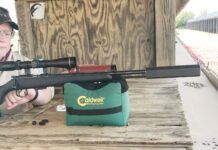
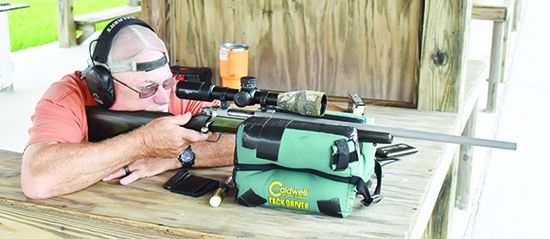
We tested with a variety of ammunition that would cover the spectrum of weights commonly used for varmint and long-range 223 Remington rifles: Hornady’s 53-grain V-Max, the 62-grain Speer Gold Dot, the 69-grain Federal Gold Medal Match, and finished up with the Mark 262 Mod 1C 77-grain OTM from Black Hills. We shot at American Shooting Centers in west Houston, using a well-sandbagged Caldwell TackDriver Pro (Brownells 100-027-023, $49), further supported by a large rear bag, heavy from Tab Gear (TabGear.com, $34). We measured velocities with a Garmin Xero C1 Pro chronograph (Garmin.com, $600). We used a well-proven Vortex Viper PSTII 3-15×44 scope from our battery for all the shooting.
Written and photographed by Joe Woolley, using evaluations from Gun Tests Team members. GT