





Few cartridges are as popular in this country as the 223 Remington. Much, if not most, of the ammo shot by rifles so chambered will be sent downrange by Modern Sporting Rifles. The 223 Remington round is easy to find, is relatively inexpensive, produces low recoil, and can be accurate, especially in a good bolt gun. Turnbolts tend to be more innately accurate and have longer barrels than gas semi-autos, and many have great triggers few semi-autos can match, which can also make them easier to shoot more accurately.
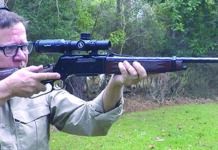
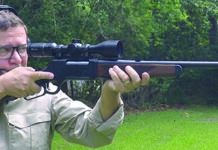
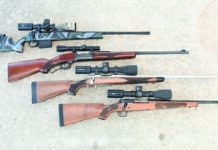
We decided to grab four samples of great bolt guns chambered in 223 Remington to see what they could do. The first is the Ruger Hawkeye Predator 17122, $1125, with a gorgeous laminated-wood stock, Ruger integral scope rings, and controlled-round feed. The second is the Savage Model 110 Varmint 57066, $775, complete with an AccuTrigger and adjustable AccuStock that makes it easy to adjust length of pull and comb height. Next is a Tikka T3x Varmint JRTXH312, $800, with a heavy 23.7-inch barrel, Tikka’s sturdy mount for a Picatinny rail, and the company’s superb trigger. Last is the much lighter and somewhat more affordable Winchester XPR 535700208, $640, with its composite stock and standard-profile barrel.
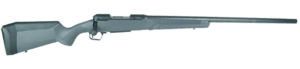
Savage Model 110 Varmint 57066 223 Remington,
$775
Gun Tests grade: B
The Savage 110 Varmint was the most accurate rifle in this test, but we had some problems with its feeding from a magazine, and it had a heavy trigger.
| Action Type | Bolt |
|---|---|
| Overall Length | 46 to 47 in. |
| Barrel Length, Twist | 26.0 in., 1:9 |
| Overall Height w/o Scope Mount | 6.25 in. |
| Weight Unloaded | 9.66 lbs. |
| Weight Loaded | 9.92 lbs. |
| Sight Radius | NA |
| Receiver Finish | Matte blue |
| Receiver Scope-Base Pattern | Savage |
| Barrel Finish | Matte blue |
| Magazine Capacity | 4 |
| Magazine Type | Detachable Box |
| Stock Material | Composite |
| Stock Drop at Comb | Adjustable |
| Stock Drop at Heel | Adjustable |
| Stock Bedding | Aluminum cradle |
| Stock Buttplate | Recoil pad with spacers |
| Stock Length of Pull Adj., | 12.75 to 13.75 in. |
| Trigger Pull Weight | 3.6 lbs. |
| Safety | 3-position tang |
| Warranty | 1 year limited |
| Telephone | (800) 307-0708 |
| Website | SavageArms.com |
| Made In | U.S. |
First designed back in 1958 and patented in 1963, the Savage 110 has weathered numerous upgrades to become the popular rifle that it is today. Reportedly, the model number was decided upon as a marketing device to remind folks of the original price – $109.95. Somehow, 110 rolls off the tongue a little more smoothly. It was designed from the beginning for mass production and was one of the first left-handed rifles so offered. Savage was an early adopter of investment castings and steel stampings, and the company still uses actions and barrels made from forged-steel bar stock.
Our Varmint model uses a 26-inch barrel with a 1:9 twist. With a muzzle diameter we measured at about 0.820 inch, we would rate this barrel as a light Palma profile, according to a chart from Shilen. It definitely adds some weight to the rifle and puts the balance point well forward. The looks remind us of the thick barrels on the old Remington Sendero rifles. The crown is well recessed and everything has a dark matte finish. It is attached to the action in the way we would expect with a Savage — using a slotted barrel nut to screw onto the action, while also sandwiching a recoil lug in between the two. The whole system then allows a do-it-yourselfer to change out barrels at home with a few tools and a go/no-go gauge to verify the head space.
The action is the round humpback beast we’ve come to know and love. Finished as a round cylinder, it is easy to machine, and that translates to dollar savings for you. The bolt is another important part of the Savage design. The two-piece bolt head is a floating design that employs a flat spring just behind the bolt head. It is used to keep head space to a minimum when the bolt is closed. It is also designed to allow a little play in the bolt head to keep it aligned as concentrically as possible with the barrel. The bolt head can also be easily removed and exchanged for a different size/caliber. Remember what we said about changing barrels? Unlike many designs, you don’t have to maintain the same bolt-face size when you do. The Savage can be changed out from, say, the 0.473-inch head necessary for a 6.5 Creedmoor to the 0.535-inch bolt face needed for a 6.5 PRC. The bolt body is relatively easy to strip, and the bolt handle is also easy to change.
We were a little surprised to find that the action housing our little 223 round is the 110 variant — that is the long-action version. The Model 10 is the standard length we would have thought to be more appropriate for this short round. But, like Tikka, Savage is using a single action for as many purposes as possible. That also means that, like the other three rifles in this test, the magazine is too long, requiring it to be sleeved as well.
The controls are simple, with a three-position safety mounted on the tang. Forward is Fire. The center position locks the trigger, but not the bolt. All the way to the rear locks everything. The bolt release can require a bit of dexterity. First, check to make sure the rifle is unloaded, then point it in a safe direction. While doing so, press the trigger completely to the rear, then pull the button on the front of the trigger guard to the rear as well. With both releases activated, the bolt can be withdrawn to the rear.
The magazine is a combination metal/polymer detachable box that holds four rounds. Release is accomplished via a well-protected lever located in front of the magazine.
The 110 Varmint, like most modern Savage rifles, uses the company’s AccuTrigger. It utilizes a blade safety in the center of the trigger face, a la a Glock, for example. The trigger can be set lighter than some and still be safe. We have tested many Savages and have loved their triggers in the past — until this one. Our Varmint rifle arrived with the trigger averaging about 4.5 pounds — way too heavy, we thought, for this type of rifle. No problem, right? We got out the handy little tool Savage provides to adjust the trigger and lightened it as far as it would go — down to 3.56 pounds. This trigger should adjust down to as little as 1.5 pounds — according to Savage. Not this one. Could the rifle still shoot well? Obviously, but we had to work harder than we wanted to manage the heavier trigger.
The Savage AccuStock is one of our favorite offerings on a factory rifle. It is checkered where it is supposed to be checkered, flat on the front where needed, and has a pistol grip with a slightly more vertical angle — all good. Sling swivel studs are mounted front and rear. This stock design offers the shooter an easy way to set the rifle up to fit them. Just like fitting a good shotgun, a well-fitted rifle is easier to shoot well. The AccuStock comes with five different inserts to raise the shooter’s head up to the right level for viewing the scope. It also provides additional spacers so that length of pull can be changed. With a scope equipped with a 44mm objective lens, we found the medium-height cheek riser to work perfectly. Also, the AccuStock has an aluminum cradle bonded to the inside of the stock. Everything attaches to the cradle, and it doesn’t touch what it shouldn’t. It is a very rigid system that we really like. Note that the action screws attaching everything are hidden. The front screw is obscured a bit by the magazine release. The other primary action screw is covered by the bolt release. That tab must be fully depressed before the screw can be accessed. After that, everything is a snap. There is a third screw at the rear of the trigger guard.
This Savage Model 110 Varmint was the most accurate in a group of accurate rifles. The combined group average across four ammo types was 0.695 inch, with the Black Hills 77-grain OTM being its favorite and the Speer Gold Dot coming in second place. We think that, with a better trigger, these numbers would have been even better. We also had feeding problems with three of the loads — the Speer, Federal, and the Black Hills. All three of those have a blunt point or are an Open Tip Match design. The nose of the bullets did not seem to be lifting out of the magazine correctly and were hitting the feed ramp instead of sliding up it.
Our Team Said: With the stoppages happening about 20% of the time, we made everything work, but we did have to run the bolt several extra times or drop the magazine to clear the round. Those two demerits dropped the grade, but the accuracy brought it back up some.
| 223 REMINGTON RANGE DATA | ||||
|---|---|---|---|---|
| Hornady Superformance 53-grain V-Max | Ruger Hawkeye | Savage 110 Varmint | Tikka T3x Varmint | Winchester XPR |
| Average Velocity | 3396 fps | 3467 fps | 3420 fps | 3420 fps |
| Muzzle Energy | 1357 ft.-lbs. | 1415 ft.-lbs. | 1377 ft.-lbs. | 1377 ft.-lbs. |
| Best Group | 0.61 in. | 0.67 in. | 0.28 in. | 0.79 in. |
| Average Group | 0.82 in. | 0.77 in. | 0.62 in. | 0.92 in. |
| Speer Gold Dot 62-grain Soft Point | Ruger Hawkeye | Savage 110 Varmint | Tikka T3x Varmint | Winchester XPR |
| Average Velocity | 2924 fps | 2922 fps | 2809 fps | 2904 fps |
| Muzzle Energy | 1182 ft.-lbs. | 1176 ft.-lbs. | 1087 ft.-lbs. | 1161 ft.-lbs. |
| Best Group | 0.97 in. | 0.32 in. | 0.98 in. | 0.76 in. |
| Average Group | 1.26 in. | 0.68 in. | 1.12 in. | 0.91 in. |
| Federal Gold Medal 69-grain MatchKing | Ruger Hawkeye | Savage 110 Varmint | Tikka T3x Varmint | Winchester XPR |
| Average Velocity | 2847 fps | 2846 fps | 2735 fps | 2837 fps |
| Muzzle Energy | 1242 ft.-lbs. | 1241 ft.-lbs. | 1146 ft.-lbs. | 1233 ft.-lbs. |
| Best Group | 0.31 in. | 0.69 in. | 0.40 in. | 0.47 in. |
| Average Group 0 | .63 in. | 0.72 in. | 0.59 in. | 0.60 in. |
| Black Hills 77-grain OTM | Ruger Hawkeye | Savage 110 Varmint | Tikka T3x Varmint | Winchester XPR |
| Average Velocity | 2885 fps | 2910 fps | 2796 fps | 2884 fps |
| Muzzle Energy | 1423 ft.-lbs. | 1448 ft.-lbs. | 1337 ft.-lbs. | 1423 ft.-lbs. |
| Best Group | 0.36 in. | 0.48 in. | 0.50 in. | 0.59 in. |
| Average Group | 0.71 in. | 0.62 in. | 0.60 in. | 0.68 in. |
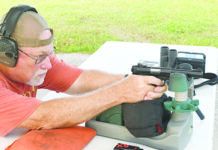
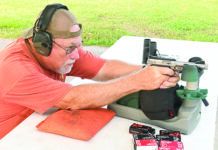
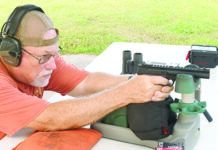
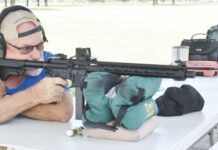
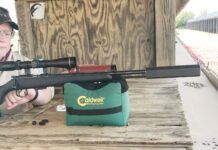
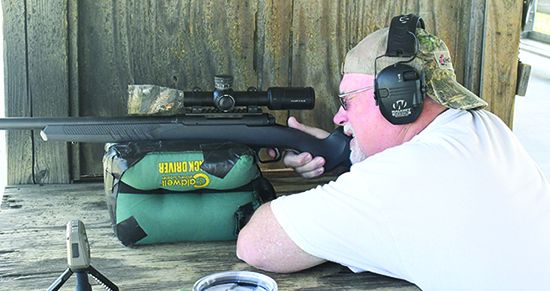
We tested with a variety of ammunition that would cover the spectrum of weights commonly used for varmint and long-range 223 Remington rifles: Hornady’s 53-grain V-Max, the 62-grain Speer Gold Dot, the 69-grain Federal Gold Medal Match, and finished up with the Mark 262 Mod 1C 77-grain OTM from Black Hills. We shot at American Shooting Centers in west Houston, using a well-sandbagged Caldwell TackDriver Pro (Brownells 100-027-023, $49), further supported by a large rear bag, heavy from Tab Gear (TabGear.com, $34). We measured velocities with a Garmin Xero C1 Pro chronograph (Garmin.com, $600). We used a well-proven Vortex Viper PSTII 3-15×44 scope from our battery for all the shooting.
Written and photographed by Joe Woolley, using evaluations from Gun Tests Team members. GT