


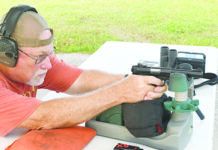
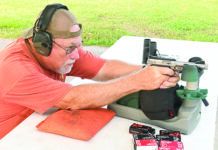
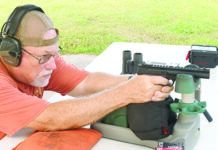

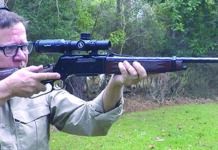






A shotgun is arguably the most versatile firearm in existence. Filled with buckshot or slugs, it is capable of downing deer-sized game. If necessary, the gun can stop the world’s most dangerous two-legged predator. With the proper load, regardless of whether the quarry flies or runs on four legs, it is also equally capable of taking small-game animals. This is why manufacturers often use some type of shotgun as the basis for a general-purpose firearm.
Having a gun that will do many things sounds good, but there are also several disadvantages to a general-purpose firearm. Most will usually “get the job done” in a number of situations, but they don’t do any of them well. We have also seen this ambiguous term used to describe a gun that really isn’t good for anything.
Such guns may also be useless in certain situations. We wouldn’t venture into an area with dangerous animals, such as grizzly bears or lions, roaming around without a reliable high-power rifle that could deliver a couple of fast follow-up shots.
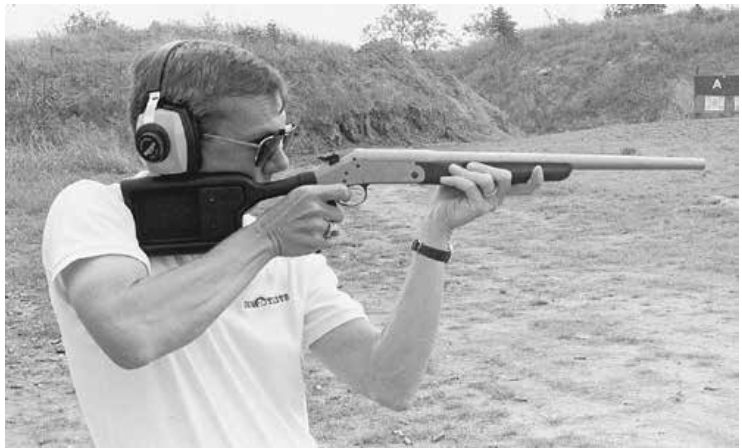
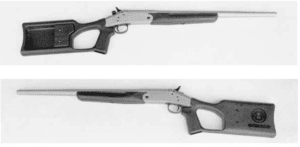
Sales literature for the subject of this evaluation, the Harrington & Richardson Tamer, talks about this shotgun’s rugged, all-weather design and how the buttstock’s design allows the person carrying it a firm hold on the gun at all times. However, it does not say what the gun was designed for and the manufacturer doesn’t offer any suggestions for its possible uses. So, we can only assume that it is a general purpose firearm.
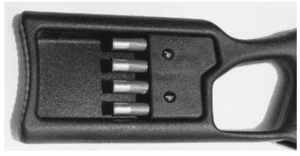
The Tamer is essentially H&R’s Topper shotgun with a shorter barrel and buttstock. This break-open single-shot, which comes in no other chambering besides .410, features a corrosion-resistant nickel finish, an external hammer and a thumbhole-style high-density polymer buttstock with a four-round storage compartment.
Weighing about 6 pounds unloaded, this somewhat compact shotgun was 32.5 inches long. Its 19.5-inch barrel had a 3-inch chamber and employed an internal fixed full choke. Dimensions of the synthetic stock were: length of pull, 12 inches; drop at the comb, 2 inches; and drop at the heel, 2.5 inches. This model’s suggested retail price at the time of the test was approximately $150. No options are available.
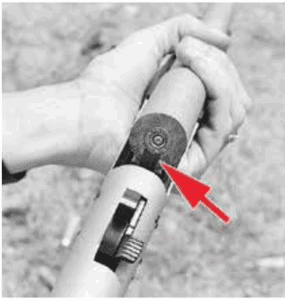
Our Tamer’s appearance was satisfactory. This shotgun’s barrel and receiver had a silver-gray matte finish, while its hammer, trigger and pins were dull blue-black. Both finishes were uniformly applied, and no blemishes were found anywhere. The barrel didn’t have any side-to-side movement, whether open or closed, and other moving parts had only a minor amount of play. The black-plastic trigger guard had a low-glare, smooth finish while the external surfaces of the black-polymer fore end and buttstock were textured. None of these parts had any shortcomings in their execution, but we thought the large gap between the top of the buttstock’s pistol grip and the bottom of the receiver was unsightly.
This Harrington & Richardson’s handling characteristics weren’t very good. The shotgun could be put into action with reasonable speed. It balanced at the barrel’s pivot pin and could be easily and quickly moved through the target but the short length of pull made it awkward to bring up to the shoulder. Our shooters also found that the comb was a bit too high, making it difficult to establish a stockweld that allowed the shooter to sight straight down the barrel. It wasn’t much more natural if the gun was fired from the hip or with the butt tucked under the arm.
The 8-inch-long semi-beavertail fore end and checkered 3-inch pistol grip provided sufficient gripping area for control. However, the shooter couldn’t reach the Tamer’s external hammer or action-release lever without taking the dominant hand completely off of the pistol grip. During recoil, this shotgun generated very little kick and muzzle rise. In fact, after cocking the hammer, all of our shooters were able to hold and fire this shotgun using only one hand.
Disassembly procedures for the Tamer are the same as those used on Harrington & Richardson’s Topper shotgun and require a crosspoint (Phillips) screwdriver with a medium tip. After inspecting the chamber to be sure it is empty, close the action and turn the shotgun upside down. Unscrew the fore end retaining screw with the screwdriver and remove it. Depress the action-release lever and pivot open the action. Separate the barrel and receiver. No further disassembly is recommended or required for normal maintenance. Reassemble in reverse order.
Although this scattergun’s action and controls operated smoothly and it never failed to fire, we still considered it unacceptably poor in function and operation. Its spring-loaded ejector, designed to automatically expel the spent shotshell from the chamber when the action is opened, stuck a dozen or more times. Bumping the butt on the ground usually cleared the chamber but there were a few occasions that we had to let the barrel cool down before even that technique would work. Otherwise, our firing session was uneventful. The internal transfer-bar safety never failed.
Trigger movement was adequate. The trigger itself was a quarter-inch wide and had a straight face with squared edges. Its pull had no slack and broke cleanly at 4 pounds. Although there was a lot of overtravel after its release, we don’t consider that significant on a shotgun.
In our opinion, the Tamer’s worst feature was its sight. The manufacturer only equipped this scattergun with a slightly elevated flat-topped brass bead that was screwed to the front of the barrel. This arrangement provided a sighting reference of sorts, but the shotgun didn’t shoot anywhere near the point-of-aim at distances a .410 of this type would probably be used.
Patterns produced with this gun were consistently high but reasonably well-dispersed. Remington 3-inch Long Range shotshells with No. 9 shot and Federal 3-inch Hi-Power shotshells with No. 5 shot were used in the test. At 6 feet, just about as close as we would want to get to a snake, those loads blew a 3-inch diameter hole in the paper target that was centered 1.5 inches high. At 10 yards, it yielded well-dispersed 14-inch-diameter patterns that were centered 6 inches above the aiming point.
Bottom Line: Harrington & Richardson’s Tamer may interest those who are looking for a shotgun that places compactness above all else. However, our test gun’s sticky ejector prevents us from recommending it as a snake or survival gun.
The Standard Catalog of Firearms does not list the Tamer with a New In Box price. SCoF says a Tamer in Excellent condition might be worth $120 and $90 in Very Good condition. SCoF further opines that for a Tamer in Good shape, $60 should get it, and one that’s Fair, $40, and one in Poor condition, $30. If we found a Tamer that had not been shot a lot, and which we had a chance to test-fire to verify the quality of its ejection, we might go $50. But that’s if we had a need for this specialty firearm. It is light and simple to operate, and those qualities will always find a market.
Adapted by Gun Tests Staff, using evaluations from Gun Tests Team members. GT