






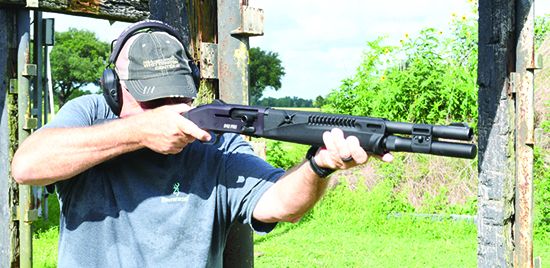
Forty years ago, those of us who were trying to learn how to shoot handguns quickly and accurately decided we wanted to be able to do the same type of sport with rifles and shotguns. The rise of the AR-15 for competition has been well documented — shotguns not so much. Still, the desire to shoot a shotgun fast has driven the development of scatterguns just as with rifles. The result has been technology that is great for self-defense shotguns as well as those for competition.
Our early solution was to take a Remington 1100 and saw the barrel off at a very legal 20-inch length. Then we added a two- or three-round magazine extension tube, put on a new front sight, made sure that we had new O-rings in the gas system, and called it a day. Competition/self-defense shotguns have progressed several generations past that, and we wanted to see what the latest models had to offer, especially because we remembered what we once used. We picked up three of the latest and greatest and went to work.
The first is the Mossberg 940 Pro Tactical 85162, $970, which comes with an 18.5-inch barrel, an eight-round magazine, oversized bolt handle and bolt release, along with receiver-mounted sights, and the receiver is also milled for a red-dot sight.
Next, we acquired a Savage Renegauge 57786, $1649. Designed a bit more for competition, we wondered if the 24-inch barrel would necessarily disqualify if for self-defense use, especially since it offers much the same list of features as the Mossberg.
Our last choice was a Stoeger Model 3000 Tactical FS 36075FS, $640. Now part of the same corporate umbrella as Benelli, and the firm’s famous shotguns, the Model 3000 also uses an inertia-driven action as does its more famous Benelli cousin. Replete with excellent sights, an extended magazine, oversized controls, a Picatinny rail, and a breaching choke, we wanted to see how the inertia-driven action compared to the gas-operated actions of the Savage and the Mossberg.
Mossberg 940 Pro Tactical 85162 12 Gauge
$970
Gun Tests grade: B+
We really like the sights on the Mossberg 940 Pro and appreciate the flexibility they offer. Handling was fast on the Mossberg, but not quite as fast as on the other two. It stuttered a few times but sorted itself out in very short order and fed flawlessly thereafter.
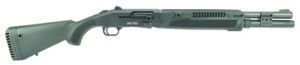
| Action Type | Semi-auto |
|---|---|
| Overall Length | Adjustable, 38.0 in. |
| Barrel Length | 18.5 in. |
| Overall Height w/o Scope Mount | 7.75 in. |
| Weight Unloaded | 7.6 lbs. |
| Weight Loaded | 8.25 lbs. |
| Sight Radius | 22.1 in. |
| Action Finish | Cerakote |
| Barrel Finish | Cerakote |
| Magazine Capacity | 7 rounds |
| Magazine Type | Tube |
| Stock Material | Synthetic |
| Stock Drop at Comb | 0.6 in. |
| Stock Drop at Heel | 1.5 in. |
| Stock Buttplate | Rubber |
| Stock Length of Pull | Adjustable, 13.75 in. |
| Receiver Scope-Base Pattern | Picatinny rail |
| Trigger Pull Weight | 3.3 lbs. |
| Safety | Tang |
| Warranty | 2-year limited |
| Telephone | (203) 230-5300 |
| Website | Mossberg.com |
| Made In | U.S. |
Already the manufacturer of two of the top selling pump-action shotguns (Models 500 and 590), Mossberg also knows a thing or two about semi-auto scatterguns, and we wanted to test the company’s latest offering. Engineered with the assistance of two of the top 3-Gun shooters around in Jerry and Lena Miculek, Mossberg melded a huge amount of experience into the 940 Pro Tactical.
The Mossberg 940 Pro’s action is described as a gas-vent system. Designed to provide longer intervals between required cleanings, it is also engineered to cycle a variety of loads quickly. Many of the operating parts (gas piston, mag tube, hammer and sear) are coated with nickel boron to make them more resistant to corrosion.
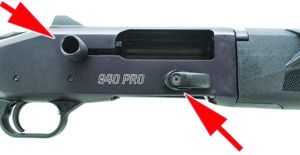
The competition model has a few different bells and whistles — the barrel and mag tube are longer, the chokes are different, and a few more parts have been slicked up — but many of the features are still there in the Tactical model. The 940 Tactical uses a steel barrel and magazine tube, with our sample accommodating a total of eight rounds onboard. Loading is simple with the shell lifter aligning the shells perfectly with the magazine tube. No buttons to activate, no problems. In case the mag tube doesn’t provide enough capacity for you, Mossberg includes a Van Comp Systems shell carrier Velcroed to the left side of the receiver. The loading port has been enlarged and beveled to ease reloading, along with the new, longer elevator. Unloading the 940 can happen three ways; through the barrel of course, alternately cycling the bolt handle and the bolt release, and the “quick release method” that allows the shooter to shuck loaded rounds by pushing up on the elevator while pushing on the shell stop, which is found just to the left of the case head. Our shooting team found that the elevator didn’t always clear the loaded shell, and pulling back on the bolt handle just a little helped.
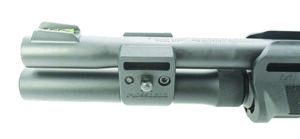
The barrel uses Mossberg’s AccuChokes, with the Cylinder bore choke tube installed in our sample. We like tight shot patterns for defensive use, and we wondered if the more open choke would allow shot to spread too much. We also admit that tight chokes can preclude the use of slugs. You have to decide what shotshell ammunition you’ll use in your defensive shotgun.
The tactical improvements don’t end there. The barrel carries a green-fiber-optic front sight well protected by wings on either side. Mossberg includes replacement pipes from HiViz, and exchanging them for the red or solid-white versions is a snap. The rear sight is a Ghost Ring style, once again protected by wings. The rear sight is mounted in a slot that has also been designed to allow the attachment of red-dot sights. Direct mounting of a red-dot sight is possible for those requiring an RMSc footprint, and adapter plates are also included to allow mounting of RMR, Docter and Leupold pattern accessories. The top of the receiver is drilled and tapped for a Picatinny rail.
The safety is an aluminum piece mounted on the tang. Large enough to be located easily by either hand, forward is Fire, and Safe is all the way to the rear. The trigger wasn’t bad as far as action shotguns go, measuring 3.31 pounds on our Lyman digital scale. There was a little take-up and a bit of creep as well. Not quite what we would want on a precision rifle, but it should work fine on a defensive shotgun. There is even a small aluminum stud that protrudes from the web of the trigger guard right in front of the trigger when the action is cocked.
The fore end added a few more tricks. The sides are well checkered (as is the pistol grip) and allow a very secure grip. In contrast to most we’ve seen, the sides of the fore end extend up and around the sides of the barrel. Though there is still an open channel on top, the elevated sides worked well as a heat shield for an errant hand. M-Lok slots are located at 3 and 9 o’clock on the upper sides of the fore end, and a third slot is located at 6 o’clock on the bottom. QD sling mounts are located on both sides of the rear of the fore end as well as the buttstock. There is a flange of sorts on the forward sides of the fore end. This was too far forward for us to use as a hand stop, but it did provide some plastic meat to help provide strength needed for the M-Lok slots. Even farther forward is a barrel clamp to hold everything nice and tight. It provides two more M-Lok slots as well as a reversible sling swivel stud.
The buttstock and attachments provide options we are more used to seeing on competition shotguns. Everything ends with a soft-rubber recoil pad that came in handy with some of the self-defense loads. Our 940 arrived with two spacers installed. Combined, the two provided an overall length of 38.75 inches and a length of pull of 13.75 inches. Obviously, those two spacers can be removed, or an additional 0.5-inch spacer can be installed, if desired. Mossberg provides shims that can be used to adjust cast and drop as necessary.
Our Team Said: We thought the Mossberg 940 Pro had the best sights in this test group. Accuracy was very good with them, and we really liked their built-in flexibility. This Mossberg stuttered a few times when trying to feed a round placed directly on the lifter. It sorted itself out in very short order and fed flawlessly thereafter. The shot pattern (remember, our personal preference is a tight pattern, YMMV) on the Mossberg had the widest spread of the three. Were a tighter choke to be included in the box, our objection would go away. The speed trials put the Mossberg in third place about one-third second behind the others.
| DRILL NO. 1 DATA | |
|---|---|
| Shotgun | Average Time |
| Mossberg 940 Pro Tactical | 1.24 |
| Savage Renegauge | 1.24 |
| Stoeger 3000 Tactical FS | 1.25 |
Process: Using 00 buckshot, fire five rounds at 7 yards at a 9-inch paper plate.
| DRILL NO. 2 DATA | |
|---|---|
| Shotgun | Average Time |
| Mossberg 940 Pro Tactical | 1.84 |
| Savage Renegauge | 1.36 |
| Stoeger 3000 Tactical FS | 1.31 |
Process: Using No. 7½ shot, fire five rounds at 6-inch steel plates at 8 yards.
Our speed tests are not designed to show how fast a firearm can be fired, but to use the same test on multiple guns fired by the same person to look for differences in the guns’ capabilities.
| 12-GAUGE RANGE DATA | |||
|---|---|---|---|
| Winchester Super-Target 2¾-inch No. 7½ Shot 1 oz. | Mossberg 940 Pro Tactical | Savage Renegauge | Stoeger 3000 Tactical FS |
| Average Velocity | 1370 fps | 1332 fps | 1342 fps |
| Muzzle Energy | 1824 ft.-lbs. | 1724 ft.-lbs. | 1750 ft.-lbs. |
| Federal Power-Shok 2¾-inch No. 4 Buckshot | Mossberg 940 Pro Tactical | Savage Renegauge | Stoeger 3000 Tactical FS |
| Average Velocity | 1245 fps | 1300 fps | 1221 fps |
| Muzzle Energy | 1959 ft.-lbs. | 2136 ft.-lbs. | 1883 ft.-lbs. |
| Hornady Black 2¾-inch No. 00 Buckshot | Mossberg 940 Pro Tactical | Savage Renegauge | Stoeger 3000 Tactical FS |
| Average Velocity | 1505 fps | 1616m fps | 1528 fps |
| Muzzle Energy | 1981 ft.-lbs. | 2286 ft.-lbs. | 2043 ft.-lbs. |
Additional specifications: Winchester Super-Target TRGT13507. Factory muzzle velocity: 1350 fps. Federal Power-Shok F127 4B, 27 lead pellets, .24 caliber. Factory muzzle velocity: 1325 fps. Hornady Black 86249, eight lead pellets, .33 caliber. Factory muzzle velocity: 1600 fps.
Written and photographed by Joe Woolley, using evaluations from Gun Tests Team members. GT