







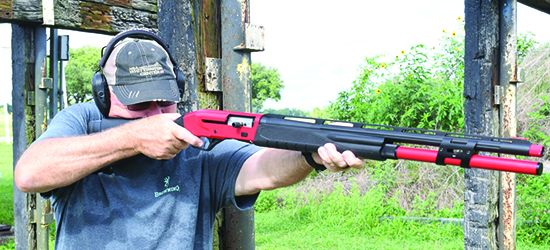
Forty years ago, those of us who were trying to learn how to shoot handguns quickly and accurately decided we wanted to be able to do the same type of sport with rifles and shotguns. The rise of the AR-15 for competition has been well documented — shotguns not so much. Still, the desire to shoot a shotgun fast has driven the development of scatterguns just as with rifles. The result has been technology that is great for self-defense shotguns as well as those for competition.
Our early solution was to take a Remington 1100 and saw the barrel off at a very legal 20-inch length. Then we added a two- or three-round magazine extension tube, put on a new front sight, made sure that we had new O-rings in the gas system, and called it a day. Competition/self-defense shotguns have progressed several generations past that, and we wanted to see what the latest models had to offer, especially because we remembered what we once used. We picked up three of the latest and greatest and went to work.
The first is the Mossberg 940 Pro Tactical 85162, $970, which comes with an 18.5-inch barrel, an eight-round magazine, oversized bolt handle and bolt release, along with receiver-mounted sights, and the receiver is also milled for a red-dot sight.
Next, we acquired a Savage Renegauge 57786, $1649. Designed a bit more for competition, we wondered if the 24-inch barrel would necessarily disqualify if for self-defense use, especially since it offers much the same list of features as the Mossberg.
Our last choice was a Stoeger Model 3000 Tactical FS 36075FS, $640. Now part of the same corporate umbrella as Benelli, and the firm’s famous shotguns, the Model 3000 also uses an inertia-driven action as does its more famous Benelli cousin. Replete with excellent sights, an extended magazine, oversized controls, a Picatinny rail, and a breaching choke, we wanted to see how the inertia-driven action compared to the gas-operated actions of the Savage and the Mossberg.
Savage Renegauge 57786 12 Gauge
$1649
Gun Tests grade: A- [our pick]
We realize that the Savage is a bit longer than our other two samples and might be harder to maneuver. That said, it was the softest shooting of the three, recorded the tightest patterns, and was right there at the top of the speed trials with the Stoeger.
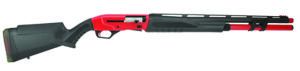
| Action Type | Semi-auto |
|---|---|
| Overall Length | 46.25 in. |
| Barrel Length | 24.0 in. |
| Overall Height w/o Scope Mount | 7.9 in. |
| Weight Unloaded | 7.6 lbs. |
| Weight Loaded | 8.1 lbs. |
| Sight Radius | No rear sight |
| Action Finish | Cerakote |
| Barrel Finish | Melonite |
| Magazine Capacity | 9 rounds |
| Magazine Type | Tube |
| Stock Material | Synthetic |
| Stock Drop at Comb | 0.25 in. |
| Stock Drop at Heel | 0.5 in. |
| Stock Buttplate | Rubber, w/buffer |
| Stock Length of Pull | 14.25 in. |
| Receiver Scope-Base Pattern | Savage style |
| Trigger Pull Weight | 3.7 lbs. |
| Safety | Crossbolt |
| Warranty | 1-year limited |
| Telephone | (800) 370-0708 |
| Website | SavageArms.com |
| Made In | U.S. |
We don’t normally think “shotguns” when Savage is mentioned, but the company has quite the selection — bolt-action slug guns, single shots, pumps, over/unders, and now a nice selection of semi-autos.
Our choice for this test was the Renegauge competition version. It is 8 inches longer than the Mossberg 940 Pro, which allows it to carry two more rounds on board. Although the magazine tube and the receiver are Cerakoted a bright red, with so many other features in common with the other two shotguns in this test, we decided to see if the extra length would disqualify it for home defense in our eyes. We have to remember that our budget always gets to cast a vote, and a single shotgun that can serve two tasks well is always a plus.
Recoil impulse on a 12 gauge can be substantial, especially if more than one shot needs to be fired. Even more so if they need to be fired quickly. Depending on the load being used, pressures generated can vary wildly (think 2¾-inch No. 7½ bird shot versus 3-inch 000 buckshot), and the ability of a shotgun to cycle all required loads can be tested beyond the ability of some platforms to function. Accordingly, the Savage Renegauge uses the patented D.R.I.V (Dual Regulating Inline Valve) gas system. Its job is to vent excess gas before it impinges on the bolt, resulting in consistent ejection and less felt recoil. And it needs to do this quickly or the whole exercise is moot. The system uses two valves (visible just above the front end of the fore end) to allow enough energy to drive the bolt rearward, while dumping excess energy out the front. In theory, it uses only enough energy to cycle the action regardless of the load. We fed a variety of ammo through these shotguns to test just that. We started with everyday No. 7½ birdshot, through our most commonly loaded No. 4 buckshot all the way to full-power 00 buck. Results and split times are tabulated in the Drills sidebar.
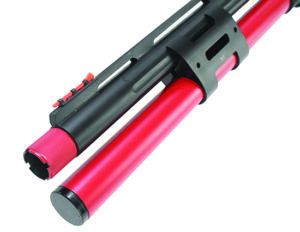
The barrel caught our attention right off the bat. Twenty-four inches long, it is fluted, has a Melonite finish for corrosion resistance, and sports a vented rib. When combined with the minimalist cheek piece on the stock, the rib placed the HiViz front sight at the perfect height for our eyes. Not too many shotguns do that. At the tip of the vented rib is an easily replaced red fiber-optic sight that did a great job of attracting our eye. We did note that the light pipe was only attached with a single screw, and the entire mount could be pivoted around on the rib. This might be a great time for some blue Loctite. The top of the receiver is also drilled and tapped for the location of a Picatinny rail, if so desired. Threaded for choke tubes, our sample arrived with a choke that extended past the end of the barrel. Labeled as a Skeet II, it also showed a diameter of 0.710 inch, which, by our charts, would make it a Modified choke. That said, it is still a very open choke that we thought would produce a wide spread to the pattern. We shot patterns on a lot of paper plates to see if it was too much or whether the load would stay intact at reasonable distances. Frankly, the results surprised us.
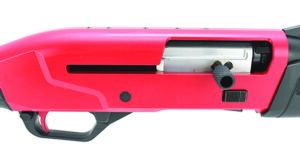
Controls on the receiver were easy to operate — if you are a right-handed shooter. The knurled bolt handle protrudes to the right and was very easy to locate and operate. The bolt release is a serrated rectangle below and slightly forward of the bolt handle. The location and the size made the bolt very easy to release in a hurry. With the hammer cocked, the bolt carrier lifts easily and aligns the shell precisely with the magazine tube. Reloads inserted very smoothly. Note that the hammer must be cocked before loading. Once the desired number of rounds are onboard — which usually means the magazine tube has nine rounds in it — one more button needs to be pushed to complete loading. Called the cartridge-release lever, a tab extends below the bottom of the receiver and just to the right side of the forward arch of the trigger guard. Once the magazine tube is full, move the cartridge-release lever to the rear, at which time a shell is released from the magazine tube onto the cartridge elevator. The shotgun’s bolt can now be cycled, inserting the shell into the chamber. Most folks would then load one more round into the magazine for max capacity. Both the ejection port and the loading port are oversized to help handle those fat 12-gauge rounds. The crossbolt safety is located at the base of the receiver, at the rear of the trigger. Pushing it to the left is Fire and to the right is Safe. A red line if visible when set to Fire.
The stock is something of a hybrid design — not the straight-grip conventional stock commonly found on shotguns, nor is it the full pistol grip common to AR platforms. The pistol grip on the Savage curves down at about a 45-degree angle, making for a very comfortable wrist angle for shooting from a variety of positions. The front of the grip has coarse serrations, and the side panels are stippled in a pattern that we found very effective, while still comfortable. The length of pull is adjustable via spacers. Recoil is mitigated a bit using a good recoil pad, which encloses a stock rod buffer. There is a sling swivel stud near the toe of the stock.
Our Team Said: The Savage Renegauge shot everything we fed it, even including some odds and ends we had laying around. The recoil impulse was the softest of the three scatterguns tested, and the speed drills reflected that. Even with the factory choke, the Savage recorded the tightest patterns — so much so that we fired several extra rounds at distance and still kept almost all of the 00 buck shot on the paper plate, even at 10 yards. Savage makes a slightly shorter version of this longish competition piece. We graded this Renegauge down half a grade because of that length, and it still won. We’ll look to test a shorter version. Expect it will get the other half a grade.
| DRILL NO. 1 DATA | |
|---|---|
| Shotgun | Average Time |
| Mossberg 940 Pro Tactical | 1.24 |
| Savage Renegauge | 1.24 |
| Stoeger 3000 Tactical FS | 1.25 |
Process: Using 00 buckshot, fire five rounds at 7 yards at a 9-inch paper plate.
| DRILL NO. 2 DATA | |
|---|---|
| Shotgun | Average Time |
| Mossberg 940 Pro Tactical | 1.84 |
| Savage Renegauge | 1.36 |
| Stoeger 3000 Tactical FS | 1.31 |
Process: Using No. 7½ shot, fire five rounds at 6-inch steel plates at 8 yards.
Our speed tests are not designed to show how fast a firearm can be fired, but to use the same test on multiple guns fired by the same person to look for differences in the guns’ capabilities.
| 12-GAUGE RANGE DATA | |||
|---|---|---|---|
| Winchester Super-Target 2¾-inch No. 7½ Shot 1 oz. | Mossberg 940 Pro Tactical | Savage Renegauge | Stoeger 3000 Tactical FS |
| Average Velocity | 1370 fps | 1332 fps | 1342 fps |
| Muzzle Energy | 1824 ft.-lbs. | 1724 ft.-lbs. | 1750 ft.-lbs. |
| Federal Power-Shok 2¾-inch No. 4 Buckshot | Mossberg 940 Pro Tactical | Savage Renegauge | Stoeger 3000 Tactical FS |
| Average Velocity | 1245 fps | 1300 fps | 1221 fps |
| Muzzle Energy | 1959 ft.-lbs. | 2136 ft.-lbs. | 1883 ft.-lbs. |
| Hornady Black 2¾-inch No. 00 Buckshot | Mossberg 940 Pro Tactical | Savage Renegauge | Stoeger 3000 Tactical FS |
| Average Velocity | 1505 fps | 1616m fps | 1528 fps |
| Muzzle Energy | 1981 ft.-lbs. | 2286 ft.-lbs. | 2043 ft.-lbs. |
Additional specifications: Winchester Super-Target TRGT13507. Factory muzzle velocity: 1350 fps. Federal Power-Shok F127 4B, 27 lead pellets, .24 caliber. Factory muzzle velocity: 1325 fps. Hornady Black 86249, eight lead pellets, .33 caliber. Factory muzzle velocity: 1600 fps.
Written and photographed by Joe Woolley, using evaluations from Gun Tests Team members. GT