
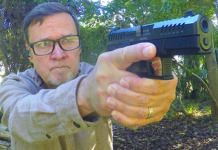
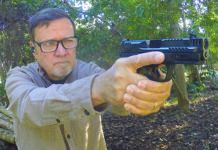
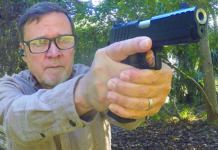






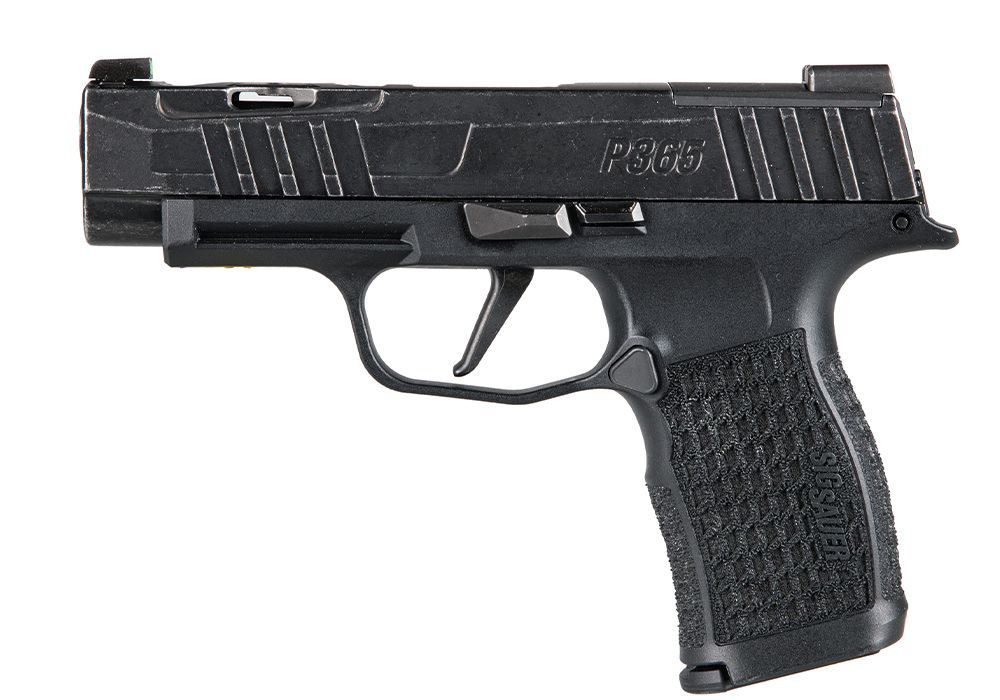
It isn’t unusual for a full-size pistol to have the frame shortened and barrel cut down to create a concealable handgun. Compact and subcompact versions of 1911s, Glocks, Walthers, and SIG handguns are successful with these modifications. A less common path is to take a subcompact pistol and add a longer slide or a taller grip to enhance handling. For example, SIG modified the P365 to the XL and then the TACOPS to enhance handling of the base handgun. Extended pistols may be more difficult to conceal than the originals — but not by much — while they generate less recoil due to the slightly bigger guns’ heavier weight, and the extendeds shoot better because they have a longer sight radius and bigger grips.
Smith & Wesson surprised shooters a few years ago with the CSX, a compact 9mm handgun in some ways similar to SIG and Kimber single-action 9mm subcompact offerings. Then Smith & Wesson introduced the CSX E-Series, which likely means Enhanced, but for our purposes here, the “E” means Extended because this aluminum-frame CSX has a half-inch-longer slide and barrel. There is also an adapter to create a longer grip. Smith & Wesson also claimed to have improved the trigger action of the CSX, which is always interesting.
A trend in modern handguns is to add weight to a polymer-frame gun by creating an aluminum-frame version of it. We decided to match the aluminum-frame CSXE against a stock SIG P365-XMACRO TACOPS, a polymer-frame striker-fired handgun with an extended grip frame and slide compared to the original P365.
We next added a different option. Because the P365 is a modular handgun with an internal chassis, it is simple enough to change the chassis out for another frame. So we got an Icarus Precision aluminum frame and placed it on a SIG P365XL Spectre pistol. The A.C.E. 365 XL EVO frame, with the non-safety fire-control unit and matte-black anodizing color, is $380 as listed on the IcarusPrecision.com website. We paid $340 for ours a while back. It fits P365XL 3.7-inch and MACRO 3.1- and 3.7-inch barrels, according the website. The Icarus aluminum grip module has a memory hump in the backstrap, a flipped beavertail design, and accommodates all X/XL length magazines. However, the website says 17-round magazines will fit but will not be flush. It also has ambidextrous thumb ledges, a flared magwell, a double-undercut trigger guard, and a 1913 Picatinny rail. It weighs 4.67 ounces. It does not come with a magazine release, and Icarus says this grip works best with standard p365 non-MACRO-style mag releases.
We also added the grip adapter at one point and also compared the shorter Icarus frame to the TACOPS polymer frame and the even-shorter standard P365. We also fired the CSXE and Icarus with extended magazines, using the magazines as a type of grip extension.
For the initial test, we fired each pistol with 50 rounds of 9mm Luger Monarch steel-case 115-grain full-metal-jacket ammo, 50 count of Blazer 115-grain FMJ rounds, and 20 rounds of Fiocchi 124-grain Covert jacketed hollow-point ammo. None of the three pistols exhibited any type of failure to feed, chamber, fire, or eject. In accuracy testing, we used three 9mm loads, the 124-grain Fiocchi Coverts, Federal 115-grain Train & Protect Versatile Hollow Points (VHP), and Federal 147-grain Gold Medal FMJs. We fired at 15 yards in deference to the pistols’ short sight radius and short slides and grips. Results were good, with some best groups smaller than 2 inches and all of the averages between 2 and 2.7 inches. Here’s what we found.
SIG Sauer P365XL Spectre P365V001 9mm Luger, $900
Icarus A.C.E. 365 XL EVO Frame, $340
Gun Tests grade: A
We really like this set up. The Spectre is a classy pistol in its own right, and with the Icarus frame, it really shines. Function is faultless, and the pistol shoots much better with the aluminum frame. The pistol feels more solid, and of course it is.
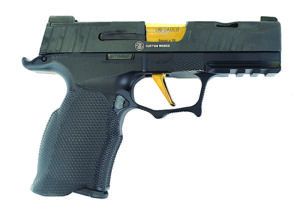
| Action Type | Semi-auto single-action striker-fired short recoil operated, locked breech |
|---|---|
| Overall Length | 6.6 in. |
| Overall Height | 4.9 in. |
| Maximum Width | 1.54 in. |
| Weight Unloaded | 23.7 oz. |
| Weight Loaded | 28.7 oz. |
| Slide | Stainless steel with black Nitron finish, front and rear cocking serrations, light rail and optics cut |
| Slide Retraction Effort | 16.2 lbs. |
| Receiver | Anodized aluminum and polymer |
| Front Strap Height | 2.3 in. |
| Rear Strap Height | 3.0 in. |
| Barrel | 3.7 in. long, carbon steel |
| Grip Thickness Maximum | 1.0 in. |
| Grip Circumference | 5.0 in. |
| Magazines | (2) 12 round |
| Rear Sight | X-Ray3 tritium dots |
| Front Sight | X-Ray3 tritium dot |
| Sight Radius | 5.6 in. |
| Trigger Pull Weight | 5.4 lbs. |
| Trigger Span | 2.5 in. |
| Safety | No manual safety |
| Warranty | Limited lifetime |
| Telephone | (603) 610-3000 |
| Website | SIGSauer.com |
| Made In | U.S. |
If you own a basic P365 and wish to upgrade it, the only expense is the Icarus frame. There are a number of grip frames available for the P365, but most are polymer. Some are as inexpensive as $67 from Wilson Combat. These are just shells because the SIG P365 is a modular pistol with a separate fire control. In contrast, the Icarus frame is highly developed. The frame features a pronounced hump in the rear, and at the top of the backstrap is a highly developed beavertail. The trigger guard is undercut. The frame treatment is excellent. In this case, the frame provides a mount for combat lights without resorting to use of a specialty SIG-type unit, although the TACOPS also offers a rail mount. The S&W CSX does not offer a light rail. Icarus designed the squared trigger guard with two distinct humps. These offer excellent placement for the fingers during combat shooting. We feel that this is one reason for the pistol’s excellent control. The pistol simply tucked in tight. While it is often said that polymer allows some pretty wild designs, the Icarus frame gives lie to that. This is a very well-designed frame. The only drawback was that the finger rests on the frame may prevent the pistol from holstering in some scabbards, especially tight-fitting leather holsters. We used the DeSantis Super Stealth, which features the GRD locking system. Results were very good. The Icarus frame adds 3 ounces to the SIG P365. The results were better than 3 ounces would seem to merit. Workmanship was faultless.
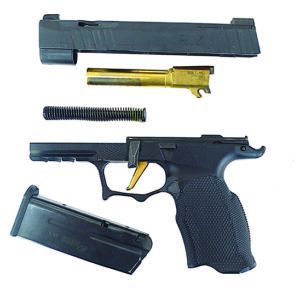
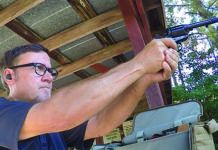
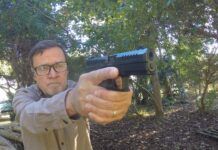
In firing the SIG/Icarus, we felt it was easily the best-shooting pistol in combat fire. The Spectre features night sights with a bright-green dot in front. This makes for accurate fire, and the frame molded into the hand. One rater said it felt like a bar of soap, not soft or slick, but nicely fitted. We found the big well allowed for fast speed loads of the big magazines. The tapered magazine fit the generous magazine well easily. The pistol was controllable and accurate in all drills. Moving to accuracy testing off the benchrest, the pistol’s felt recoil was modest. The pistol settled in the hand well. The flat bronze-toned trigger of the Spectre — matching the bronze barrel — broke cleanly at 5.4 pounds. It is usual for the Spectre to have a cleaner trigger than other P365 pistols. Accuracy was good, but it was not quite up to the TACOPS, but it was good.
Our Team Said: It isn’t a Best Buy because the Spectre is an expensive proposition, but we could have saved more than $200 choosing a simple SIG P365 XL. As for left-hand fire, both the TACOPS and the SIG/Icarus do not have ambidextrous slide locks, which limits the pistol’s use for left-handed shooters.
| 9MM LUGER RANGE DATA | |||
|---|---|---|---|
| Federal Gold Medal 147-grain FMJ GM9AP1 | SIG Sauer P365-XMACRO TACOPS | SIG Sauer P365XL Spectre/ Icarus Precision Frame | Smith & Wesson CSX E-Series |
| Average Velocity | 920 fps | 915 fps | 880 fps |
| Muzzle Energy | 276 ft.-lbs. | 273 ft.-lbs. | 253 ft.-lbs. |
| Smallest Group Size | 1.5 in. | 1.7 in. | 2.3 in. |
| Average Group Size | 2.0 in. | 2.2 in. | 2.7 in. |
| Federal Train & Protect 115-grain VHP TP9VHP1 | SIG Sauer P365-XMACRO TACOPS | SIG Sauer P365XL Spectre/ Icarus Precision Frame | Smith & Wesson CSX E-Series |
| Average Velocity | 1130 fps | 1139 fps | 1114 fps |
| Muzzle Energy | 326 ft.-lbs. | 331 ft.-lbs. | 317 ft.-lbs. |
| Smallest Group Size | 1.45 in. | 1.6 in. | 1.85 in. |
| Average Group Size | 2.1 in. | 2.2 in. | 2.4 in. |
| Fiocchi Covert X 124 grain JHP | SIG Sauer P365-XMACRO TACOPS | SIG Sauer P365XL Spectre/ Icarus Precision Frame | Smith & Wesson CSX E-Series |
| Average Velocity | 1125 fps | 1109 fps | 1090 fps |
| Muzzle Energy | 348 ft.-lbs. | 339 ft.-lbs. | 327 ft.-lbs. |
| Smallest Group Size | 1.5 in. | 1.4 in. | 1.8 in. |
| Average Group Size | 2.0 in. | 2.0 in. | 2.5 in. |
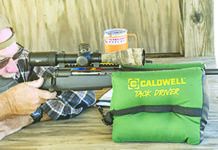
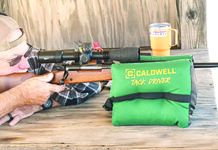
To collect accuracy data, we fired five-shot groups from a bench using an MTM Case-Gard K-Zone rest. Distance: 15 yards. We measured velocities with a Competition Electronics Pro Chrony with the first screen 10 feet from the muzzles.
Written and photographed by Bob Campbell, using evaluations from Gun Tests Team members. GT