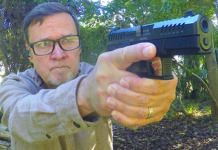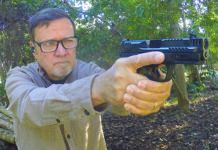








It isn’t unusual for a full-size pistol to have the frame shortened and barrel cut down to create a concealable handgun. Compact and subcompact versions of 1911s, Glocks, Walthers, and SIG handguns are successful with these modifications. A less common path is to take a subcompact pistol and add a longer slide or a taller grip to enhance handling. For example, SIG modified the P365 to the XL and then the TACOPS to enhance handling of the base handgun. Extended pistols may be more difficult to conceal than the originals — but not by much — while they generate less recoil due to the slightly bigger guns’ heavier weight, and the extendeds shoot better because they have a longer sight radius and bigger grips.
Smith & Wesson surprised shooters a few years ago with the CSX, a compact 9mm handgun in some ways similar to SIG and Kimber single-action 9mm subcompact offerings. Then Smith & Wesson introduced the CSX E-Series, which likely means Enhanced, but for our purposes here, the “E” means Extended because this aluminum-frame CSX has a half-inch-longer slide and barrel. There is also an adapter to create a longer grip. Smith & Wesson also claimed to have improved the trigger action of the CSX, which is always interesting.
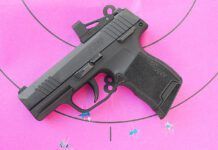
A trend in modern handguns is to add weight to a polymer-frame gun by creating an aluminum-frame version of it. We decided to match the aluminum-frame CSXE against a stock SIG P365-XMACRO TACOPS, a polymer-frame striker-fired handgun with an extended grip frame and slide compared to the original P365.
We next added a different option. Because the P365 is a modular handgun with an internal chassis, it is simple enough to change the chassis out for another frame. So we got an Icarus Precision aluminum frame and placed it on a SIG P365XL Spectre pistol. The A.C.E. 365 XL EVO frame, with the non-safety fire-control unit and matte-black anodizing color, is $380 as listed on the IcarusPrecision.com website. We paid $340 for ours a while back. It fits P365XL 3.7-inch and MACRO 3.1- and 3.7-inch barrels, according the website. The Icarus aluminum grip module has a memory hump in the backstrap, a flipped beavertail design, and accommodates all X/XL length magazines. However, the website says 17-round magazines will fit but will not be flush. It also has ambidextrous thumb ledges, a flared magwell, a double-undercut trigger guard, and a 1913 Picatinny rail. It weighs 4.67 ounces. It does not come with a magazine release, and Icarus says this grip works best with standard p365 non-MACRO-style mag releases.
We also added the grip adapter at one point and also compared the shorter Icarus frame to the TACOPS polymer frame and the even-shorter standard P365. We also fired the CSXE and Icarus with extended magazines, using the magazines as a type of grip extension.
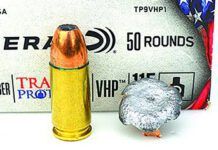
For the initial test, we fired each pistol with 50 rounds of 9mm Luger Monarch steel-case 115-grain full-metal-jacket ammo, 50 count of Blazer 115-grain FMJ rounds, and 20 rounds of Fiocchi 124-grain Covert jacketed hollow-point ammo. None of the three pistols exhibited any type of failure to feed, chamber, fire, or eject. In accuracy testing, we used three 9mm loads, the 124-grain Fiocchi Coverts, Federal 115-grain Train & Protect Versatile Hollow Points (VHP), and Federal 147-grain Gold Medal FMJs. We fired at 15 yards in deference to the pistols’ short sight radius and short slides and grips. Results were good, with some best groups smaller than 2 inches and all of the averages between 2 and 2.7 inches. Here’s what we found.
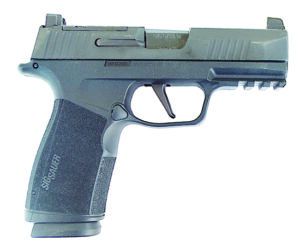
SIG Sauer P365-XMACRO TACOPS 365XCA-9-BTAC-TB-RXSL 9mm Luger,
$800
Gun Tests grade: A
The TACOPS shoots well and handles well. The only drawback is its size, but if you are able to conceal this handgun effectively, it is a great choice.
| Action Type | Semi-auto single-action striker-fired Short-recoil-operated locked breech |
|---|---|
| Overall Length | 6.6 in. |
| Overall Height | 5.2 in. |
| Maximum Width | 1.4 in. |
| Weight Unloaded | 22.8 oz. |
| Weight Loaded | 28.0 oz. |
| Slide | Stainless steel with black Nitron finish, front and rear cocking serrations, light rail and optics cut |
| Slide Retraction Effort | 16.2 lbs. |
| Receiver Material | Black polymer |
| Front Strap Height | 2.4 in. |
| Rear Strap Height | 3.2 in. |
| Barrel | 3.7 in. long, carbon steel |
| Grip Thickness Maximum | 1.0 in. |
| Grip Circumference | 4.9 in. |
| Magazines | (4) 17-round steel |
| Rear Sight | X-Ray3 tritium dots |
| Front Sight | X-Ray3 tritium dot |
| Sight Radius | 5.6 in. |
| Trigger Pull Weight | 6.0 lbs. |
| Trigger Span | 2.5 in. |
| Safety | No manual safety |
| Warranty | Limited lifetime |
| Telephone | (603) 610-3000 |
| Website | SIGSauer.com |
| Made In | U.S. |
The P365 TACOPS features the P365 internal chassis, allowing easy changing of the grip frame. The pistol features a taller handle and longer slide. If the XL version is attractive, the TACOPS may be even more so. The elongated slide, with its 3.7-inch barrel, is well balanced, and the tall grip accommodates a 17-round magazine. This pistol offers higher capacity and considerably improved handling over the original P365. Gunmakers call their guns whatever they want to. If the P365 is a subcompact, the P365 TACOPS may be a compact, but it isn’t as large as the Glock 19 compact. The pistol comes with four magazines, which takes some of the string out of its price. The larger grip accepts grip inserts, which the P365 does not. The magazine well is flared, making for rapid speed loads. The pistol has forward cocking serrations and SIG X-Ray3 sights. A small gun that shoots like a big gun is a well-worn phrase that applies to this pistol. We have tested another TACOPS in the past, with a trigger action breaking at 5.6 pounds and an XMACRO that tested at 5.5 pounds. This gun was heavier at 6.0 pounds, still not out of the norm for these handguns. The trigger features little take up and breaks cleanly. Reset is fast. While there is a striker block and drop safety, the P365 is a single-action-trigger pistol. In common with most SIG 17-round magazines, these were difficult to load to full capacity. We used the supplied magazine loader, but in the end, we only loaded them to 15 rounds. Perhaps they will break in with use.
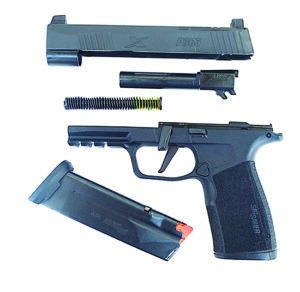
We liked the SIG takedown much more than the S&W process. The pistol is unloaded and carefully checked to be empty of a round in the chamber and no magazine in the gun. The slide is locked to the rear, and the takedown lever rotated. We prefer a captive lever of this type if we can have it. The slide is run forward and the magazine guide and spring and barrel are easily lifted out. The pistol reassembles easily. This is a clean design with good features. The slick rear of the slide is snag free. The grip fits most hands well, and the pebble-grain finish offers a good balance of adhesion and abrasion. The sights offer an excellent sight picture.
We fired the pistol in combat shooting at 5, 7, and 10 yards. The TACOPS gets on target quickly and handles well. The long grip is a compromise of sorts and works well. The pistol has big-gun features but isn’t quite as large as a Glock 19, and it isn’t as controllable. We found no fault with the SIG in handling or reliability. Speed loads were rapid.
In bench accuracy, this was the most accurate pistol tested, with one group as small as 1.5 inches with the Federal Gold Medal 147s.
Our Team Said: We liked the TACOPS. It shoots well, but at this size and weight, it should. Magazine capacity is 17 rounds (assuming break-in adds two additional rounds to the 15 we could get in the mags), and it isn’t that big a gun to conceal.
| 9MM LUGER RANGE DATA | |||
|---|---|---|---|
| Federal Gold Medal 147-grain FMJ GM9AP1 | SIG Sauer P365-XMACRO TACOPS | SIG Sauer P365XL Spectre/ Icarus Precision Frame | Smith & Wesson CSX E-Series |
| Average Velocity | 920 fps | 915 fps | 880 fps |
| Muzzle Energy | 276 ft.-lbs. | 273 ft.-lbs. | 253 ft.-lbs. |
| Smallest Group Size | 1.5 in. | 1.7 in. | 2.3 in. |
| Average Group Size | 2.0 in. | 2.2 in. | 2.7 in. |
| Federal Train & Protect 115-grain VHP TP9VHP1 | SIG Sauer P365-XMACRO TACOPS | SIG Sauer P365XL Spectre/ Icarus Precision Frame | Smith & Wesson CSX E-Series |
| Average Velocity | 1130 fps | 1139 fps | 1114 fps |
| Muzzle Energy | 326 ft.-lbs. | 331 ft.-lbs. | 317 ft.-lbs. |
| Smallest Group Size | 1.45 in. | 1.6 in. | 1.85 in. |
| Average Group Size | 2.1 in. | 2.2 in. | 2.4 in. |
| Fiocchi Covert X 124 grain JHP | SIG Sauer P365-XMACRO TACOPS | SIG Sauer P365XL Spectre/ Icarus Precision Frame | Smith & Wesson CSX E-Series |
| Average Velocity | 1125 fps | 1109 fps | 1090 fps |
| Muzzle Energy | 348 ft.-lbs. | 339 ft.-lbs. | 327 ft.-lbs. |
| Smallest Group Size | 1.5 in. | 1.4 in. | 1.8 in. |
| Average Group Size | 2.0 in. | 2.0 in. | 2.5 in. |
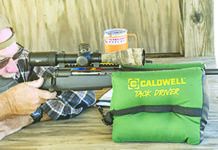
To collect accuracy data, we fired five-shot groups from a bench using an MTM Case-Gard K-Zone rest. Distance: 15 yards. We measured velocities with a Competition Electronics Pro Chrony with the first screen 10 feet from the muzzles.
Written and photographed by Bob Campbell, using evaluations from Gun Tests Team members. GT