













According to industry figures, the 25 ACP pistol is second-best-selling handgun in this country. Is this because they are such good pistols? Nope. In our opinion, it is because of their low price. The majority of these guns are alloy single-action pocket pistols that retail for under $70. Even some high quality double-action models sell for less than $200.
Ballistically, the 25 ACP is certainly no powerhouse. Most loads in this caliber are capable of generating only around 65 foot-pounds of muzzle energy out of a pocket pistol. This is less than that of 22 Long Rifle ammunition from a handgun of the same size, but the 25 ACP’s feeding and ignition is inherently more reliable.
For this test, we acquired three 25 ACP double-action pocket pistols. They were a Beretta Model 21A, a Taurus PT-25, and an Intratec Protec-25. All were blowback operated, and none had any provision for locking the slide open after the last round was fired. Here’s what we found:
Taurus PT-25: Unacceptable
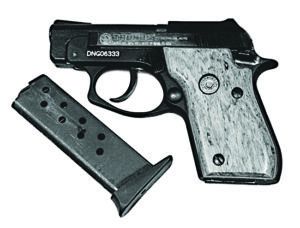
The PT-25 is a 25 ACP pocket pistol. Its slide and tip-up barrel are like that of the Beretta Model 21, but the two guns have little else in common. This slightly larger semiautomatic features a double-action-only trigger, a spurless hammer, and an American-style magazine release. Its magazine, which holds one more round than the others included here, has an extended floorplate.
Most of our test gun’s steel surfaces had a rough, matte-blue finish. The alloy frame had a somewhat smoother dull-black finish. Metal parts didn’t transition very well, we felt, but none had any excessive play. The blued-steel magazine’s only shortcoming was the ragged top edge of its black plastic floorplate. The grip panels were made of Brazilian hardwood with a smooth, glossy finish. We found that the left panel didn’t follow the frame as well as the right, and all four grip screws shot loose after 125 rounds.
This Taurus sat in the hand and pointed as well as the Beretta, though its front sight tended to align higher. The tang wasn’t long enough to prevent the slide from biting one of our shooter’s hands, and everyone thought the grip was a bit too wide. However, thanks to the magazine’s finger rest, all but the largest hands could grasp the gun with three fingers. This extra amount of purchase made the PT-25 easier to control during recoil than its competitors.
All of this gun’s controls were on the left side of the frame. The magazine-release button was conveniently located at the rear of the trigger guard and operated smoothly. The two-position frame-mounted safety blocked the trigger and slide when pushed upward. Thumbing this small lever downward, to Fire, wasn’t a problem, but engaging it required the use of the off-hand. This pistol’s magazine-disconnect device, which prevented firing when the magazine was removed, worked as it should.
The barrel-lock lever, mounted above and behind the trigger, released the tip-up barrel when pushed forward. Initially, this lever automatically returned to its rearward position when the barrel was locked down. However, after about 90 rounds, it started sticking halfway back, which only partially locked the barrel. So, for the rest of the test, we had to manually push the lever the rest of the way back to lock the barrel. If this wasn’t done, the barrel would pop up after firing, allowing the slide to come off the frame. Fortunately, the one time this happened, the shooter wasn’t hurt.
Furthermore, from the 75- to 300-round mark, the Taurus misfired four times and failed to eject twice. It also misfed 11 times, but only with the longer Winchester ammunition.
Our Team Said: Our shooters liked the Taurus PT-25’s handling qualities, but its below-average fit and finish and functioning problems convinced us not to recommend this pistol.
Intratec Protec-25:
A Nightmare
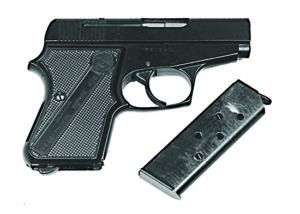
The Protec-25, made by Florida-based Intratec Firearms, is the cheapest 25 ACP double-action-only pocket pistol available. It features an alloy slide and frame, a spurless hammer and a sighting groove. This handgun does not have a manual safety. Options include a black Tec-Kote or two-tone finish.
For this test, we acquired a Protec-25 with a low-glare black finish. Its frame had some minor casting flaws, and there were numerous vertical streaks on both sides of the slide. All moving parts had a small amount of play, and the trigger pin was so loosely fitted that it would start backing out after about 50 rounds.
The all-steel magazine was unevenly blued and poorly constructed. Its body had sloppy spot welds and grinding marks, and the floorplate’s corners and edges were sharp.
This Intratec’s handling qualities were well below average. Due its slightly top-heavy balance and flat shape, pointing wasn’t natural. The overly slim grip was uncomfortable and didn’t even come close to fitting the palm of the hand. Furthermore, its molded checkering was too smooth and shallow to be functional.
In keeping with the Protec-25’s snag-resistant design, its only control was a magazine catch on the heel of the butt.
Our Protec-25 test gun started malfunctioning on the third round. It misfired 17 times, due to light firing-pin strikes, and failed to eject once. The trigger frequently failed to return forward after 55 rounds, and the slide constantly jammed back after 80 rounds. Due to frustration and safety concerns, we stopped firing the Protec-25 at the 100-round mark.
Our Team Said: The Intratec Protec-25 was, in our opinion, totally unacceptable.
Beretta Model 21A Bobcat:
The Best
Gun Tests grade: B
In spite of this Beretta’s rudimentary sights, it was easily the most accurate pistol in this pocket pistol test.
| Finish | Blue |
|---|---|
| Weight (unloaded) | 11.5 oz. |
| Overall Length | 4.9 in. |
| Overall Height | 3.6 in. |
| Barrel Length | 2.4 in. |
| Sight Radius | 3.5 in. |
| Magazine Capacity | 8 |
| Grip Composition | Plastic |
| Grip Length | 2.50 in. |
| Grip Width | 1.10 in. |
| Grip Depth | 1.81 in. |
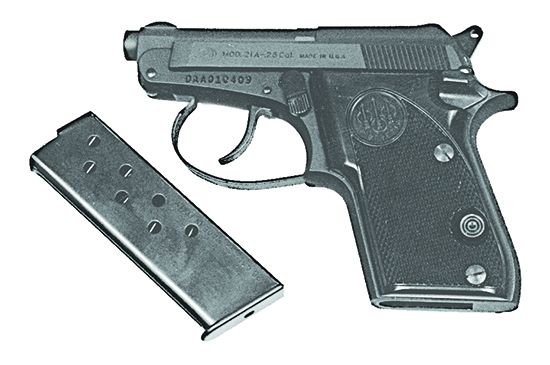
The Model 21A, also known as the Bobcat, is a double-action pocket pistol made by Beretta USA. This tiny semiautomatic features a tip-up barrel, an open-top slide, and an external hammer with a round spur. It is available in 22 Long Rifle or 25 ACP with a matte, blue, or nickel finish.
Except for a couple of insignificant tool marks on the inside of its slide, our Beretta’s matte finish was flawless. Metal-to-metal fit was very good, overall. But a minor amount of wear on the hammer’s left side indicated that it was off-center enough to rub against the slide. We felt the flat trigger guard cheapened the gun’s appearance, but it was securely attached to the alloy frame. The blued all-steel magazine and black-plastic grip panels were well-constructed.
Considering the Bobcat’s small size, we thought it handled acceptably. The gun sat evenly in the hand and was a fast pointer. Due to its intended use as a close-range arm, we didn’t consider this lightweight pistol’s below-average muzzle stability to be an issue. The grip was only long enough for two fingers, but maintaining a firm grasp wasn’t a problem. Although this 25 ACP generated slightly more felt recoil than the others included here, it didn’t amount to much.
This Beretta had three controls. The barrel-release lever, mounted on the frame near the top-front corner of the left grip panel, allowed the barrel to “tip-up” when pushed forward. It could be manipulated with the right thumb or the left index finger. Due to the unusual location of the magazine-release button, low on the left grip panel, it could only be reached with the off-hand.
The two-position safety lever on the left side of the frame blocked the trigger and slide when pushed upward. It could be engaged regardless of whether the hammer was cocked or not. This lever’s small size and stiff movement made it difficult to operate. There was no magazine-disconnect device.
Field-stripping the Bobcat is extremely simple and doesn’t require tools. To do so, remove the magazine. Tip up the barrel and empty the chamber. Pivot the barrel forward until it comes to a complete stop. With the safety on Fire, cock the hammer. Grasp the front portion of the slide. Retract the slide about an eighth of an inch, lift its front end slightly, then pull the slide forward until its back end disengages from the frame’s guide lugs. No further disassembly is needed for routine cleaning.
Accessing this pocket pistol’s chamber was a simple matter of tipping up the barrel. This made it unnecessary to retract the slide during loading and unloading, which was fortunate because the slide’s small size made it relatively hard to grasp firmly. Releasing the barrel also gave the shooter an unobstructed view of the bore during clearing and cleaning.
Functioning was, for the most part, reliable. Three of the 100 rounds of Winchester 50-grain FMC ammunition we gave this gun failed to feed. However, because the overall length of these rounds were around 0.005-inch greater than that of the UMC and Federal loads, and they didn’t misfeed, we considered the malfunctions to be more a fault of the ammunition.
We felt the trigger was above average for a pocket pistol. In the single-action mode, it had a small amount of slack and let-off at 3.5 pounds. The double-action pull was reasonably smooth and released at 8.5 pounds.
Our Bobcat’s worst feature was its fixed sights. The front, a thin blade with rounded edge, was integral with the barrel. The rear was a shallow notch cut into a slightly raised area on the back of the slide. This arrangement was hard to find and align in a hurry. Furthermore, its lack of adjustment made it impossible to change the gun’s point of impact, which was 2.5 inches low and to the right at 7 yards.
In spite of this Beretta’s rudimentary sights, it was easily the most accurate pistol. From a sandbag rest, we were able to achieve five-shot groups that averaged around 1.75 inches at 7 yards.
According to the results of our chronograph testing, all three of the loads we used also generated their highest velocities out of the Bobcat. In fact, the average velocities of this ammunition were from 14 to 76 fps faster than their published estimate of 760 fps.
This Beretta’s sights and controls weren’t ideal, we felt. But the Model 21A was the only 25 ACP pistol included here that was reliable enough to earn our recommendation.
| 25 ACP RANGE DATA | |
|---|---|
| Winchester USA 50-grain FMJ | Beretta Model 21A |
| Average Muzzle Velocity | 774 fps |
| Average Muzzle Energy | 67 ft.-lbs. |
| Smallest Group Size | 1.63 in. |
| Average Group Size | 1.83 in. |
| Remington UMC 50-grain FMJ | Beretta Model 21A |
| Average Muzzle Velocity | 836 fps |
| Average Muzzle Energy | 78 ft.-lbs. |
| Smallest Group Size | 1.25 in. |
| Average Group Size | 1.63 in. |
| Federal Classic 50-grain FMJ | Beretta Model 21A |
| Average Muzzle Velocity | 792 fps |
| Average Muzzle Energy | 70 ft.-lbs. |
| Smallest Group Size | 1.38 in. |
| Average Group Size | 1.73 in. |
Accuracy testing consisted of firing five consecutive five-shot groups with each load at 7 yards.
Our Team Said: The Blue Book of Gun Values currently lists the blued 1995-era Beretta 21A Bobcat with a New In Box price of $250. A 98% gun would fetch $225, one in 95% condition would go for $200. A 90% piece would be $150, an 80% gun $115, a 70% pistol $95, and one in 60% condition, $85. We’d be hard-pressed to go more than $125 to $150 for one in very good condition.
Adapted by Gun Tests Staff, using evaluations from Gun Tests Team members. GT





I had a Raven many years ago. It went bang 6 times then died. Got rid of it. I think it cost me 49$ NEW in the box in 1980
I carried a Galesi 25 until the Kel Tec p 32 arrived . Still carry it .