









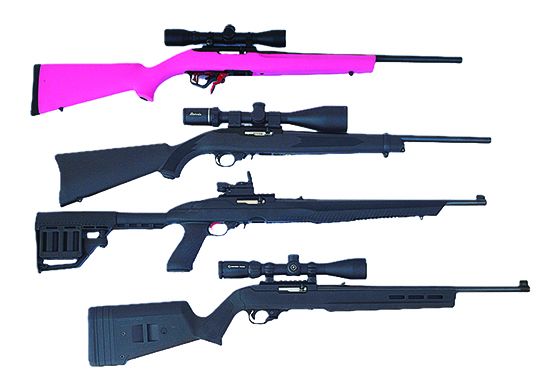
We recently tested four replacement triggers for the 10/22 rifle, the Ruger BX-Trigger, $75; Tandemkross Manticore, $375; Timney Calvin Elite, $305; and Volquartsen TG2000, $339. They are different enough that some will find a perfect trigger among them, but each one has characteristics that we think favor some uses over others.
Using and firing America’s favorite 22 LR semi-automatic rifle is limited by its trigger action. As a plinker, trainer, and small-game hunter, the factory Ruger 10/22 is fine. But its practical accuracy may be improved by adding an aftermarket trigger. An aftermarket trigger with less motion and a lighter break is essential for those wishing to upgrade the rifle for competition or pursuing accuracy for its own sake. Unlike on some other rifles, the work involved is simple and easily accomplished.
To get started, we checked five factory 10/22 trigger actions. All ran 5.2 to 5.8 pounds of break pressure needed to fire the rifles. That’s the objective range we started at, but we also made some subjective assessments. Here are the factors we looked at in grading the triggers beyond their break weights.
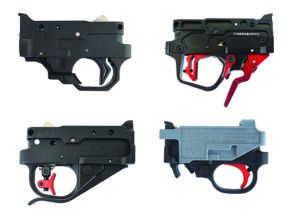
Tandemkross Manticore Trigger Assembly for Ruger 10/22, $375; the Ruger BX-Trigger 90462, $75; and the Timney Calvin Elite Replacement Trigger for Ruger 10/22, $305. The testers had opinions about which was best for certain chores.
Take up: The amount of movement from its resting position to before the trigger breaks. In some cases, this factor is measurable. Take up is often a matter of personal choice.
Break weight: Trigger break may be measured by a registering device. A good, clean break is essential for speed shooting and for the best accuracy. We were looking for a trigger break of less than 3 pounds.
Sear engagement: Every trigger must have some sear engagement to keep the rifle from firing. The amount of engagement and how smooth and sharp the sear surfaces are defines how “crisp” and “clean” the shooter feels the break.
Overtravel: The distance the trigger moves after the gun fires. Sometimes there is a trigger stop, and this is an aid in controlling overtravel. Some aftermarket triggers have a mechanical overtravel adjustment.
Reset: How fast the trigger is ready to go again after breaking a shot. All of these attributes rolled together are called the trigger action.
The Test Procedure
We used five rifles during the test. Each was fired for function and accuracy before modification. One remained stock for comparison. Any problems would thus be the fault of the trigger.
We fired each rifle with 100 rounds of CCI Mini-Mag after trigger installation to test reset, function, and reliability. All rifle/trigger combinations passed. We also tested accuracy with the Mini-Mags.
Ruger BX-Trigger 90462, $75
Ruger.com
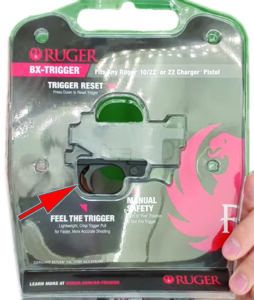
Trigger. It also fits the 22 Charger Pistol. And if you want to try the trigger before you buy, reach into the cut out.
The BX-Trigger is a modestly priced replacement trigger offered by Sturm Ruger & Company. This is a plastic unit, and it isn’t as finely turned out as the more-expensive aluminum-housing triggers. The BX-Trigger comes in a package with a plastic cover that prevents the springs from flying away if the trigger is dry fired outside of the rifle. This is a great idea.
We fitted the BX-Trigger into a Ruger 10/22 Model 31139, a general-purpose practice rifle. The BX-Trigger’s take up is better than any of the factory units we had on hand, no question there, and so is the BX’s reset. We cleaned the trigger with a good internal spraying to clear grease away, something we did not do with the high-end triggers, and let it dry overnight. The trigger action began the test at 3.1 pounds.
To install, make sure the rifle chamber is unloaded and remove the magazine. Flip the rifle so the magwell is facing up, and loosen the takedown screws with a 5⁄32-inch driver. Center the safety in the housing so it doesn’t mar the inletting and remove the stock. Lay the barreled action on its right sight and take a 4mm punch and non-marring small hammer and gently tap out the trigger-housing pins. Remove the fire control unit from the rifle, and make sure the secondary ejector stays in its slot.
Remove the BX’s gray dry-fire shell that holds its pins in and allows dry firing outside the rifle. Don’t dry fire it without the gray shell. Slide the BX into the 10/22’s action, making sure the secondary ejector stays in its slot. Reinstall the pins and the stock.
Check the trigger’s function. On an empty chamber and with the safety on, pull the trigger. It shouldn’t click. Then place the safety on Fire, pull the trigger, and the action should click. Next, hold the trigger back and cycle the bolt. You should feel the trigger reset with an audible click.
Our Team Said: The BX-Trigger is a noticeable improvement over the stock trigger. It is worth the money, but it is not in the class with the high-end triggers.
GUN TESTS GRADE: B [BEST BUY]
Tandemkross Manticore Trigger Assemblyfor Ruger 10/22 TK18N0488,
$375
Tandemkross.com
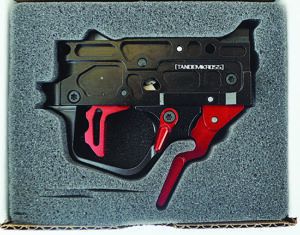
trigger arrived in padded packaging.
We could have purchased the Manticore for $300 without the Fireswitch extended magazine release, Cornerstone ambidextrous safety, and Bolt Keeper bolt lock. These upgrades neatly solve any handling problems encountered with the Ruger 10/22. We feel they were well worth the money.
The trigger action is adjustable with a single screw located beside the hammer. Adjustment is done outside the rifle. Don’t dry fire the unit outside the gun without controlling the hammer. The springs will fly out, true of all of these units. The Manticore arrived set at 3.25 pounds. We were able to set it down to 2.1 pounds, but tested the trigger action at 2.25 because this seemed to be the sweet spot for control. The break may be set as heavy as 5 pounds. This is handy because some competitions may demand a higher break than 3 pounds, and training a young shooter may call for a heavier break weight. The toggle-type safety is ambidextrous. After day two of testing, one test-team member said, “I like this safety so much because it is like an AR.” Well the safety is a toggle type, even if it is in a different position than the AR’s, but we get his point. To an extent, it is AR compatible in handling, and we really like the safety. The bolt lock is pressed up when you wish to lock the bolt safely to the rear. The extended paddle release is a large unit, and it is very fast. One tester didn’t like it as much. He has had difficulty with extended magazine release levers on the Ruger when benchresting. In that situation, he is correct that it would not be for him. One of the testers built a rifle with the Tandemkross trigger for his wife. She found the bolt release useful and the magazine release especially welcome. All testers liked the safety lever better than the Ruger crossbolt type.
We did a modest amount of take-up and overtravel adjustment. The take-up screw is on the left side of the housing just above the trigger. It was easily adjusted to very little take-up. Overtravel is adjusted by a set screw in the trigger. On an individual basis, they would become important to the shooter engaging in competition or long-range shooting.
Installing the Tandemkross Manticore action is a bit more involved than the other triggers. Like all the others, first carefully unload the rifle and set the magazine aside. Remove the barrel band then unscrew a single action screw to remove the barreled action from the stock. Be certain to set the Ruger safety in the middle position to remove the action. If not, it will catch on the stock. Turn the action upside down. Remove two pins and slide the trigger action off of the receiver. Simple as that. Unbox the replacement unit. Never pull the trigger while the action is removed. Springs will fly toward the ceiling. Remove the safety and extended bolt-release levers. The action will not fit into the stock with these extended levers. Place the new trigger action in the Ruger receiver and replace the action pins. After installing the trigger, replace the action in the stock, simple as that. Re-install the levers.
We fired the modified rifle from a benchrest at 25 yards. There was a solid improvement in accuracy. We also fired for speed at a variety of challenging targets. The rifle was more combat accurate than before and offered greater accuracy. The improvement is notable. In comparison to the other triggers as tested, we really liked the Tandemkross bolt release and rotating safety lever. The bolt stop is superior to the sometimes-clumsy Ruger bolt stop and bolt release.
Our Team Said: We were well pleased with the Tandemkross Manticore. Was the additional $75 spent for the ambidextrous safety, large bolt stop, and paddle-type bolt release worth the money? We felt they were a bargain, especially for anyone with a physical impairment. But don’t order the paddle release if you are a benchrest shooter. The ambidextrous safety is a must have for left-hand shooters. If you simply wish to have a better-shooting rifle, the standard trigger is a considerable improvement. While the Manticore was slightly more difficult to install in the stock once mounted on the receiver, this extra trouble wasn’t any real trouble.
Without the extras added to the Tandemkross, the three triggers are within $30 of the others in price. For a left-handed shooter, or someone who doesn’t like the Ruger bolt release, or someone competing in any match that demands fast loads, the Tandemkross stands out. The Tandemkross magazine release is fastest, but it may dump the magazine if the rifle is primarily a benchrest shooter.
GUN TESTS GRADE: A [OUR PICK]
Timney Calvin Elite Replacement Trigger for the Ruger 10/22 1022CE,
$305
TimneyTriggers.com
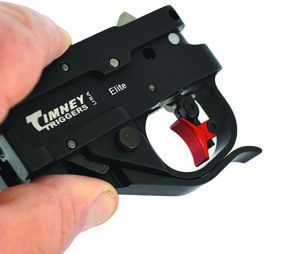
The Timney is built to tighter tolerances than the Ruger factory trigger, with a tight trigger interface. The extended magazine release is a bonus that works well. The Timney features a trigger shoe allowing vertical adjustment on a horizontal post. You may adjust height or cast with this trigger, a unique feature. Interestingly, the trigger shoe allows the shooter to have a trigger that feels more forward, or more to the rear, than most, accommodating different hand sizes. The Timney trigger isn’t adjustable from the factory for weight, take-up, or overtravel. This is a drawback, but the factory settings are excellent. Some shooters may prefer the ability to set overtravel and take-up. The trigger has practically no take-up and is absent of creep. Its overtravel is difficult to describe; the overtravel exists, but scarcely, with less than a millimeter of movement. Reset is also very sharp. As for the trigger shoes, they not only allow a great deal of adjustment, they offer different styles. One is a conventional curved type, another is a flat face popular with many AR shooters. A third is a flat-faced finger-rest type.
Another good feature is an enhanced magazine release, which stays out of the way on the bench but is very fast in operation. We measured the trigger break before and after the test program and saw that it remained remarkably consistent. The trigger breaks at almost exactly 2.05 pounds, lightest of the test, without any type of adjustment. Notably, the trigger action is sometimes seen to register different trigger-pull weights, depending on where you place the measuring device. We used two trigger-pull gauges and set the arm dead center of each trigger, as much as possible. The Timney measured slightly differently with a covered and straight trigger shoe, as expected. This trigger performs well and seems well suited to bench accuracy.
Our Team Said: The Timney release seems to be the best compromise. It is about as fast as any paddle-type release. For those looking to improve the trigger action out of the box, and who feel the size and surface area of the trigger make a difference (and it does), the Timney is a first choice. However, its lack of adjustment is a downside.
GUN TESTS GRADE: A-
Volquartsen TG2000 Trigger with Rapid Release VCTP-1-B-10-RR-9,
$339
Volquartsen.com
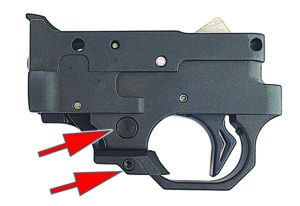
The TG2000 trigger is nicely finished and is housed in an aluminum case. It is easily installed. To start, field-strip the rifle as outlined previously. Bump out two pins, remove the Ruger unit, and replace it with the TG2000.
The TG2000 is well finished in every regard, and the trigger face nicely shaped for good control. Pre-travel adjustment is done by slipping a small wrench into a tunnel in the front of the trigger housing. For some, it is a little difficult to find the screw. Insert the tool and carefully find the screw. A good rule is to adjust pre-travel out until the sear will not break the trigger, then move back about a quarter turn to get sear engagement. The overtravel screw is easier to address because it is located in the rear of the housing. Again, adjust this one out until it won’t release the trigger, then back it up until you find the sweet spot with enough travel to reset the trigger, but not too much. We should also point out that if you achieve a fine-tuned reset in dry fire, that doesn’t mean it will always reset with live ammunition. It takes time and effort and carefully disassembling the rifle back and forth to achieve a perfect break. But then, the trigger alone is excellent, even without working with the overtravel and pretravel. You don’t have to adjust the trigger past the factory default. It simply allows a perfect break of your preference. If you are after a perfect trigger action, then this is all worth the time and trouble. Those of you who pursue the Nth degree of accuracy should consider this trigger action. The trigger itself breaks at a very clean 2.2 pounds out of the box. There was an improvement in practical accuracy.
Our Team Said: For a benchrest rifle and a person who feels the difference in take-up and overtravel more than the average shooter, choose the Volquartsen.
GUN TESTS GRADE: A
| RANGE DATA | ||
|---|---|---|
| Rifle 1 | Factory Trigger | Ruger BX-22 Trigger |
| 25-yard Group Average | 1.7 in. | 1.1 in. |
| Rifle 2 | Factory Trigger | Tandemkross Trigger |
| 25-yard Group Average | 1.1 in. | 0.5 in. |
| Rifle 3 | Factory Trigger | Volquartsen Trigger |
| 25-yard Group Average | 0.9 in. | 0.5 in. |
| Rifle 4 | Factory Trigger | Timney Calvin Elite Trigger |
| 25-yard Group Average | 0.8 in. | 0.3 in. |
| Rifle 5 | Factory Trigger | |
| 25-yard Group Average | 1.5 in. |
Results are the averages of three five-shot groups at 25 yards with CCI Mini-Mag ammunition. The Ruger 10/22 rifles were variously equipped, as follows. Rifle 1: Ruger BX-22 Trigger, Aim Sports Red Dot, Adaptive Tactical stock. Rifle 2: Crimson Trace scope, Hogue Overmolded stock. Rifle 3: TruGlo Fixed 4x scope, Magpul Hunter stock. Rifle 4: Burris Fullfield scope, Boyds AT 10-22 stock, Beyer barrel. Rifle 5: Surefire scope, factory synthetic stock.
Written and photographed by Bob Campbell, using evaluations from Gun Tests Team members. GT




Glad to be back. Completely forgot about you fellas for quite a while…old age and a
lot of medication.
Have 3 generations of shooters in the family now. Cannot think of a better way spend
a day.
God Bless the USA and HAPPY 250th.