









Introduced by Winchester in 1959, the 22 Winchester Magnum Rimfire (WMR) cartridge, more commonly called 22 Magnum, was designed to bridge the difference between the popular 22 LR rimfire cartridge and more powerful and expensive 22-caliber centerfire rounds. On the low end of the spectrum, the ubiquitous 22 LR can usually push a 30- to 40-grain bullet at 1000 to 1200 fps. On the opposite end, centerfire rounds ranging from the 22 Hornet to the 220 Swift can send 40- and 50-grain bullets anywhere from 2400 to 4000 fps. In between, the 22 WMR round will push a 30- to 40-grain bullet out at 1800 to 2100 fps. Then we ran the energy numbers and found out the diminutive 22 WMR could generate energy approximately equal to a decent 9mm Luger pistol round at those speeds. With newfound respect for the cartridge, we started shopping for rifles chambered in 22 Magnum.
In this feature, we present three different 22 Magnum rifles with three different feature sets and three different price points. The first is a Christensen Arms MPR Rimfire that is truly match worthy but arrives at a near $2k cost. A Ruger American comes in at a much better price, but it is more suited to a life of roaming the woods looking for squirrels and varmints. The third entry is a Savage Minimalist, available at an even better price for what might be a truck or saddle gun.
In more detail, the MPR Rimfire from Christensen Arms, $1726, sports a folding aluminum chassis, full-length slotted fore end, and a Trigger Tech trigger. The MPR Rimfire is designed for competition and any other precision work you need. Second is the Ruger American 08370, $490, which offers a polymer stock with removable pieces that can provide a proper length of pull and cheek height for most needs. Last is a Savage rifle called the Minimalist, and it is. Weighing in at a mere 5.25 pounds loaded, the little Savage Minimalist handles well and was very accurate, we found. Interestingly, all three of these 22 Magnum rifles are threaded for suppressor use, though we didn’t shoot them with a can.
Christensen Arms MPR Rimfire 22 WMR,
$1726
GUN TESTS GRADE: A [our pick]
We’ve tested several Modern Precision Rifles in various calibers, and all of them have shot well. This MPR chambered in 22 Magnum didn’t let us down. Readily configured for individual preferences and sporting a great trigger, the MPR was easily the most accurate rifle.
| Action Type | Bolt |
|---|---|
| Overall Length | 33.75 in. |
| Barrel | 16 in. long, 1;14 twist |
| Overall Height w/o Scope Mount | 6.88 in. |
| Weight Unloaded | 5.8 lbs. |
| Weight Loaded | 6.1 lbs. |
| Sight Radius | NA |
| Action Finish | Cerakote |
| Barrel Finish | Cerakote and carbon fiber |
| Magazine Capacity | 9 |
| Magazine Type | Ruger-style detachable box |
| Stock | Aluminum chassis |
| Stock Drop at Comb | Adjustable |
| Stock Drop at Heel | Adjustable |
| Stock Bedding | None |
| Stock Buttplate | Rubber |
| Stock Length of Pull | Adj. 13.25 in. minimum |
| Receiver Scope-Base Pattern | Picatinny rail |
| Trigger Pull Weight | 1.53 lbs. |
| Safety | Two-position rocker |
| Warranty | Accuracy guarantee and limited |
| Telephone | (888) 518-8858 |
| Website | ChristensenArms.com |
| Made In | U.S. |
We’ve tested centerfire versions of the Modern Precision Rifles before and wondered if a rimfire version could maintain the performance we expect from its larger brethren. We weren’t disappointed.
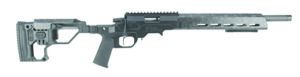
With roots in the aerospace industry that date back to the mid-1990s, Christensen was one of the pioneers of carbon-fiber-wrapped barrels, a great example of which is mounted on this rifle. Sixteen inches long with a 1-in-14-inch twist (1:14), the match-grade tube measured a hefty 0.860 inch at the muzzle on our dial caliper. The carbon-fiber wrap lends plenty of rigidity while producing a very lightweight barrel. Christensen provides a muzzle cap to cover the 1⁄2×28 threads.
The theme continues with the FFT fore end. Flash Forged Technology allows a proprietary mix of carbon fibers to be used for several parts in various Christensen rifles. It can save as much as a pound of weight over a conventional carbon-fiber stock. Very environmentally friendly, mistakes or blems can be chopped up and put back in the mix to be recast and used in the next rifle they build.
The fore end sports M-Lok slots at 3, 6, and 9 o’clock and provides for a flat surface on the bottom to facilitate shooting from bags. The hand guard attaches to the aluminum chassis via eight flush-fitting screws. We’ve mounted ARCA-Swiss rails on these slots on the bottom of other Christensen rifles, where they served us well. Whether attached to a bipod or a tripod, the fore end has stayed solid with no wobble to ruin the accuracy of this rifle.
The material used on that fore end also leaves the front end of the rifle a bit light, which means the rifle floated a little when we shot it offhand. What it really does is leave the balance just about perfect when a suppressor is mounted on it. With the way cans are selling now, having a rifle that’s “can-centric,” that is, shorter and already threaded for a silencer, seems like a good idea.
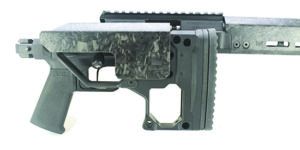
While the barrel could be installed in just about any stock, the chassis was designed to take the other parts and help them stretch the limits of the 22 Magnum round. It actually breaks down into several components — the grip assembly, the lower receiver, and the action. The grip is standard AR-15 equipment. Shipping with a very thin grip that might be perfect for you, it is easy to change out to your favorite style if you want to. The grip module also includes a trigger guard that is big enough for gloved fingers but not oversized for bare digits.
A flat-faced Trigger Tech field unit is installed, allowing the shooter a reported 2- to 5-pound pull weight. Ours was a bit lighter, averaging a mere 1.6 pounds to fire the rifle. That was after we adjusted the trigger as low as we could get it by inserting an Allen key into a screw visible just in front of the trigger. In previous generations of centerfire MPRs we’ve tested, that required the shooter to very carefully insert the short side of the wrench into the screw and turn it a few notches before having to move the key and reinsert. Now, Christensen uses a milled slot to allow the shooter access to the screw from the bottom of the trigger guard. We normally insert and turn until the adjustment screw starts to come out and then reverse the turn for a few clicks.
The rest of the chassis held a number of surprises we really liked. Instead of requiring more $100 proprietary magazines, Christensen uses a nine-round Ruger rotary magazine. Fitting below flush on the chassis, a competitive shooter could actually shoot the rifle while it rested on top of the magazine with no problems. We also tried the MPR with a 15-round Ruger magazine, and it worked just fine. The mag release is a paddle located between the front of the trigger guard and the magazine well. It was large enough to be easily activated while also being well protected from an inadvertent release. Then Christensen put a barricade stop in front of the mag well, just in case you decide to use those longer magazines while you push your rifle forward into your shooting rest.

The features don’t stop there. The chassis is adjustable for cheek height using another FFT piece that can be moved on a rail by loosening two bolts. Length of pull can be adjusted in a similar manner, though we tend to keep our rifles short as an aid to positional shooting. The buttstock hinges at a sturdy joint that allows the butt to move forward, where it is held closed by a strong magnet. Overall length is shortened to 25 inches, and the stock protects the closed bolt while folded. Multiple quick-detach holes are provided on the stock, though none on the fore end. The MPR comes equipped with a section of Picatinny rail fore end, and we’d love to see a slightly longer unit with a QD hole there.
The action is very similar to other Christensen MPRs except, of course, the length being shorter. The top of the action is fully enclosed with a 15-slot section of Picatinny rail installed. The rail is zero-minute of angle, but this isn’t exactly a cartridge designed to test the limits of your scope. The bolt is slender with dual extractors. The ejector is mounted in the inside of the action. A Remington-like safety is used, providing the shooter with a two-position thumb rocker located just behind the bolt. The bolt handle is slender, and the bolt knob has been milled to allow for secure purchase. The bolt release is a lever on the left rear side of the action.
Given the expected use of rimfire cartridges, we tested the rifles at 50 yards. We hoped for minute-of-angle (MOA) accuracy, but didn’t expect it. The Christensen was the most accurate of the bunch. The MPR liked the 30-grain Varmint loads from CCI best, posting three-shot groups that averaged 0.31 inches in diameter. We understand these were at 50 yards, but that is still a 0.6-MOA group. The 40-grain CCI Target averaged 0.36 inches, and the 40-grain Speer Gold Dot loads came in at 0.35 inches. Not too shabby. Everything fed and fired perfectly. Recoil was almost non-existent.
Our Team Said: The Christiansen MPR is Our Pick, which you’re probably not surprised by based on the rifle’s price. But money doesn’t always dictate performance, and the Christensen did everything we asked of it and more.
| 22 WMR RANGE DATA | |||
|---|---|---|---|
| CCI Varmint 30-grain VNT | Christensen MPR Rimfire | Ruger American Rimfire | Savage Minimalist |
| Average Velocity | 2165 fps | 2127 fps | 2128 fps |
| Muzzle Energy | 312 ft.-lbs. | 301 ft.-lbs. | 302 ft.-lbs. |
| Best Group Size | 0.21 in. | 0.70 in. | 0.26 in. |
| Average Group Size | 0.31 in. | 0.79 in. | 0.34 in. |
| CCI Maxi Mag 40-grain TMJ | Christensen MPR Rimfire | Ruger American Rimfire | Savage Minimalist |
| Average Velocity | 1891 fps | 1886 fps | 1888 fps |
| Muzzle Energy | 318 ft.-lbs. | 316 ft.-lbs. | 317 ft.-lbs. |
| Best Group Size | 0.24 in. | 0.38 in. | 0.44 in. |
| Average Group Size | 0.36 in. | 0.68 in. | 0.53 in. |
| Speer Gold Dot 40-grain Hollow Point | Christensen MPR Rimfire | Ruger American Rimfire | Savage Minimalist |
| Average Velocity | 1953 fps | 1883 fps | 1935 fps |
| Muzzle Energy | 339 ft.-lbs. | 315 ft.-lbs. | 333 ft.-lbs. |
| Best Group Size | 0.29 in. | 0.54 in. | 0.55 in. |
| Average Group Size | 0.35 in. | 0.62 in. | 0.64 in. |
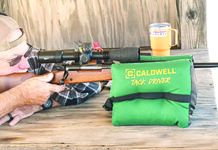
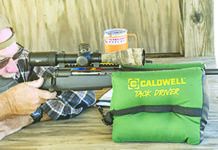
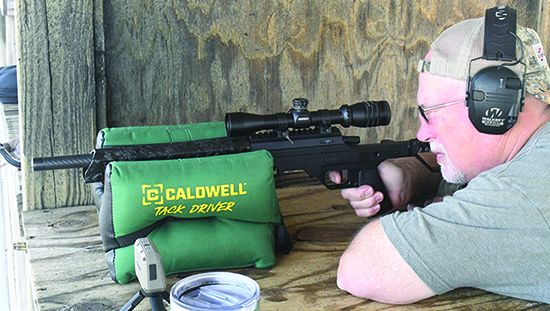
We shot for group and function using three different types of ammo, all available from MidwayUSA.com. The first were 30-grain varmint loads with polymer tips from CCI. The second was a 40-grain total-metal-jacket Target load, also from CCI. The last was a 40-grain Gold Dot hollow-point load from Speer. Our team tested at American Shooting Centers in west Houston. We supported the rifles in a Caldwell TackDriver Pro (Brownells 100-027-023, $49), further supported by a large rear bag, heavy from Tab Gear (TabGear.com, $34). We fired three-shot groups at 50 yards. We measured velocities with a Garmin Xero C1 Pro (Garmin.com, $600). For optics, we used a Redfield Battlezone Tac-22 scope with 2-7x34mm magnification, $250.
Written and photographed by Joe Woolley, using evaluations from Gun Tests Team members. GT