









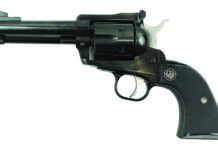
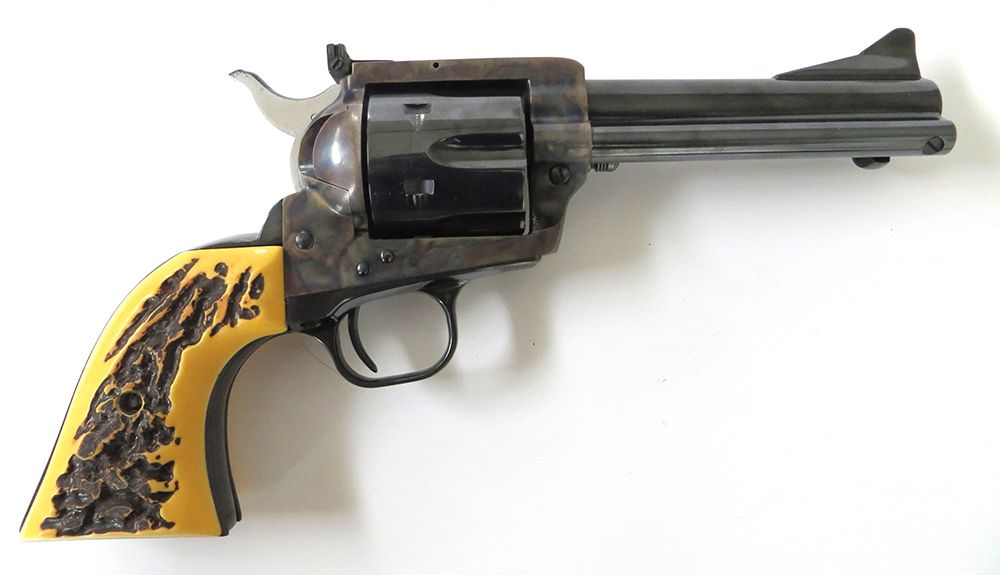
The Colt New Frontier appeared in 1961 with Colt’s Second Generation single-action models made from 1956 through 1975. It debuted when John F. Kennedy was president and the “New Frontier” meant outer space and space exploration. Colt latched onto the national mood and dubbed the new single-action revolver with adjustable sights the New Frontier. It was originally chambered in 38 Special, 357 Magnum, 44 Special, and 45 Colt with three barrel lengths: 4.75, 5.5 and 7.5 inches. All New Frontier revolvers have a serial number prefix of “NF” followed by the serial number. The gun writer Skeeter Skelton evangelized the New Frontier, especially in 44 Special. Third Generation Colt single-action revolvers began production in 1976 and continue to this day. The New Frontier was re-released in 1978 and is currently cataloged in either 44 Special or 45 Long Colt with barrel options of 4.75, 5.5, and 7.5 inches. The New Frontier is popular with collectors and shooters and commands top dollar, even for well-used specimens.
The Third Generation New Frontier we acquired for this test featured a 4.75-inch barrel and was in pristine condition. Original grips were made of smooth walnut inset with a gold Colt medallion, but our New Frontier had aftermarket laminated stag-horn grips that look like they were made by Jay Scott, which was owned by Colt. Jay Scott grips have a wood backing that is used to secure the grips so they do not crack under recoil. The grips overlapped the frame at the butt a bit and felt a bit chunky compared to traditional single-action grips.
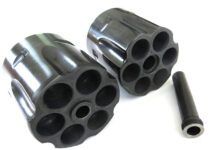
The metal bluing was deep and comely, contrasting with the casehardened-color frame. The New Frontier normally did not come with an extra cylinder, but one is available for an additional cost of about $290 through Colt’s Custom shop.
This New Frontier was well built and solid, with no wiggle in either cylinder and excellent timing. We saw no ring around the cylinder, even after test firing and cocking. The ability to shoot both 45 ACP and 45 Colt through both revolvers was a substantial plus because the calibers are so popular and available. We did anticipate a difference in accuracy as we have seen in other convertible revolvers, mainly due to the rifling twist rate, which in this case is 1:16, perhaps not being the right choice for both rounds. The 45 ACP also has a bit of jump through the chamber that the longer 45 Colt doesn’t, and we thought that might show downrange. The nit we had with both the Ruger and Colt cylinders is they need an easier way to tell them apart visually. The Colt 45 ACP cylinder has a tiny stamp between two the chambers that was difficult to see and could only be seen with the loading gate open, and then only when the cylinder was in the right position. We would like a ring machined around the rear of cylinder or longer flutes, or no flutes, to differentiate between the chamberings.
The Colt loads the old-school way by first having its hammer pulled to half cock or two clicks of the hammer. The loading gate is then opened and a round is inserted into a chamber, the cylinder is rotated to skip the next chamber, then the remaining chambers are loaded. This ensures the hammer rests on an empty chamber. Because the Colt has no safety device except common sense, the revolver might discharge if accidentally dropped on the hammer over a loaded chamber. We needed to pay attention when handling the Colt; if we rotated the cylinder too much, we couldn’t load a chamber because there was no access and the cylinder cannot be rotated backward. That chamber needs to be skipped and picked up next time around. Of course, this is not news to traditional SAA shooters.
The four clicks a Colt SAA makes upon cocking are music to some testers’ ears. The New Frontier was smoother to cock than the Ruger, but the hammer locked back closer to the back strap, which could be an issue for meaty-handed shooters by catching the web of their hands between their thumbs and first fingers. The checkering on the hammer spur was elegant and functional, and testers thought it was nicer looking than the Ruger’s serrations, though the serrations were well executed. The trigger had no creep at all and broke crisply on average at 3.5 pounds, which we thought was optimal.
The sights of the Colt were well executed. The front ramp had deep serrations, so it cut glare, and we encountered plenty of glare on the test days, with the sun high in a clear blue sky. The rear sight offered nice, positive clicks for windage, but no clicks for elevation. We did like that the direction was indicated “UP” on elevation and “L” for windage, a feature the Ruger lacked.
Using a two-hand hold and rest, we found that the Colt liked nearly anything we fed it, in particular, Winchester Super X 45 Long Colt ammo loaded with a 255-grain LRN bullet. It consistently printed 1-inch five shot groups at 15 yards. The Colt did best with the Atlanta Arms 45 ACP, with a best group at slightly over half an inch.
Loading and unloading were easy tasks, with the ejector rod only needed toward the end of our testing session. Swapping cylinders, we found the 45 ACP cartridge loaded and unloaded as smoothly.
Our Team Said: We found we liked the Colt a lot. It is definitely a more traditional SAA with no safety features that needs to be carried with only five rounds loaded. The price is what really turned off shooters when directly compared with the Ruger, though we all surmised the Colt would hold its value better than the Ruger. The grips were a little too B-movie Western for some shooters, but the front sight was done right with serrations. The Colt had a steep cost compared to the Ruger, but it was still an investment some would make.