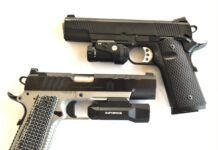









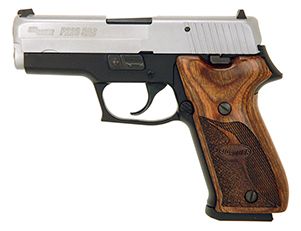
Sig Sauer (formerly known in the United States as Sigarms), offers as many as 13 different 45 ACP P220 “Carry” models. These pistols are distinguished from the venerable P220 pistol by their shorter top ends, which house a 3.9-inch barrel instead of the original length 4.4-inch tube. Variations include action, grips, slide finish and “dehorning” of edges. Prices for the different P220 Carry models range from $929 for the most basic pistol to $1286 for the Carry Elite Stainless.
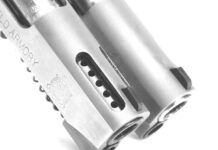
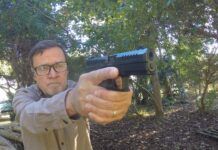
Our Carry SAS featured combination knurled wood and checkered grips that covered the back strap and a radical dehorning of edges, primarily on the slide fore and aft. This model did not feature an accessory rail but rather a smooth traditional dust cover ahead of the trigger guard. The slide was stainless steel and finished with cocking serrations to the rear. The front sight featured a tritium dot to be read over a non-luminous white line that was centered in the rear notch of the Sig Sauer Contrast rear sight. Magazine ejection was via a left-side-only button. But this button can be shifted to the opposite side for the left-handed shooter. Magazine capacity was eight rounds with a viewing hole for each round visible from both sides of the stainless-steel magazine. The base pad was removable for service. Two eight-round magazines were supplied, but ten-round magazines are also available from Sig Sauer.
The P220 Carry SAS is a DAK model, meaning that the trigger is full-time double action. With the chamber empty and the trigger forward, the hammer sat deep inside the recess of the slide. Movement of the slide cocked the hammer and left it standing back slightly from the firing pin to avoid accidental discharge. From this position pressing the trigger required about 8.5 pounds to raise the hammer and break the shot. We noticed that pressing the trigger about one-third of its stroke (not to ignition) will also cock the hammer. This can be useful primarily when practicing with an empty gun. But we would rather work the slide manually each time for fear of building a habit such as working the trigger without the intention of firing. Dry-firing with the hammer in the fully down position presented a heavier trigger pull and a longer stroke.
Before our test session began, we posed three questions about the P220 Carry SAS: First, given the shorter barrel, how much would velocity be reduced when compared to the standard-length model we tested in the August 2007 issue. Second, would recoil be increased? Third, what role would the DAK trigger play in terms of accuracy and rapid-fire performance? Comparing the one common round from both tests, we found that our P220 Carry SAS lost about 61 fps when firing 185-grain Hornady JHP/XTP ammunition. The reduction of power may have played a part in answering our second question. With less velocity (and power), we found our Carry model did not transmit objectionable recoil even when loaded with Hornady’s 200-grain JHP/XTP +P rounds. The 200-grain rounds were the most powerful of our 45 ACP ammunition, producing about 338 ft.-lbs. of muzzle energy.
Our third question, how the DAK system might affect accuracy and speed during rapid fire, was answered during our indoor tests at close range. But first, let’s review the accuracy we achieved with the P220 Carry SAS from support at a distance of 25 yards.
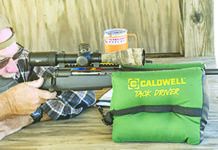
The aforementioned 185-grain Hornady rounds presented only moderate recoil and printed an average group size of 2.4 inches across. The spread from largest to smallest group was only about 0.6 inch. The extra pressure +P rounds produced the same amount of spread, but thanks to a best group of 1.7 inches across, final average width per five shots was just 2.0 inches. But our most accurate test ammunition was our handload. Our best group measured only 0.75 inch center to center. One “blown” shot produced a 1.6-inch group, bringing the final average for five shots to 1.2 inches. Credit is due to the 230-grain Sierra Tournament Master bullet combined with a starting load from Richard Lee’s Second Edition of Modern Reloading.
But we think the DAK trigger should also take a bow. The DAK trigger allows the operator to modulate the trigger while tracking highly visible sights until ignition. These are two key elements of any good shot.
In our rapid-fire test we learned that we could maintain accuracy even when faced with a shot timer and a little adrenalin. When it came to producing perfect strings of fire (two holes on the A and one on the B), we ultimately produced more with the P220 Carry than with our other guns. But it didn’t start out that way. Initial runs had big flyers. The first shot was the key. Once our finger had a feel for the stroke, second and third shots were more accurate. In fact we had more shots touching the letter B in the head area than punctured the letter A at center mass. Total time was about 2.30 seconds for a perfect run. Our best first shots took about 0.9 seconds, but we could see shrinking this by advancing the trigger more aggressively as we came on target.
Our Team Said: The DAK trigger presents nearly a 1:1 ratio of movement regarding the distance the trigger must travel and how far the hammer must move. Distance equals time. So we don’t think the P220 Carry SAS will ever be a screaming-fast pistol. The SAO model or even a good hand on the traditional double-action trigger would likely be faster. But the precision available from the P220 Carry SAS with DAK trigger might very well even the score.