









Part of the reason why Colt introduced the New Frontier was the wild success of Bill Ruger’s Blackhawk single-action revolvers with adjustable sights that first appeared in 1955. Ruger’s revolvers were and still are super popular with shooters. Another noted gun writer, Elmer Keith, was a fan of the Blackhawk.
The Blackhawk debuted in 357 Magnum, and like Colt single actions with adjustable sights, the Blackhawk was originally produced as a flattop. Ruger made the flattop Blackhawk from 1955 through 1962, then modernized the design by bulking up the top of frame to protect the sides of the adjustable rear sight. Since the design change, Ruger has made small runs of flattops as commemoratives as well as distributor exclusives. We tested a 50th Anniversary New Model Blackhawk flattop a few years ago in 357 Magnum and gave it an excellent rating. We hoped we would be equally happy with a flattop convertible.
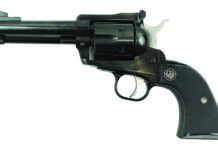
We were able to wrangle a Lipsey’s exclusive New Model Blackhawk that incorporated all of the retro-styling of the original Blackhawk flattops plus the added features of the New Model Blackhawks, such as the safety transfer bar and reverse indexing cylinder of the Vaquero. The grip frame was also made of steel—original flattop Blackhawks had an aluminum grip frame—and the grip was similar to a Colt grip rather than the chunkier and slightly longer grip of current New Model Blackhawk. The owner replaced the white faux ivory grips with a pair Buffalo Brothers (BuffaloBrothers.net) polymer finger-grooved grip in antique ivory coloring. The grips were well fitted and felt thin, and to our shooters they offered a better grasp for right-handed shooters due to the finger grooves. The Ruger had a well-executed blued finish over the entire revolver, while the trigger and hammer were left bright stainless, contrasted nicely with the polished-blue metal surfaces.
The Ruger locked up tight and the timing was spot on. No cylinder ring appeared even after extensive range sessions and even after changing out cylinders multiple times over the course of testing. The front of cylinder had a nice bevel that allowed for easier holstering.
Those accustomed to handling a Colt SAA or clones had ramp-up time learning to load the Ruger. Out of habit, they placed the hammer at half cock. That is not required. Just open the loading gate, and the cylinder will rotate freely and all chambers can be loaded or unloaded. This New Model Blackhawk incorporates the safety-transfer bar, which all testers agreed gave the Ruger a level of safety the Colt lacked. The reverse indexing pawl also allowed users to slightly rotate the cylinder back to load or unload more easily, something the Colt did not allow.
Out front, testers said the serrations on the Ruger’s front sight should be slightly deeper to cut glare better. The adjustable rear sight had positive clicks for both elevation and windage adjustments, but there was no visual direction on up/down or left/right, as there was with the Colt. In use, the sights of the Colt had a slight edge over the Ruger’s, but both were well executed and quite serviceable.
The hammer of the Ruger took slightly more effort to cock than the Colt. Most liked the Ruger’s wide trigger and felt they could press the trigger better. The trigger on the Ruger did have some creep — meaning there was some slack in the trigger before the trigger and hammers sear engaged — so most liked the Colt trigger better. With the hammer fully cocked, there was more space between the hammer and the back strap on the Ruger. Big-handed testers liked this feature over the Colt because there was less, or no, hammer bite.
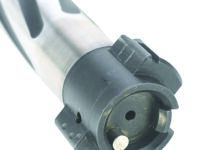
Swapping out the cylinder was faster with the Ruger because all that was required was to open the loading gate, press the left side of the base-pin latch, pull the base pin, and the cylinder could be removed. There was no need to place the hammer on half cock, as was required with the Colt. We also felt the Ruger base pin gave the operator more grip to pull it out from the frame. The Ruger did not use a cylinder bushing like the Colt. This bushing is a holdover from black-powder cartridge days that allowed the cylinder to rotate even if fouled with black-powder residue. We suppose this could pose an issue with the Ruger if it is extensively fired using only black-powder cartridges. Testers with SAA experience preferred the bushing design of the Colt.
Also, the ejector head was small compared to the Colt, and it slid very close to the barrel. After an extensive shooting session, users had to make sure they did not burn their fingertips on the hot barrel when using the ejector. The Colt’s ejector system pivots away from the barrel and prevents singeing a finger.
At 15 yards, both pistols shot well and were accurate. There were no misfires, and all the ammo performed well. With Herter’s 45 Colt ammo in the Ruger, one tester was able to create one large hole with five shots at 15 yards using a rest. With the Winchester Super X 45 Colt, it was easy to keep all five shots inside a 2.5-inch-square aiming mark. We enjoyed shooting both revolvers.
Our Team Said: The Lipsey’s New Model Blackhawk was a good product, and our team noted that it was possible to buy two Ruger revolvers at $770 for the price of the Colt.