









Within Range of California Gun Laws
See reader feedback on pistols, rifles, handguns and more! Reader John S. took our list of 380 ACPs to his local gun store in the Golden State, but his results were far from golden. Mare's Leg pistols are in fact legal for sale in California. Not all home building materials take bullets equally. And pistols that look like rifles. Lots of them.

Handgun Bullets: How Do They Penetrate in Home Materials?
An important consideration in home defense is the prospect of the penetration of a wall by an errant projectile. The primary objective in a defensive situation is to destroy tissue that is vital to the adversary's mobility. Only when an object or projectile strikes vital neural pathways (brain, spine, some nerve groups) or major blood pipelines (heart, lungs, some arteries and veins) that cause rapid blood loss will the pressurized system of the human body shut down. The primary responsibility of the home defender is to strike the target. Letting go with a round when you do not have a reasonable expectation of hitting the target isn't a responsible action. Still, being human, we may miss the target, so it's wise to know what a projectile (bullet, slug, or shot) may do when it connects with common building materials. Also, besides being responsible for every round we shoot, one of the raters in this test pointed out that the defensive shooter may also like to know what he can expect of materials that might hide or protect him if he or a loved on is under fire from an intruder.
To find out how handgun projectiles reacted to impacts on various materials, we first fabricated wall segments with commonly found wallboard and pine boards, then fired a few hundred rounds of ammunition to destroy the structures. At the end, we came up with common-sense recommendations that can solve the problem of overpenetrating handgun bullets that might be used in home defense. Remember, these tests cannot be compared to the FBI test program. The FBI was looking for penetration. That agency needed loads that would reasonably be expected to penetrate light cover and still strike a heavy blow. We were looking for handgun loads that don't meet the well-known FBI penetration criteria.
22 LR Pistols Based on Rifles From Ruger, MRI, and Mossberg
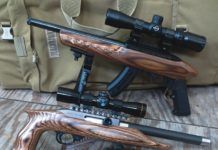
The Ruger 10/22 rifle is the most customizable semi-automatic rimfire rifle on the market. In fact, some manufacturers have taken 10/22 rifles and radically converted them to make highly accurate target rifles or built in internally-suppressed barrels for low-noise shooting. Some have molded shells to make the 10/22 look like an M1 Carbine or a Thompson submachine gun, while others have made them into pistols, as this test recognizes. By reconfiguring the buttstock into a pistol grip and reducing the barrel length, the same receiver is used to create an entirely different class of pistol. We wanted to take a look at these pistols, two derived from a Ruger 10/22 and one from the Mossberg 702 Plinkster, to see what they offered other than just an abbreviated variant of a long gun.
We secured a slightly used model of Magnum Research's Picuda that was mounted with a fixed 4x-power Leupold scope (#58750; $440). Ruger debuted its own 10/22 pistol in 2008, calling it the Charger, and ended production in 2012 — only to reintroduce a revised variant in 2015. The original Ruger Charger was very similar in appearance to the Magnum Research Picuda, while this new Ruger 22 Charger we tested is more refined, with plenty of features to like. Mossberg's 715P pistol came out in 2014. While the Magnum Research and Ruger are similar since they share a similar operating system, their design appeals to shooters and hunters who desire precision shooting, while the Mossberg is made to satisfy plinkers.
All three pistols use a simple blowback mechanism that is the same mechanism as used in the rifle. The pistols look ungainly since they use the same receivers as the rifles. The barrels, however, are cut down in all three models. The Magnum Research and Ruger reconfigured the rifle stock to a pistol grip sans buttstock. Though the Ruger and Magnum Research grip/stock were similar, the Ruger offered more options, so a shooter can set up the pistol to suit his shooting needs.
To make the 715P, Mossberg basically takes a 702 barreled action and sandwiches it between two polymer halves to give the pistol the appearance of an AR-15 pistol. The similarity to an AR pistol is only cosmetic, as the 715P functions just like the 702. Consider it a sheep in wolves' clothing. The Charger 22 and Picuda come optics ready, requiring a user to invest in a optic and rings. A Weaver rail is built into the Magnum Research pistol, while the Ruger comes with a Picatinny rail screwed into to the receiver. We mounted a BSA Edge 2-7x32mm pistol scope (#PS27X32; $140) on the Ruger. The Mossberg has open sights and is good to go out of the box, but to keep the playing field relatively level we added a CenterPoint Tactical 30mm Enclosed Reflex red-dot optic (Model #72601; $30). Mossberg offers a red-dot sight as an option on other 715P models. The CenterPoint optic co-witnessed with the top quarter of the iron sights on the 715P, which we liked. The rail on the Mossberg looks like a Picatinny/Weaver style, but it is not, as we discovered when mounting the CenterPoint Tactical red dot. Here's more about what we discovered about these rimfire rifles converted to pistols.
Springfield 9mm 1911s: Loaded Versus Range Officer Showdown
There are many good reasons for purchasing a 1911 in the non-traditional 9mm Luger cartridge. Compared to 45 ACP, 38 Super, and 10mm, 9mm Luger ammunition is less expensive and easy to come by. Also, the 9mm is only improved when fired from the 1911, with that platform's solid ergonomics, reliability, and distinctive appearance. In a 1911, the 9mm is easy to shoot well, despite a history in which 9mm target guns were seldom as accurate as a properly set up 45. As it turns out, the 9mm 1911 with modern ammunition is plenty accurate. Some shooters might also worry that 9mm 1911s might be less reliable, but we can only say that in our small sample of hundreds of rounds, two tested 1911 9mm handguns were reliable.
Where do such guns fit in? For one, the 9mm 1911 is a great target and competition handgun. Just as a cowboy-action shooter may choose a 38 Special SAA for economy and low recoil, an IDPA shooter may find the 9mm affords economical practice without creating waves in the arm from recoil. The self-defense shooter need not worry either, because with +P loads, the 9mm is no slouch in the wound-ballistics department.
We have had calls to choose between two closely matched stablemates from Springfield Armory, and both the Loaded Target PI9134LP and the Range Officer PI9129LP are traditional full-size 9mm pistols. This simply means that they are based upon the 45 ACP's frame. They are very similar to 38 Super pistols, save for a breech face of 0.384 versus 0.405 inch for the 38 Super. By changing a barrel and opening the breech face, the 9mm pistol may be converted to 38 Super. As you may imagine, converting a 38 Super to 9mm is a bit easier since the larger breechface usually works okay with both cartridges. (Exceptions: The Para USA LDA 9 and the Springfield EMP 9mm are 9mm pistols that are a bit smaller in dimension than the full-size Springfield pistols. They cannot be converted to the 38 Super.)
The full-size 9mm handguns are designed to fill a niche for those favoring the 9mm, or those simply wishing to own a lighter-kicking 1911 than one chambered in 45 ACP or 40 S&W.
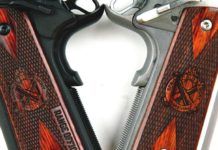
The 9mm Range Officer has the same forged national match frame and slide as the Trophy Match and TRP 1911s. It gets the same precision fit as those more expensive pistols, Springfield says. Likewise, it uses the same match-grade stainless-steel barrel and bushing and is topped with a fully-adjustable rear target sight. This is a great help to us in adjusting point of aim to point of impact when we're shooting different bullet weights. It has a single-sided thumb safety.
The Loaded 9mm Stainless Steel has a polished finish on the flat surfaces and bead-blasted matte finish on the rounded areas. The 5-inch barrel is a match-grade stainless steel unit. The slide features slanted serrations on the front and rear, where the RO has only rear cuts. The mainspring housing is flat and includes the company's integral locking system, or I.L.S., which replaces the mainspring housing of the handgun. When engaged, the I.L.S. prevents the hammer from moving by locking the mainspring cap, making the gun inoperable. Elsewhere, the pistol has a lightweight Delta hammer and a beavertail grip safety with raised memory pad for positive engagement. The extended thumb safety is ambidextrous, and its long aluminum match-grade trigger separate it from the RO. The pistol is fitted with a two-piece full-length guide rod. The grips are held in place with Torx grip screws that look nice and distinguish it from the RO.
During the evaluation, both handguns were field stripped. Interestingly, the Range Officer slide easily slipped on the Loaded Model Frame. The Loaded Model slide, however, was too tight on the Range Officer frame to function. Since modern 1911 handguns are not disassembled and thrown into a barrel on Guadalcanal for cleaning, then assembled regardless of original set up, this is acceptable and also interesting. The Range Officer seemed to have the tighter barrel bushing lockup. The barrel was a tight fit overall. We were surprised that the barrel bushing was only finger tight with the Range Officer.
But what matters is the shooting, and what our team found is that these 1911s chambered in 9mm Luger make for a very pleasurable shooting experience. An accurate 1911 in 9mm is even more enjoyable. Here's more of what we learned about them when firing them side by side:
Convertible Flattops: Lipseys Blackhawk and New Frontier
Colt started to put adjustable sights on its single-action revolvers around 1890 to fill a need for target shooters. Most single actions of the day, and, in fact, to the present, feature simple fixed sights; a blade front and rear consisting of a groove milled along the top strap. These sights suffice for most shooters, though some Kentucky windage and elevation are required with some models that did not shoot to point of aim. Adjustable sights take out the guesswork since they can be adjusted to any load being fired. Colt named the single action with adjustable sights the Flattop Target Model, and these First Generation revolvers were shipped from 1888 to 1896 with fewer than 1,000 made. Obviously, they are quite rare. Bisley models were also offered as Flattop Target Models, and even fewer of these models were produced. What these first Flattop revolvers featured was a replaceable front-sight blade to adjust elevation and a rear sight that was drift-adjustable for windage. Since the rear sight groove was not needed, the top strap of the frame was machined, flat hence the name "Flattop."
The two flattops we tested recently were a used Third Generation Colt New Frontier and a new Lipsey's exclusive Ruger New Model Blackhawk. Both wore aftermarket grips, and from outward appearances, looked nearly identical. What piqued our interest in these two revolvers was they were also convertibles with an extra cylinder. One cylinder was chambered in 45 Colt (sometimes called Long Colt to ensure it doesn't get confused with a shortened pronunciation of Automatic Colt Pistol) and the other was chambered in 45 ACP. Both cartridges are very popular, and 45 ACP made these six-shooters compatible with ammo normally used in a semi-automatic pistol.
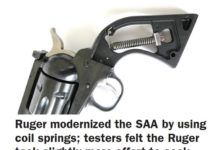
The operating systems of each revolver are what distinguish them. The New Frontier is an old-school single action with no built-in safety, so it must be carried with the hammer resting on an empty chamber to guard against discharges if dropped. The Ruger New Model Blackhawk incorporates a transfer-bar safety mechanism that allows the revolver to be carried with all chambers loaded. The Colt uses a flat mainspring and flat springs throughout, and the Ruger uses a coiled mainspring as well as coiled springs throughout.
We used a revolver range rod and rod head combo from Brownells in 45 Auto/45 Colt (080-617-045WB, $42) to check each chamber for alignment with the bore. We found no issues. Next we looked at headspace—the space between the recoil shield of the frame and the rear of the cylinder—and assumed all would be fine since the Ruger was new the Colt looked unused. Again, our assumption was confirmed with Clymer No-Go gauges from Brownells in 45 Auto (184-000-041WB, $60) and 45 Long Colt (184-100-511WB, $30). Both cylinders for both revolvers have non-rebated cylinders. The headspace check process was a bit different for each revolver. For the Colt, we put the hammer on half-cock and opened the loading gate; for the Ruger, we just had to open the loading gate and drop the No-Go gauge into a chamber. If correct, the gauge stops the cylinder's rotation. This was repeated with all 24 chambers;12 for both 45 Colt cylinders and 12 for the two 45 ACP cylinders. With the Colt, the No-Go gauge is removed only after removing the cylinder. The process is tedious, but it's warranted to ensure the safety of a used revolver. The Ruger has a reversing pawl, like Ruger's Vaquero models, so the process is quicker. So is unloading the Ruger, but we'll get to that. Finally, we checked the cylinder-to-barrel space, aka cylinder gap, using a Brownells feeler gauger (606-950-252WB, $28). The space should spec out between 0.004 to 0.006 inch. We found the dimension on the Colt was 0.007 inch for each cylinder. On the Ruger, the 45 Colt cylinder gap measured 0.005 inch and the 45 ACP cylinder was 0.006 inch.
With the pistols all checked out, we were then able to get to the fun part and begin shooting them. Here's how that went:

Tactical 1911 Pistol Shoot Out: SIG Sauer Vs. Smith & Wesson
The 1911 handgun has survived for more than one hundred years based on excellent ergonomics, great reliability, and its ability to chamber a fight-stopping cartridge. Modern 1911 handguns are much evolved from the Colt 1911 first issued to Army troops in 1911. However, a doughboy going to Europe in 1917 would be able to instantly load, make safe, fire and use a modern 1911 handgun. The ability of the platform to accept a weapon-mounted light was an inevitable part of the 1911's evolution, because a gun-mounted combat light is a good tactical addition. They allow for the identification of a threat, illumination of an area, and make fail-safe identification possible.
Two so-equipped full-size 1911s are the SIG TACOPS and the Smith & Wesson 1911TA E Class. The SIG Sauer 1911 TACOPS 1911R-45TACOPS, $1213 list, is a no-nonsense black tactical pistol. We found it at DefenderOutdoors.com for $1,080, at BudsGunShop.com for a cash discount price of $1,062, and for $910 at GrabAGun.com. Our test gun is part of the larger SIG 1911 family, which at our last count, had 31 members. Generally speaking, SIG 1911s have done very well in our evaluations. In the October 2014 issue, we graded a 1911 Carry Scorpion 1911CAR-45-SCPN as a B+. In the November 2013 issue, a 1911 Carry Stainless 1911CA-45-SSS earned an A- grade and a "Best Buy" nod. In the February 2009 issue, a 1911 C3 No. 19GS0031 earned an A grade. In the May 2006 issue, a Sigarms 1911 GSR No. 19GS0001 earned a Conditional Buy, mainly because of its price, not its functionality. We'd translate that to a B+ today.
S&W's SW1911 "E" Series pistols are supposed to be "enhanced, with tight tolerances, precision-fit trigger, chamfered and recessed muzzle, "fish-scale" scalloped slide serrations and other premium features commonly found on custom-made firearms. The standard E-series 1911s come in blued or stainless steel, and the model number with "SC" appended have scandium-alloy frames. The blued version we tested is #108409, while the stainless model is #108411. List for our test gun is $1399, and we saw it for sale at DefenderOutdoors.com for $1140, TombstoneTactical.com for $1099, and at BudsGunShop.com for $1065.
Smith 1911s have not matched SIG's level of performance in our tests. In the April 2010 issue, the S&W Model SW1911 No. 178017 in 9mm got a B+. A 45 ACP Smith & Wesson MSW1911 No. 108284 earned a B+ in the February 2010 issue. In March 2006, a 1911SC No. 108289 got a "Don't Buy" rating, as did a 1911PD No. 108296 tested in the November 2005. Way back in April 2003, we tested the first-year version of the company's 1911 and said "Buy It" to a Smith & Wesson 1911 45 ACP.
But history isn't necessarily destiny at Gun Tests. Out of the box, the Smith & Wesson had more bling and eye appeal, no denying that. And at the heart of each pistol was a tight barrel-to-slide fit, which provided X-ring accuracy without sacrificing reliability. Just like you, we prefer to shoot good guns, and what we found here were two pretty good ones, though our team had its preference at the end.
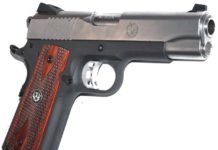
Rugers Lightweight Commander
Colt still makes the Lightweight Commander (O4860XSE, $1104), but no longer makes one of our favorite carry guns, the CCO, or Colt Concealed Officer's model. We thought this Ruger looked enough like the Colt CCO that a comparison was in order. In this first-look report, we take a good look at the new Ruger and briefly see how it stacks up to a custom CCO on hand.
We shot the Ruger with 230-grain FMJ "hardball" by Black Hills and Winchester, Winchester's 200-grain BEB, and with Federal 185-grain JHP Hi-Shok. We tried a few rounds of Cor-Bon 185-grain JHP, but found the recoil to be much too fierce. Here's what we found from our first look at the new Ruger.

Light-Recoil 45 ACP Loads
The road in life isn't always straight and narrow. It can be winding and even out of control. Some changes are unwelcome, even fearful. Among the significant changes as we age is a loss of muscle mass. Shooters who once handled hard-kicking handguns now find them ever more difficult to handle. Arthritis and a culmination of old injuries make firing the big-bore pistol difficult. These individuals, along with young shooters who have adopted a lightweight pistol such as a Colt Commander, and slightly-built female shooters interested in a low-recoil load, are faced with difficult decisions. Once the decision is made to take advantage of the big-bore 45 ACP handgun, shooters are seldom willing to back down to the 9mm.
(Ammunition Buying Guide Part 1 #2) Frangible Ammunition Testing
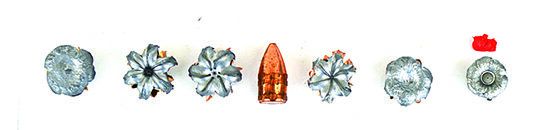
This feature report on frangible ammunition was instigated by questions from readers. Most of the questions were along the same line: Can such-and-such ammunition possibly do what they say it does? Can a chunk of lead, fairy powder, or depleted uranium or other secret element possibly increase the effectiveness of a handgun bullet in the manner stated?
The concept of frangible ammunition has been around for a long time, but that doesn't mean that it is completely understood. As an example, during our rush to collect as many examples of these loads as possible, we found that otherwise knowledge- able gun-store clerks were mistaken concerning exactly what we were looking for. One of the fellows was asked to order frangible loads from as many different makers as possible. When our ammo came in the following week the clerk had batted .500. Half of the ammo was frangible, but the others were "lead free" loads, which are a different animal. We winced inwardly but paid up and smiled because this young man always gets the job done in a timely manner and is helpful in ordering the tons of ammunition we need every year.
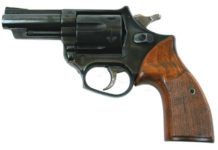
Are Used 357 Mags from Colt, S&W, and FN Worth the Money?
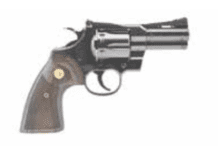
The 357 Magnum has an excellent reputation as a defensive round. On medium-sized game like whitetail deer at modest distances, it is effective as well. The round has been around since 1934; General George Patton carried an ivory-handled S&W 357 Mag during WWII. It is a versatile cartridge with many bullet types offered by a variety of manufacturers. Plus, 38 Special ammo in standard and +P loadings can be used in a 357 Magnum as a low-recoil alternative when training or plinking. We wanted to see if we could find a bargain in a full-size revolver with a 4-inch barrel that we could use for personal protection, and we came across two such contenders, a Smith & Wesson Model 19-4 that rated about 90 to 95 percent and a Colt Trooper MK III that rated 80 to 90 percent. Both featured 4-inch barrels, adjustable sights, and wood grips. We also came across an uncommon choice in this chambering, an FN Barracuda, available in the 1970s on a limited basis. It is unique due to the availability of an interchangeable cylinder, which could be switched between 9mm Luger and 357 Magnum. Here's more about these interesting and affordable choices, along with our recommendations.

Polymer-Frame 9mm Shoot Out: P320 Versus PPQ M2 Vs. VP9
During the past few months, SIG Sauer, Walther, and Heckler & Koch have introduced pistols that feature striker-fired actions. These handguns are designed to compete for the hearts and minds of institutional buyers and concealed-carry-permit holsters as well. The improvement in rapid-fire combat shooting is provable, and absolute accuracy is improved over the original SIG P250, Walther P99 and HK P30. The question is, which handgun is the most improved and the best buy for the money — that is, the most reliable and accurate?
In this test of three 9mm striker-fired models, we were firing handguns intended for personal defense in the home, concealed carry, and practical competition. We are certain each maker is hoping to compete with Glock for institutional sales as well. At first glance, the handguns appeared similar. Each featured a polymer frame, a light rail, and similar sights. Each was relatively simple to operate. None had a manual safety as part of the design. Some features, such as the sights and the magazines, were similar. A casual shooter might sign off on all three handguns, but that isn't what we do.
Our shooters noticed the trigger actions were markedly different, and grip texturing and handling were considerably different. As the firing sessions progressed and the brass stacked up, the shoot out turned into a strong challenge between the Walther and the HK pistol. These worthy competitors traded places several times in the firing evaluations. The SIG P320 brought up the rear, in our estimation. Here's why:
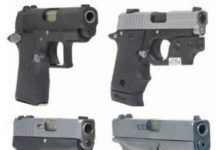
A Quartet of Pocket Pistols from SIG Sauer, Glock, Kahr, and Colt
Many concealed-carry customers pooh-pooh pistols chambered in 380 ACP as being underpowered for self defense, but they may well be in the vocal minority, because sales of 380-chambered handguns and ammunition continues apace, with more of the smallish sidearms finding their way into pockets and purses than ever before. It can be argued, in fact, that Glock kept seeing its rivals sell so many inexpensive-to-make pocket pistols that the Austrians were forced into the U.S. 380 ACP market with the G42 just so they could grab a slice of the ever-growing pocket-pistol pie.
At Gun Tests, we have mined this lode plenty ourselves, finding quite a few worthy pocketguns and pocketguns-plus over the years. We have previously given A grades to a new CZ USA Model 83 No. 91302, a Bersa Firestorm, a Colt Mustang Pocketlite, and a Kel-Tec P3AT. A half-grade down at A- grades have been the Ruger LCP-CT, a used Beretta Model 84 and CZ Model 83, a Ruger LC380 No. 3219, and a Taurus 738B No. 1-73803. Our new e-book on 380s, available on the Gun-Tests.com website, recaps those guns and six more B+ or B pistols, or you can search for "380 ACP" in the archives and pull up the entire list of such firearms we've evaluated over the years.
We think many consumers like these pistols because most of them are easy to carry and conceal, and they're willing to trade off the "carry everywhere" portability for slightly less power than some 38 Specials, for example. Our tests of several 380 ACP self-defense loads had three (Federal 90-gr. Hydra-Shok JHP, Speer 90-gr. Gold Dot JHP, and Fiocchi 95-gr. FMJ) that penetrated at least 13.5+ inches in water, very close to what a Remington 125-gr. JHP 38 Sp. +P did as a control — and not too many experts say the 38 Special is "too little" gun.
This round, we tested three brand-new models and one variation of a previously tested model as a reference point. The first of the new models was the Colt Mustang XSP Pocketlite Polymer O6790, MSRP $649, but which we found at ImpactGuns.com for $565 and $572 at BudsGunShop.com. Or Bud's would sell it for a cash price of $555. Next up was the Glock 42 Subcompact Slimline, MSRP $480, which SlickGuns.com had for sale at $490 plus free shipping. Bud's listed it for $437 or $424 cash. Kahr's CW 380 No. 3833, $419 MSRP, comes in at a $322 retail price at Bud's or a $313 cash discount price. At GeorgiaGunStore.com, the price was $312. The fourth entry was a P238 from SIG Sauer, No. 238-380-NBS12, with a hefty MSRP of $710 and a retail price of $498 from Bud's Gun Shop (but listed as out of stock the last time we checked), or $583 from TombstoneTactical.com or $520 from JoeBobOutfitters.com.
In more detail, the polymer Colt XSP is one of two Mustangs in the company's 380 line. Colt ceased production of the Mustangs in 2000 then reintroduced the line in 2011. The new guns are designed to accept original parts. Both have stainless-steel slides, measure 5.5 inches in length, have 2.75-inch barrels, and operate with short single-action trigger function, or like miniature 1911s. The Mustang Pocketlite has an aluminum frame, while the XSP, introduced in 2013, has a lightweight polymer skin. According to company specs, the polymer XSP is about an ounce lighter than the Pocketlite.
The new Glock 42, made in Georgia, is a slimline subcompact pistol and is the smallest pistol Glock has ever introduced, but it's not the company's first 380 Auto. The Glock 25 was introduced in 1995 in Germany as a small-dimension firearm for markets where civilian personnel are not allowed to possess handguns featuring military calibers. In the USA, the G25 is reserved for law-enforcement agencies only. Like the G25, the Glock 28 is reserved for LE. The G25 is 7.36 inches long, 5 inches tall, and has a capacity of 15+1. The G28 is 6.41 inches long, 4.7 inches tall, and has a capacity of 10+1. Both are noticeably larger than our tested G42, which was 5.94 inches long, 4.13 inches tall, and has a capacity of 6+1. Marketed for pocket carry and to shooters with smaller hands, the single-stack G42 lacks the interchangeable backstraps of other Glocks, but field-strips the same way as other larger Glocks.