








Is Rugers New Gunsite Scout Rifle a Pretender, or Contender?
Some decades back, the late John Dean "Jeff" Cooper came up with a concept for what he ultimately called a "scout rifle." This was intended to be an all-around rifle, capable of being used for hunting, but especially useful for the lone military scout (an ancient term). The precise details of this light bolt-action rifle concept have been listed here and there over the years. Some of the specs included 308 caliber, minimal length and weight, a forward-mounted scope, possible provisions for clip loading, a suitable sling, and numerous other features that had great value to the late Mr. Cooper and his fans. After years of searching for the best solution, and the construction of several custom rifles that came close to Cooper's ideal, along came Steyr, which incorporated most of Cooper's rifle ideas into the Steyr Scout, which actually had Jeff Cooper's personal monogram on it. The Steyr Scout rifle so pleased Mr. Cooper that, so far as we know, he ceased his efforts to find a better version of his concept. But that did nothing to stop other makers from coming up with rifles that vaguely approximated some of the scout-rifle features, and of course these had the "scout" name attached to them.
Ruger has offered several short 308 rifles, including one a few years ago that also had provisions for a forward-mounted scope. The Frontier rifle was heavy and generally had none of the better features of the Steyr. Savage also has a scout rifle, and we have a test scheduled on one of those in the near future. But now Ruger has again come out with a scout rifle that looks a lot more like it. It even bears the name of the rifle range that Jeff Cooper began—Gunsite—in Arizona. The new Ruger is called the Gunsite Scout.
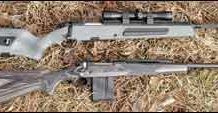
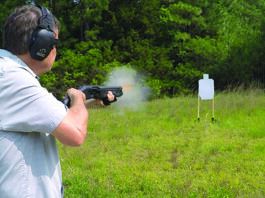
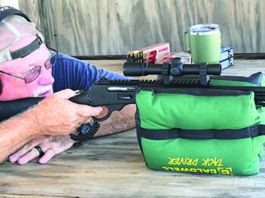
We thought it would be interesting to compare the new Ruger Gunsite Scout (MSRP $995) with the established and still available Steyr Mannlicher Scout rifle (MSRP $2975 in the limited-edition Jeff Cooper Commemorative package). We checked pricing on AuctionArms.com and found no listings for the new Gunsite rifle. One seller, Northwest Armory in Portland, had two Steyr Scouts in 308 Win. listed with a buy-it-now-price of $1881.
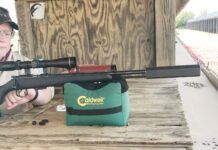
One of our staff loaned us his original Steyr JC Scout for this test. We shot the two rifles with a mixed batch of recovered military ball ammo, with Winchester Match, Hirtenberger 150-grain JSN, and with a handload featuring a 150-grain soft-nose bullet. Here's what we found.
Henry Lever Action Octagonal No. H001TV 17 HMR
Pyramyd Air Sponsors Air Gun Range at NRA Annual Meeting
Browning X-Bolt Medallion No. 035200227 7mm Rem. Mag.
Videos on GunReports.com!
Classic Police Self-Loaders: Model 8 Versus Model 1907
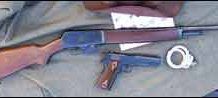
Around the turn of the previous century there was a rapid advance in firearms design. Among the great changes was the popularity of self-loading rifles. While the lever-action rifle and the single-action revolver were used by Western lawmen well into the century, officers confronting armed gangs felt a need to get themselves on a level playing field with the criminal element. A relatively short and handy self-loading rifle was just the ticket for use against thugs armed with a variety of weapons and traveling in sheet-metal vehicles. The rifles we are comparing in these pages also had sporting use, and they were used widely by outdoorsmen. But cops, federal agents, and prison guards were the primary users of these firearms. The Remington Model 8, in particular, was used by hunters, and remains popular as a Northeastern woods gun. The Winchester 1907 saw considerable military use. Several thousand were used in World War I, a drop in the bucket compared to some designs, but important for Winchester.
Videos on GunReports.com!
Historical Winchester Model 1886 Short Rifle Now Available
Gun News from Around the Web: Feb 28, 2011

NRA-ILA List: National Anti-Gun Organizations, Celebrities, Businesses, and Journalists
French MAS Semiautos: History-Making Rifles Compete
Long before WWI the French were hard at work on semiauto rifle designs. Unfortunately they didn't have much in production at the start of the Great War, so they fought that war largely like the rest of the world did, with bolt-action rifles. It was not until 1949 that France had its own successful semiauto rifle in the MAS, chambered for the 7.5x54mm cartridge, which is similar to the 7.62 NATO round. That rifle was designated the Model 1949, and it incorporated some features of the bolt-action Model 1936, including its cartridge, rear-sight arrangement and two-piece stock. Later modifications developed the M1949 into the Model 1949-56. For this report we acquired one of each type from Collectors Firearms (www.collectorsfirearms.com), the M1949 chambered for the original cartridge and the ‘49-56 rechambered by some arsenal to 7.62 NATO. The French cartridge is a bit longer and very slightly fatter than the NATO cartridge, so we presume the barrel had to be set rearwards to effect the conversion.
MAS stands for Manufacture Nationale d'Armes de St-Etienne. This is a gas-driven design that would be familiar to the fans of the various AR-15/M-16 rifles. The gas tube impinges directly on the bolt carrier, blowing it rearward with each shot. There are no moving parts, like pistons or pushrods, in the gas system.
Although the rifles had essentially the same actions, the M1949 had only a stacking lug at the front and no muzzle brake, presenting what amounted to a naked barrel muzzle. The ‘49-56 had a grenade launcher, muzzle brake/flash hider, and folding grenade sights. The rear sight on each rifle was an aperture, adjustable upward from 200 to 1200 yards. The front blade on the M49 was a fixed post, but the later rifle had an elevation-adjustable front post.
The detachable magazines had their clasp as part of the magazine, a simple and rugged system that locked into a notch cut in the right side of the action. The 10-round magazines were interchangeable between our two test rifles. Apparently higher-capacity magazines have been available for the MAS rifles. The original parts kits issued with the rifles apparently were well thought out and included critical spare parts, magazines, bayonet, cleaning stuff, and for some, a compact 3.9X scope. All the MAS rifles have a rail on the left side of the action permitting easy scope mounting.
The later rifle had a larger trigger guard, permitting firing with gloves. Both rifles had a simple leather sling attached to the left side of the rifle. The 49-56 had a black slip-on recoil pad, apparently original issue.
Each rifle had a two-piece hardwood stock with a wood hand guard covering the forward part of the barrel and the gas tube. The woods were plain walnut and birch. The safety consisted of a lever located to the right front of the trigger guard. In the safe position it partially obscured the trigger opening, which was more obvious for right handers. Both bolts had a serrated white plastic covering on the bolt knob. The actions were solid, well-made, nicely machined items that looked to be extremely strong. There were no plastic nor flimsy metal parts anywhere on either rifle. These were serious war-time rifles made to work and to last.
Takedown for these rifles was remarkably simple. After clearing the rifle, remove the magazine and let the slide go forward. Then slide the large button at the rear of the receiver downward, toward the wrist of the rifle. Press forward on the top-rear portion of the action, which is the cover, and when it moves just over half an inch toward the front of the rifle it can be lifted off toward the rear, releasing tension on the recoil spring. Then slide the bolt carrier rearward until the bolt and carrier are all the way back, and they can then be lifted out. That's it. With a normal cleaning rod the barrel must be cleaned from the front. For reassembly reverse the process. You have to fight the spring a bit, but it's an easy job. If you have to remove the trigger assembly, you'll need a screwdriver to remove a slotted screw at the rear of the trigger guard.
Largely because of extremely poor winter weather, we tested the two rifles with one type of ammo each. For the Model 1949 we used Serbian Prvi Partizan 139-grain FMJ, and for the 1949-56 we used Magtech 150-grain FMC. Here's what we found.