










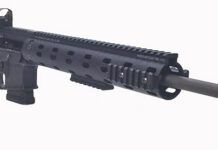



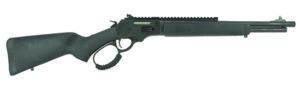
More than a century and a half after the introduction of lever-action rifles, the American shooting public seems to be discovering these guns anew. And the latest craze is the tactical lever gun — something we would have called an oxymoron in years past. Now, we see the usefulness of the concept. New lever-action models bring different stocks, threaded muzzles, and better sights to the platform, so we grabbed samples of two of the most interesting tactical lever guns chambered in 30-30 Winchester to test. The first is the Rossi R95 Triple Black 953030161TB, $950. Unlike Rossi’s more conventional lever guns, this model brings an adjustable peep sight mounted on a Picatinny rail, a brass-bead front sight, a large-loop lever, and is threaded for a suppressor. Then we added the Marlin Model 336 Dark 70902, $1260, which sports a redesigned loop, a polymer stock with a good recoil pad and M-Lok slots, along with an octagonal fore end also festooned with M-Lok slots.
Optics
We realize that a lever-action 30-30 will never be a long-range precision rifle, but we wanted to see what these rifles could do beyond what iron sights or a red dot could deliver. So we made the decision to use low-powered optics and saw at once that was going to cause some problems. The rifles’ taller rear sights — that we really liked — sit right where we need to mount the ocular lens of the scope. But we found two good solutions that would work for us.
The first was to use a standard LPVO scope in high rings. We grabbed a Vortex PST II 1-6×24, $600, from our battery. This is an optic we’ve used many times with great results. Possessing very clear glass and a great reticle marked in 1-mil stadia lines, the 1-6 magnification gave us everything we needed. We used A.R.M.S. rings (ARMSMounts.com, $219) that lifted the optic above the line of the sights and almost pulled our cheeks off the stock. Marlin, in its wisdom, included a cheek riser in the package that allowed at least a good chin weld, if not a full cheek weld.
We also tested a Burris 2.75x20mm fixed-power extended-eye-relief optic (BurrisOptics.com, $350). Mounting it forward of the rear sight in a scout-scope style, we were able to keep our heads in a much more natural position. For this test, we actually liked the Burris better because it delivered low-head-position both-eyes-open operation. That said, while we would have been fine taking the lower-powered Burris afield, we didn’t feel that it provided enough magnification for testing. Accordingly, we used the Vortex for accuracy tests on both rifles.
Rossi R95 Triple Black 953030161TB 30-30 Winchester
$950
Gun Tests grade: B+
We thought the Rossi was a bit smoother to operate than the Marlin, but the R95 did not have M-Lok slots and was not as accurate as the Marlin. But it didn’t miss it by much.
| Action Type | Lever |
|---|---|
| Overall Length | 35.25 in. |
| Barrel Length | 16.5 in., 1:12 twist |
| Overall Height w/o Scope Mount | 8.0 in. |
| Weight Unloaded | 6.78 lbs. |
| Weight Loaded | 7.06 lbs. |
| Sight Radius | 18.25 in. |
| Action Finish | Black oxide |
| Barrel Finish | Black oxide |
| Magazine Capacity | 5 |
| Magazine Type | Tubular |
| Stock | Wood |
| Drop at Comb | 1.0 in. |
| Drop at Heel | 1.5 in. |
| Buttplate | Rubber |
| Length of Pull | 13.75 in. |
| Receiver Scope-Base Pattern | Picatinny rail |
| Trigger Pull Weight | 2.54 lbs. |
| Safety | Crossbolt |
| Warranty | 1-year limited |
| Telephone | (800) 948-8029 |
| Website | RossiUSA.com |
| Made In | Brazil |
Rossi, out of Brazil, is part of the conglomeration that brings us Taurus firearms, and the Rossi Model R92 Puma is a nice alternative to the current Winchester 92s made by Miroku in Japan. With their pistol-caliber carbines so very popular in Cowboy Action Shooting, we wanted to see what the Rossi Model 95 replica could do.
Just like the Marlin, Rossi starts with a barrel just long enough to be legal at 16.5 inches with a 1:12-inch twist. Measuring 0.655-inch just behind the flare at the muzzle, the R95 is slightly narrower than the Marlin. Even with slight differences in profile and materials, the Rossi weighs in less than 2 ounces different than the Marlin.
The barrel is narrow enough that Rossi added a slight flare at the muzzle to allow for the 5⁄8×24 thread and a good shoulder for the thread protector, muzzle brake, or suppressor to butt against.
Rossi offered a slightly different take on the sights, and we liked what we saw. The brass-beaded front sight is mounted on a sturdy base and is drift adjustable. The rear sight, as with the Marlin, is mounted on a Picatinny rail. The Rossi unit is a peep sight utilizing a smaller aperture than the Marlin. The Rossi sight clamps to a sliding dovetail on the rear of the Pic rail. Loosening a set screw allows it to move fore and aft along this slanted piece to effect changes in elevation. The Pic rail is secured by four screws, one of which decided to launch itself somewhere out into the universe during our testing. We noticed that our groups were shifting substantial distances left and right while recording a group on both sides. We investigated and found the forwardmost screw missing. We also found that when we torqued down the other three screws, we could proceed with our testing just fine.
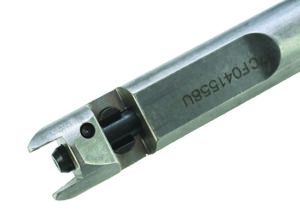
The action looks like a Marlin Model 95, but then it doesn’t. The R95 still has the solid top on the receiver with the ejection port opening to the left side. The lever still attaches to a triangular piece just below the bottom of the receiver. The Winchester, in contrast, uses a slick-bottomed receiver with the closed hinge being tucked inside the receiver. The extractor on the Rossi is pinned to the bolt and hinges in operation, while the Marlin uses a ring that clamps around the bolt body. As with the Marlin, the Rossi uses an ejector that looks something like a leaf spring and fits into a recess on the receiver wall inside of the bolt. Be careful in disassembly because this can fall out when the bolt is removed. Also, where the Marlin uses a two-piece firing pin where the parts don’t mate up until everything is closed properly, the Rossi uses a single-piece firing pin that has two falling pins — one on either side — that lifts up and out of the way when the bolt is properly in battery, thus releasing the firing pin.
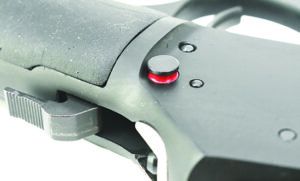
Other details jumped out at us as well — like the enlarged loop along with the paracord wrap. We found the lever to be very smooth and comfortable to operate. As with the Marlin, we found the loading gate to be properly finished. Gates with sharp edges can shave the cartridges going into the magazine. The hammer was the spur type we expected and was easy to manipulate through all three positions. This would be an easy rifle to carry on half-cock, thumbing the hammer back to the firing position as necessary. Of course, even with the half-cock notch, there is still a crossbolt safety located between the hammer and the trigger. Moving it right to left disengages the safety and exposes a red ring that advertises the state of that safety. The magazine is a five-rounder and is well protected by the fore end. This Rossi also provides conventional sling-swivel studs located on the toe of the stock and the forward barrel band.
The stock is wood and is slightly more hand filling than the Marlin. Painted a matte black, Rossi added a gloss-coat spiderweb pattern that lends a good purchase to the hands. The end is capped with a good recoil pad.
This test group has admitted numerous times that we are trigger snobs, and this Rossi gave us a great reason to grin. Once cocked, the trigger required virtually no take-up prior to compression — but neither did the Marlin. The smiles came with a trigger that required barely 2.5 pounds of compression. We don’t remember seeing that in a lever action before. Kudos to Rossi.
During the shooting tests, we noticed that we had lost a mounting screw on the forward part of the Picatinny rail. We never found that screw, but we tightened down the remaining three screws and the tests went on just fine. Average group size was about 0.15 inch larger than the Marlin, with everything clustering around the 2-inch mark. The best performing ammunition — barely — was the Barnes 150-grain load, with the best individual group coming from the Hornady 160-grain FTX load at 1.4 inches.
Our Team Said: Feeding and function were perfect, with the Rossi’s lever operating a bit more smoothly than the Marlin in our opinion. The Marlin held the edge in accuracy and in upgrades, but the Rossi is a good gun at a better price.
| 30-30 WINCHESTER RANGE DATA | ||
|---|---|---|
| Barnes Pioneer 150-grain TSX FN FB | Marlin 336 Dark Series | Rossi R95 Triple Black |
| Average Velocity | 2189 fps | 2087 fps |
| Muzzle Energy | 1596 ft.-lbs. | 1452 ft.-lbs. |
| Best Group | 0.85 in. | 1.73 in. |
| Average Group | 1.53 in. | 1.95 in. |
| Hornady LEVERevolution 160-grain FTX | Marlin 336 Dark Series | Rossi R95 Triple Black |
| Average Velocity | 2265 fps | 2156 fps |
| Muzzle Energy | 1824 ft.-lbs. | 1651 ft.-lbs. |
| Best Group | 1.21 in. | 1.40 in. |
| Average Group | 2.08 in. | 1.99 in. |
| Federal Power-Shok 170-grain JSPRN | Marlin 336 Dark Series | Rossi R95 Triple Black |
| Average Velocity | 2092 fps | 2001 fps |
| Muzzle Energy | 1653 ft.-lbs. . | 1512 ft.-lbs |
| Best Group | 1.94 in. | 1.46 in. |
| Average Group | 1.97 in. | 2.19 in. |
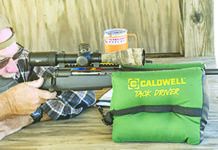
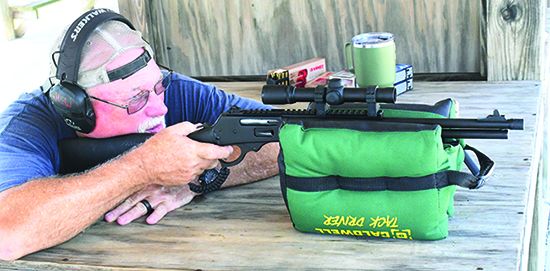
We tested with a variety of ammunition that would cover the spectrum of weights commonly used for whitetail hunting. We started with Barnes Pioneer 150-grain TSX Flat Nose Flat Base 32137 all-copper hollow points. Then we moved up to Hornady LEVERevolution 82730 160-grain FTX rounds, and topped off our list with Federal Power-Shok 30308 170-grain jacketed soft-point round-nose ammo. We test-fired at American Shooting Centers in Houston using a well-sandbagged Caldwell TackDriver Pro (Brownells 100-027-023, $49), further supported by a Tab Gear large rear bag, heavy (TabGear.com, $34). We used a Garmin Xero C1 Pro chronograph (Garmin.com, $600) to measure velocities. We used a Vortex Viper PSTII 1-6×24 scope for all the accuracy shooting.
Written and photographed by Joe Woolley, using evaluations from Gun Tests Team members. GT