












Compact 44 Rem. Mag. Rifles: Rossi and Ruger Shoot It Out
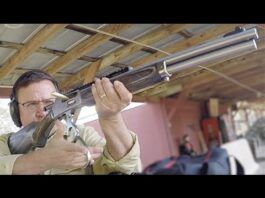
The 44 Remington Magnum has been a favorite hunting cartridge for some of our test team members who live in states where straight-wall cartridges are legal for deer hunting, but where short sight line conditions keep ranges way down. Chambered in short, carbine-length rifles, the 44 Rem. Mag. can be quick to shoulder, fast to shoot, and offer plenty of power. As one of our 44 Rem. Mag. hunters said: "They make big holes and leave a nice blood trail." These rifles are lightweight and make for easy carry. In brush-choked terrain when pushing deer, sitting in tree stand for a black bear, or waiting on pigs to wallow, these carbines offer power, and in lever-action models, super-fast follow-up shots. They can also make a good truck gun.
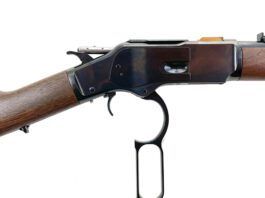
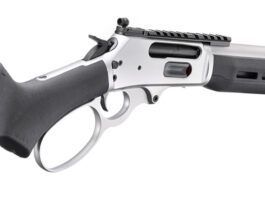
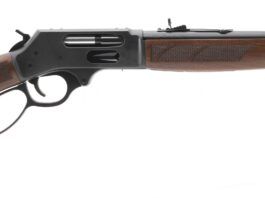
While lever-action 44 Rem. Mag. carbines are common, we wanted to look at something different and assembled three candidates. To serve as a baseline, we chose the Rossi R92, a clone of the iconic Winchester Model 1892 and a good example of a typical lever-action 44 Mag. carbine with exposed hammer, iron sights and tubular magazine that's loaded via a loading port. The Ruger 77/44 is quite different. It is a bolt-action rifle and comes with scope mounts and detachable rotary magazine. The Ruger 96/77 is a lever-action carbine similar to the Savage Model 99. The hammer is enclosed in the receiver, it has a scope mount built into the receiver, and uses a detachable magazine. The 96/77 was produced from 1996 through 2004 and our test sample was lightly used. The R92 and 77/44 are both current production guns and easily obtained; used 96/44 models are also fairly easy to find, especially on online gun-auction websites.
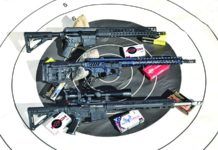
AR-10s in 308 Win. and 6.5CM: $995 E.R. Shaw Is a Best Buy
Many people would agree that the AR platform is the most versatile of all rifle designs. Created for military combat (as many sporting rifles were originally), Eugene Stoner's design can be long, short, scoped, topped with iron sights, and maintained by novice operators with just a short list of tools. Also, the design allows for a choice of cartridges, for it is the chambering that defines what it can effectively be used for. In this test, we pitted a gas-impingement-operated 308 Winchester AR-10 against a piston-operated 308 and a gas-impingement AR-10 chambered for what is becoming a popular standard cartridge, the 6.5 Creedmoor.
Our 308 Winchester AR-10s were the $3955 BDR10-3G Black/Blue Splash direct-impingement system and SIG Sauer's $3108 716G2 DMR piston-driven system. A new rifle from the makers of E.R. Shaw Barrels, the E.R. Shaw ERS-10 chambered for 6.5 Creedmoor ammunition was a direct-impingement firearm carrying a list price of $995.
We chose four different rounds for collecting accuracy data from the 100-yard line at American Shooting Centers in Houston. The 308 rifles were fed SIG Sauer's 150-grain HT and 168-grain Open-Tip Match (OTM) ammunition, and two rounds from Black Hills Ammunition. They were the 155-grain Sierra Tipped MatchKing (TMK) rounds and the 175-grain boat-tailed hollowpoints (BTHP). Our 6.5 Creedmoor selections for the E.R. Shaw rifle were Federal's 140-grain soft-point "Non-Typical" White Tail rounds and three varieties from Hornady. They were the 140-grain Extremely Low Drag (ELD) Match, 143-grain ELD-X Precision Hunter, and the 147-grain ELD Match rounds. For optics we relied upon our Steiner 4-16x50mm Steiner Predator Xtreme first focal plane scope mounted inside a pair of 30mm Warne rings atop a riser from Yankee Hill Machine. Let's find out which of our rifle trio was most accurate, reliable, and versatile.
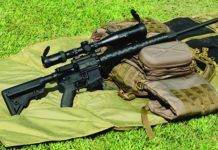
Bigger ARs: 6.5 Creedmoor, 6.5 Grendel, & 308 Winchester
The history of popular firearms in the 21st Century (so far) has been indelibly marked by the rise of civilian-owned AR-15 semi-automatic rifles. What most people don't know is that the system was originally intended to fire larger-caliber ammunition than 5.56mm or 223 Remington. Designed by Eugene Stoner, the AR-10 (the "AR" is short for "ArmaLite Rifle," not "assault rifle" as many non-gunners believe) evolved from the 7.62x51mm NATO chambering to smaller calibers for greater reliability and practicality; in particular, soldiers were able to carry more ammunition because the bullets and magazines were smaller and weighed less. The structure of the rifle itself could be made lighter as well without the fear of receivers cracking or pins working loose. In this last regard, such was the state of metallurgy and machining in the 1960s.
In today's manufacturing world, advanced technology provides for more exacting tolerances so that finished products are more consistent. And thanks to the space program and other factors, stainless steel and other metals are more malleable and durable than ever. With the Pentagon still chasing a more effective round than 5.56/223 and the public's thirst for a bigger bang, a return to larger calibers for the AR platform was inevitable. In this test we compare three different ways to project larger-diameter bullets. Our first test rifle (or carbine, if you will) was the $3999 MR762A1 from Heckler & Koch. As its nomenclature suggests, the MR762 fires 7.62x51mm ammunition or its American incarnation, 308 Winchester. From Core15 rifles in Ocala, Florida, we chose the $2470 Core30 Tac II chambered in 6.5 Creedmoor, which fired 0.264-inch-diameter bullets. Our third rifle also shot 0.264-inch bullets, but from a cartridge case short enough to be housed in the smaller AR-15 chassis. Alexander Arms managed to stuff Bill Alexander's invention, the 6.5 Grendel, into an AR-15 receiver and topped it off with a 24-inch-long barrel. List price of the Alexander Arms Overwatch rifle we tested was $1613.
For 6.5 Grendel shots of record, we chose 120-grain American Eagle, 123-grain Hornady A-Max, and Alexander Arms' own brand of ammunition topped with the 123-grain Lapua Scenar bullet. Our H&K MR762A1 was treated to 110-grain FB-tipped rounds from Noveske, 168-grain OTM rounds, and 150-grain HT rounds from SIG Sauer, plus a diet of Black Hills Gold 155-grain Tipped Match King ammunition. The Core30 rifle was loaded with all Hornady brand ammunition; the 129-grain White Tail Interlock, 140-grain ELD Match, 143-grain Precision Hunter ELD-X, and 147-grain ELD-Match rounds.
For optics we used both a 4-16x50mm Steiner Predator Xtreme scope and SIG Sauer's new Tango6 4-24x50mm scope. The Tango6 is a compact scope for its maximum power of 24x magnification. In our view, this makes it a good choice for semi-automatic rifles that already have a lot of mass top to bottom thanks to the pistol grip, and you don't want the rings or mount to put weight on the handguard. Both the Steiner and the SIG were first-focal-plane scopes so we could manipulate the size of the reticle. We especially liked using the small dot in the center of the Tango6 reticle. Not really visible until reaching 8x magnification, we were able to enlarge the dot to just the right diameter to indicate dead center but not significantly block the target.
Tests were performed at American Shooting Centers in Houston, Texas. Accuracy data was collected from the 100-yard benches. We also made use of the 400-yard range where a variety of steel targets stood to challenge those who dare. We fired at the 18-inch-wide by 30-inch-tall IPSC/USPSA target to test our skills. With three rifles that were different in concept and caliber, we wondered if one would stand above the others in all aspects of performance. Or would each rifle claim supremacy when viewed in a specific role. Let's find out.
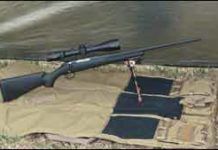
243 Win. Bolt-Action Rifles Under $500: Ruger Vs Mossberg
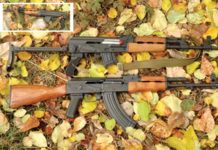
AK-47s: Fixed-Stock Romanian Versus Folding-Stock Yugoslav
The ever-popular AK-47 has been made in many countries over many years, and in many variants. They have been around a long time and are still being manufactured new today. Some are better than others, and the buyer will have to do some research to find the best bargain, and luck might have a part to play as well. In an effort to clear away a tiny bit of the fog, we acquired one of the recently offered fixed-stock versions from Romania, called the WASR-10 (about $450), and put it up against a recently made Yugoslav [IMGCAP(1)]version with a folding stock, called the M70 AB2 (about $500). Both were in the original 7.62x39 caliber, and both were in near-new condition. Our test ammo was two-fold only, Russian hollow-point and Chinese soft nose. Both rifles had what we consider to be excellent triggers. And besides the caliber and pedigree, that's about all they had in common. We took a hard look at them, and here's what we found.
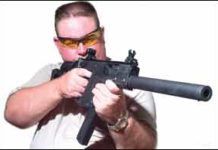
45 ACP Carbine Showdown: Is Kriss Vector a Hit, or a Miss?
The operational concept of carrying a carbine that shoots the same round as your handgun makes a lot of sense. It streamlines ammo choices and reduces complexity in the middle of a fight, which is always a positive. The downside, however, is that handgun ammo shot from a rifle is still handgun ammo, and though the longer rifle barrel generally produces more fps at the muzzle for a given round, the operator still gives up rifle-cartridge velocities.
For example, in this test of the Kriss Super V Vector CRB/SO Civilian Carbine 45 ACP, HK's USC 45, and the Hi-Point 4595TSFG, we looked back a couple of issues to see what 45 ACP pistols developed in terms of muzzle velocity and energy. In July, we tested three short-barrel 45s, the Glock Model 36, Colt Defender, and Springfield Micro. Shooting the Black Hills 230-grain FMJ, a round similar to our test ammos in this test, we saw average velocities run 780 fps, 756 fps, and 769 fps for the Glock, Colt, and Springfield, respectively. That corresponded to muzzle energy calculations of 310 ft.-lbs. for the Glock, 291 ft.-lbs. for the Colt, and 301 ft.-lbs. for the Micro.
In three full-size guns tested in February 2011, we shot Cor-Bon Performance Match 230-grain ammo through a Colt Gold Cup, Kimber Eclipse, and Springfield Loaded Target. In the same order, those guns produced average velocities of 820 fps, 829 fps, and 811 fps and muzzle energies of 344 ft.-lbs., 350 ft.-lbs., and 335 ft.-lbs.
To ensure we got head-to-head readings, we looked back to the February 2010 issue and found another test of full-size 45s using Monarch 230-grain MC ammo. In that test, an STI Sentinel Premier's readings were 785 fps/315 ft.-lbs., with a Springfield TRP at 780 fps/311 ft.-lbs., and a Smith & Wesson MSW1911 getting an average velocity of 779 fps and muzzle energy of 310 ft.-lbs. The slowest ammo in this carbine test was the Monarch 230-grain fodder, with readings in the Hi-Point of 787 fps/316 ft.-lbs.; the HK 846 fps/365 ft.-lbs., and 888 fps/403 ft.-lbs. for the Kriss. Averaged across the three rifles, the Monarch's velocity would be 840 fps, or 59 fps (7%) higher than in the 5-inch pistols.
That doesn't seem like a lot, and in reality it's probably not. But rifles add the ability to carry lights and lasers, compliance items such as toothy flash suppressors, and a lot more. But which of our test guns should be the one you want to sling up and get mobile with? Here's what we found:
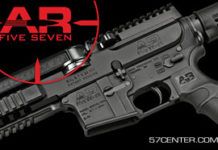
Split the Difference: Is a $700 5.7×28 Upper a Good AR Buy?
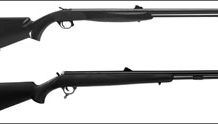
Affordable 50-Cal Muzzleloaders: Knight Vs. Thompson/Center
50-Caliber Inline Muzzleloading Shoot-out: Buy The Savage
50-Caliber Inline Muzzleloading Shoot-out: Buy The Savage
Taurus, AWA, and Beretta Rifles Meet at the Not-Quite-OK Corral
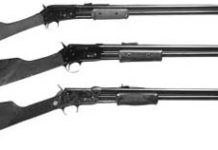
There's a new breed of action rifle in Cowtown. Instead of the diehard lever gun of old, many Cowboy Action shooters looking to shave the last seconds off their time will soon be using a pump rifle. In the quest for speed in that game, top shooters are posting winning scores with the old Colt Lightning design, or clones thereof. Because top shooters use them, that means everybody wants one, whether or not they work better than the ol' lever action mainstay. Variety is, of course, what drives the gun industry, and we're surely not complaining, but we confess we had no idea how well these corn-shuckers would perform. The original Colt Lightning was made in three sizes, the smaller two being more popular. The medium frame, first of the series, was made from 1884 to 1902, and was offered in .32-20, .38-40, or .44-40 to match popular revolver calibers of the day. Total quantity made was around 90,000 in the medium frame, which today's guns copy. Original guns in shootable condition are scarce and costly, but today you can buy a decent copy of the Lightning from several sources, including Taurus, American Western Arms (AWA), USFA, Beretta, and one or two others, and at least one of them is totally affordable. Calibers now include .45 LC and .38/.357, but AWA still offers the original chamberings.
To immediately dispel several rumours making the rounds of the Internet, yes you can get Taurus Thunderbolts ($475), and no, AWA USA, which produces the $850 Lightning Carbine, is not out of business. We spoke with the heads of both companies and verified product availability, and ultimately acquired a sample of the guns of each, in .45 LC.
We also had the loan of a Beretta Gold Rush carbine ($1429) in the same caliber. We shot them over the machine rest and in simulated action shooting, and this is what we found.
Historical Matchup: Two Tommies and a Grease Gun in .45 ACP
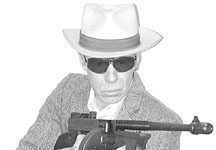
The Tommy gun first carved a name for itself on the streets of Chicago during the grand bad days of the "Roaring Twenties," and later played an important part in several world conflicts. The term "Chicago Typewriter" is only one of many applied to what was, for some, an excellent fighting tool. First placed on the market in 1921, Gen. John T. Thompson's remarkable invention quickly found its way into lawless hands, most likely led — or at least inspired — by Chicago's bootleggers. Only later, when police forces realized their lack of comparable firepower, did law enforcement adopt the weapon.
One of the earliest marketers of the Tommy gun was the Auto Ordnance Corp., same name as the makers of two of our test guns. The first price noted was $200, quite a handful of change in the early 1920s. However, if you wanted a submachinegun at that time, there were exactly no other options worldwide until about 1928, according to Smith's "Small Arms of the World." The Tommy gun thrived.
The first editions of the Thompson were marvels of careful machining. These were the guns with the slotted bolt knob on top (so you could see the sights), the double pistol grip, the 50- or 100-round drum magazines, and with cooling fins cut around the rear portion of the barrel. The early Tommy guns also incorporated a friction-type mechanism (Blish theory) that was supposed to delay the blowback operation, though later tests indicated little actual delay took place, and the system was eventually dropped. The early guns also had the Cutts compensator, designed to help control muzzle climb in full-auto mode. These guns had hand-detachable butt stocks and an adjustable leaf-type rear sight. These came to be known as the Model 1928A1. Caliber was, of course, .45 ACP, but some were also produced in 9mm and 38 Auto.