




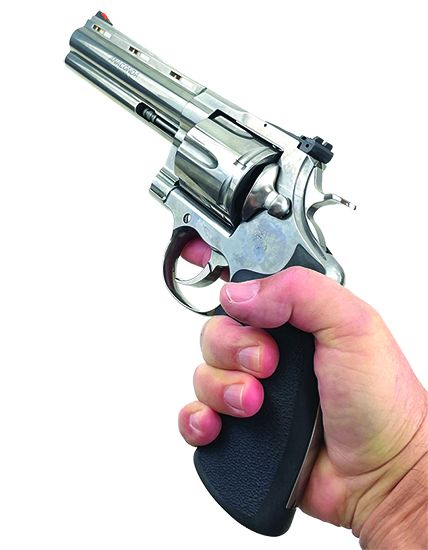
About a generation ago, the 44 Magnum reigned as the most powerful handgun in the world. It has since been toppled in size and power by other cartridges, but not before a few handguns chambered in the round became legendary. Not only with shooters, but also the general public through pop culture.
Three classic 44 Magnums we immediately think of in this vein are the Magnum Research Desert Eagle, Smith & Wesson Model 29, and Colt Anaconda. These are massive handguns. The Colt and S&W are revolvers, and the Desert Eagle is a semi-automatic. Target shooting and hunting are the main purposes for these guns.
We wanted to pit these iconic handguns against each other to see which one made our day the best. We tested these guns out of the box with open sights at 10 and 25 yards. We collected accuracy data at 25 yards shooting slow fire in single action, operating the hammers manually for each shot. The 10-yard test was combat style in double action for the revolvers and flipping the safety off on the Desert Eagle and shooting single action at a tombstone target.
The sweet spot for 44 Magnum bullet weight is 240 grains, though there are lighter and heavier bullets weights available. For this test, on the light side was Hornady Custom rounds with 200-grain XTP bullets that screamed out of the 6-inch barrels between 1450 and 1500 fps. Yes, this round in particular provides a punch on the target and in the palm of your hand. For 240-grain ammo, we fired SIG Sauer V-Crowns with jacketed hollow-point bullets, Sellier & Bellot soft points, and Black Hills new manufacture jacketed hollow points. Shooting the 240-grain ammo was more tolerable and, in fact, pleasant in the Desert Eagle. For the Smith and Colt, 44 Special ammo is compatible, which is pleasant to the palm in the these heavy revolvers. We didn’t test 44 Specials because they are not compatible with the Desert Eagle.
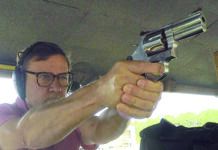
As far as technique goes, it is best to fire these heavy magnums with your elbows locked, letting your shoulders take the recoil. If you bend your elbows, the recoil may kick the gun back toward your face. These 44 Magnums are beasts to shoot, producing a lot of recoil. These are not newbie guns.
The cylinder gap test showed the S&W was bit over spec at 0.009 inches (spec is 0.004 to 0.006 inches). Still, we didn’t get any splatter when shooting the Smith. The Colt was dead in the middle at 0.005 inches. What classic 44 Magnum would we choose?
Colt Anaconda ANACONDA-SP6RTS 44 Magnum,
$1373
Gun Tests grade: A-
The Anaconda is Colt’s biggest snake gun, and it offers great looks, smooth trigger, and good accuracy. It is basically a bulked-up Python capable of handling the powerful 44 Magnum cartridge. The grip could be better
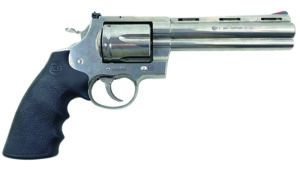
| Action Type | Revolver |
|---|---|
| Trigger Type | Double action/single action |
| Overall Length | 13.0 in. |
| Barrel Length | 6.0 in. |
| Overall Height | 7.2 in. |
| Maximum Width | 1.7 in. |
| Weight Unloaded | 52.96 oz. |
| Weight Loaded | 58.24 oz. |
| Cylinder Gap | 0.005 in. |
| Capacity | 6 |
| Frame | Semi-bright stainless steel |
| Barrel | Semi-bright stainless steel |
| Cylinder | Semi-bright stainless steel |
| Frame Front Strap Height | 2.4 in. |
| Frame Back Strap Height | 3.8 in. |
| Grip | Hogue Monogrip, soft finger groove rubber |
| Grip Thickness (Maximum) | 1.3 in. |
| Grip Circumference (Maximum) | 6.0 in. |
| Front Sight | Ramp w/orange insert |
| Rear Sight | Adj. notch |
| Trigger Pull Weight (Double Action) | 10.2 lbs. |
| Trigger Pull Weight (Single Action) | 6.5 lbs. |
| Trigger Span (Double Action) | 3.4 in. |
| Trigger Span (Single Action) | 3.0 in. |
| Safety | Transfer bar |
| Warranty Limited | 1 year |
| Telephone | (800) 962-2658 |
| Website | Colt.com |
| Made In | U.S. |
The original Anaconda debuted in 1990 and was built until 2006. Even though the Anaconda was late to the 44 Magnum party — S&W rolled out the Model 29 in 1955, Ruger introduced the Super Blackhawk in 1959 and the Redhawk in 1979, and Dan Wesson launched the Model 44 in 1980 — it still earned a reputation among shooters as an accurate revolver. The Anaconda has had some silver-screen time, but not as much as the other two 44 Magnums in this test. In 2021, the Anaconda was re-introduced, and this new one is much different than the original. This new Anaconda is really a bulked-up Python, and like the new Python as well as the new King Cobra, the Anaconda features a longer linear leaf spring that translates to no stacking on the trigger pull. It’s like a leaf spring that offers a smoother and more consistent trigger through the entire pull. Even though the double-action trigger-pull weight measured 10.2 pounds, it actually felt lighter. The single-action pull weight was a heavy 6.5 pounds.
Our Anaconda wore a semi-bright stainless-steel finish and rubber finger-groove grips made by Hogue. The rubber grip had palm swells, which fill the palm of your hand when you grip the revolver, but the backstrap is bare steel. With hot loads, this grip slams into your palm. Not sure why Taurus and Ruger can get rubber grips right on 44 Magnum wheelguns and Colt can’t.
The barrel is 6 inches in length and is equipped with a vent rib and full underlug, a characteristic of some of Colt’s snake guns. The front ramp sight has an orange insert and is easily swapped out if you prefer a fiber-optic front sight. We felt the red-insert ramp front sight was retro looking and worked fine. The rear sight on the Anaconda is a fully adjustable plain notch. The top strap is drilled and tapped should the owner want to mount an optic.
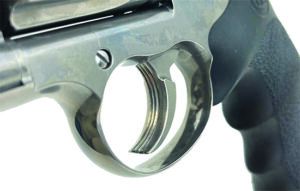
The hammer is serrated and offers plenty of traction to cock and uncock the big snake. The trigger is wide and serrated. The crane-to-frame lock-up was tight, and there was virtually no wiggle in the cylinder.
The SIG V-Crown ammo performed the best with a 1.06-inch five-shot group at 25 yards; the average was smaller than 1.5 inches. Next was our go-to 44 Magnum ammo, Black Hills, with 1.79-inch best group and average of 2.07 inches. The Sellier & Bellot gave a decent 2.18-inch best group and 2.62-inch average group size. All of this ammo had a muzzle velocity over 1220 fps in the Colt. The hot Hornady gave a best of 1.97 inches and average of 2.36 inches. Muzzle velocity was speedy at 1445 fps. We noticed the Hornady ammo was spicier than the other loads in terms of energy. Recoil had plenty of muzzle flip. Accuracy was good even with the heavy single-action trigger pull. The Anaconda was the least accurate of the three guns tested, but with the groups we shot, it was definitely suitable for hunting.
Switching to double-action shooting, the Anaconda offered a very smooth trigger pull. We could stage the trigger as we were recovering from recoil, and that allowed us a light pull-through to fire the shot when we were ready.
Our Team Said: The good news about the Anaconda is the sweet double-action trigger. The sights are good. The bad news is the grip. A grip with rubber that covers the metal backstrap would make this revolver more comfortable to shoot. If you are a fan of Colt’s snake guns, the Anaconda needs to be in your serpent collection.
| 44 MAGNUM RANGE DATA | |||
|---|---|---|---|
| Hornady Custom 200-grain XTP | Colt Anaconda | Desert Eagle MK XIX | S&W Model 29 |
| Average Velocity | 1445 fps | 1522 fps | 1455 fps |
| Muzzle Energy | 927 ft.-lbs. | 1029 ft.-lbs. | 940 ft.-lbs. |
| Smallest Group | 1.97 in. | 1.21 in. | 2.37 in. |
| Average Group | 2.36 in. | 1.38 in. | 2.72 in. |
| SIG Sauer V-Crown 240-grain JHP | Colt Anaconda | Desert Eagle MK XIX | S&W Model 29 |
| Average Velocity | 1269 fps | 1281 fps | 1280 fps |
| Muzzle Energy | 858 ft.-lbs. | 874 ft.-lbs. | 873 ft.-lbs. |
| Smallest Group | 1.06 in. | 1.99 in. | 0.99 in. |
| Average Group | 1.46 in. | 2.10 in. | 1.41 in. |
| Sellier & Bellot 240-grain SP | Colt Anaconda | Desert Eagle MK XIX | S&W Model 29 |
| Average Velocity | 1220 fps | 1084 fps | 1230 fps |
| Muzzle Energy | 793 ft.-lbs. | 627 ft.-lbs. | 806 ft.-lbs. |
| Smallest Group | 2.18 in. | 1.87 in. | 1.84 in. |
| Average Group | 2.62 in. | 2.29 in. | 2.20 in. |
| Black Hills (new) 240-grain JHP | Colt Anaconda | Desert Eagle MK XIX | S&W Model 29 |
| Average Velocity | 1249 fps | 1059 fps | 1260 fps |
| Muzzle Energy | 831 ft.-lbs. | 598 ft.-lbs. | 846 ft.-lbs. |
| Smallest Group | 1.79 in. | 1.84 in. | 2.50 in. |
| Average Group | 2.07 in. | 2.01 in. | 2.56 in. |
To collect accuracy data, we fired five-shot groups from a bench using a rest. Distance: 25 yards with open sights. Velocities and energies were recorded using a Garmin Xero C1 Pro chronograph.
Written and photographed by Robert Sadowski, using evaluations from Gun Tests Team members. GT