


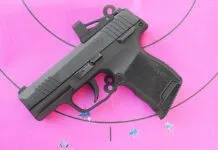











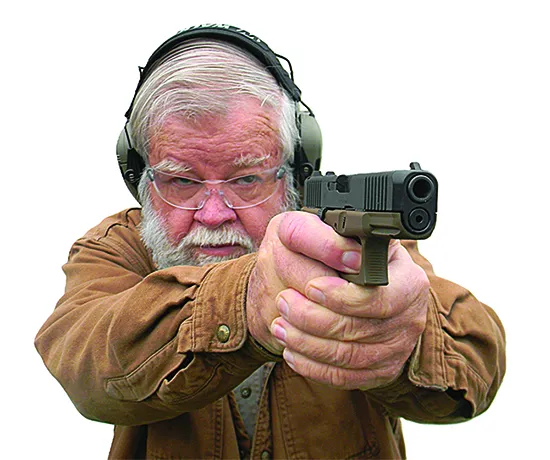
Two new recently introduced guns demanded our attention: the Ruger RXM, a pistol resembling the Glock Generation 3 Model 19, and the Springfield Armory Echelon 4.0C, a compact version of the Echelon 9mm. We elected to pitch them against the most modern version of the Glock, the G19 Generation 5 MOS. These pistols are similar in size and weight as well as capacity, and each is optics ready and has extended magazines available. All are simple to operate, with the only controls being a slide lock, magazine latch, and takedown trigger. There is no manual safety, only safety features. Outside those similarities, the Glock has the greatest aftermarket support at present, but the Ruger will build on that.
We did not make the three types of optics mounting systems a huge part of the test. However, there are differences worth discussing. Even today, every gun doesn’t accept every red dot. The more common footprints offer the most choice, and some otherwise excellent European optics using the Docter foot print are not compatible with some pistols. While all three pistols are optics ready, the Glock and Springfield seem more versatile.
The Ruger’s direct mount is fine for most uses and should be secure. But be certain to choose the red-dot optic first and be certain the handgun is compatible with the optic you want to purchase. Follow procedure, mount the red dot and torque its screw properly, and use just a dot of blue Loctite to secure the optic. Don’t allow Loctite to gravitate into the extractor channel.
The Echelon is a purpose-designed optics-ready pistol, and the red dot sits lower on it than on other pistols. The Springfield’s Echelon’s pin set up is a different mounting process from direct mounting or MOS plates. These pins seem to be the most secure, we thought.
It’s been almost 10 years since the announcement of the Glock Modular Optics System, or MOS. This system uses a series of proprietary numbered plates to adapt the Glock MOS slide from simple iron sights to any of the popular red-dot patterns. The MOS system is fairly straightforward, but it can be difficult for those who have never tried to mount an optic on a pistol before. The manual offers a detailed explanation of the process, but an early pitfall to avoid when purchasing your initial MOS kit is to make sure to purchase the kit for the width of your handgun’s slide.
Glock 19 Gen5 MOS PA195S203MOSDE 9mm Luger,
$620
Gun Tests grade: B
In this test, the Glock proved reliable, but so did the other pistols. Accuracy was at the bottom, but not by a large measure. Folks will choose the Glock based on its reputation for reliability, and in some cases, aftermarket parts availability.
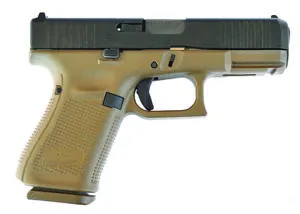
| Action | Semi-auto recoil-operated locked breech, striker fired |
|---|---|
| Trigger | Safe Action, double action only |
| Overall Length | 7.28 in. |
| Overall Height | 5.04 in. |
| Maximum Width | 1.4 in. |
| Weight Unloaded | 21.5 oz. |
| Weight Loaded | 30.16 oz. |
| Barrel | 4.0 in. |
| Slide | Black-phosphate-finished steel |
| Slide Retraction Effort | 16.0 lbs. |
| Receiver | FDE Polymer |
| Front Strap Height | 2.0 in. |
| Rear Strap Height | 3.6 in. |
| Barrel Length | 4.1 in. |
| Grip | Replaceable inserts |
| Grip Thickness | 1.3 in. |
| Grip Circumference | 6.0 in. |
| Magazines | (3) 15 round |
| Magazine Price | $25, Gen 5 15 round |
| Rear Sight | Fixed white outline |
| Front Sight | Fixed white dot |
| Sight Radius | 6.0 in. |
| Trigger Pull Weight | 5.6 lbs. |
| Trigger Span | 2.6 in. |
| Safety | Trigger lever |
| Warranty | 1 year |
| Telephone | (770) 432-1202 |
| Website | US.Glock.com |
| Made In | U.S. |
The Model 19 was the first Glock modification, it being a shortened-slide-and-grip version of the Glock 17 9mm. The Glock 19 is often touted as the ideal-size carry pistol with its 4-inch barrel, 15-round magazine, and 22-ounce weight. The Generation 5 is the newest Glock model (except for the new V lines), and the company has earned an enviable place in the market based on reliability and function. Glock has about three quarters of the police market sewed up, as well as a substantial part of the military market. In the civilian market, everyone seems to have a Glock. Glock was not the first polymer-frame pistol, but the striker-fired polymer-frame revolution certainly began with the Glock.
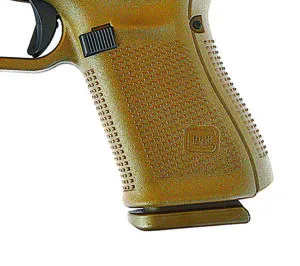
Gen 5 guns feature an enlarged magazine well to facilitate rapid magazine changes. The pistol features forward cocking serrations and DLC finish on the slide. The Gen 5 guns also have an ambidextrous slide stop. The new barrel is designated the Marksman model, and it has proven more accurate than previous Glock tubes. Glock Gen 5 pistols usually feature a cut out for removing a stuck magazine, but the Glock tested here did not have this cut out. We have no explanation for this, but we have never seen a stuck Glock magazine.
Like on other Glocks, this pistol’s Safe Action system features three safeties — a trigger safety, drop safety, and firing-pin safety. All are passive, there is no manual safety. The Glock’s trigger is 5.5 pounds and has a typical spongy feel, like most other Glock triggers we have tested. Grip pebbling is good, not too abrasive or too tacky. A rater with large hands changed backstraps on the Glock and felt that thus fitted, it was the lightest-kicking pistol. Personal choice.
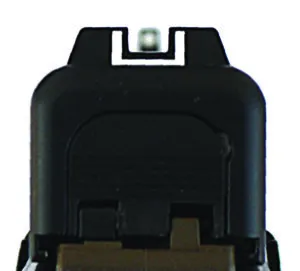
The firing tests were uneventful, which we like. The Glock Gen 5 pistol is reliable, and we would be surprised if a Glock was not reliable. The pistol did well enough in the combat firing test, but the Glock was at the bottom of the totem pole, our shooters said, grading the other two pistols as more capable. In a tier of performance, the Ruger RXM was only slightly superior in combat firing, and we feel that this is due to the Ruger’s sights and trigger. We liked the Ruger’s grip as well.
Our Team Said: The Springfield is comparable in price to the Glock, and the Echelon’s performance was superior in both combat firing and in bench accuracy. Just the same, the Glock is a reliable handgun, and it is certainly combat capable. We rated it down because the issue sights were inferior to the other two handguns. After the test, one of the raters elected to keep the Glock Gen 5 and add it to his carry rotation. To get the pistol up to par for personal defense, he added a three-dot set of XS night sights, $125. This would bring the price of the pistol up to $745 with the sight installation cost.
| 9MM LUGER RANGE DATA | |||
|---|---|---|---|
| Black Hills Factory New 124-grain JHP | Springfield Armory Echelon 4.0C | Ruger RXM | Glock 19 Gen 5 MOS |
| Average Velocity | 1090 fps | 1068 fps | 1101 fps |
| Muzzle Energy | 327 ft.-lbs. | 314 ft.-lbs. | 334 ft.-lbs. |
| Smallest Group | 1.9 in. | 2.3 in. | 2.4 in. |
| Average Group | 2.2 in. | 2.6 in. | 3.0 in. |
| Hornady Critical Duty 135-grain FlexLock 90236 | Springfield Armory Echelon 4.0C | Ruger RXM | Glock 19 Gen 5 MOS |
| Average Velocity | 1056 fps | 1038 fps | 1070 fps |
| Muzzle Energy | 334 ft.-lbs. | 323 ft.-lbs. | 343 ft.-lbs. |
| Smallest Group | 2.0 in. | 2.2 in. | 2.4 in. |
| Average Group | 2.4 in. | 2.6 in. | 2.8 in. |
| Federal Tactical LE 147-grain HST P9HST2 | Springfield Armory Echelon 4.0C | Ruger RXM | Glock 19 Gen 5 MOS |
| Average Velocity | 996 fps | 1004 fps | 980 fps |
| Muzzle Energy | 324 ft.-lbs. | 329 ft.-lbs. | 313 ft.-lbs. |
| Smallest Group | 2.1 in. | 2.3 in. | 2.6 in. |
| Average Group | 2.4 in. | 2.7 in. | 2.9 in. |
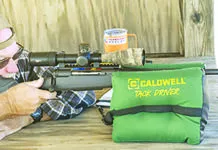
To collect accuracy data, we fired five-shot groups from a bench using an MTM Case-Gard K-Zone rest. Distance: 25 yards. We measured velocities with a Competition Electronics Pro Chrony with the first screen 10 feet from the muzzles.
Written and photographed by Bob Campbell, using evaluations from Gun Tests Team members. GT