


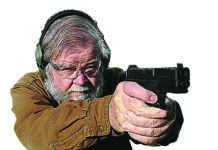
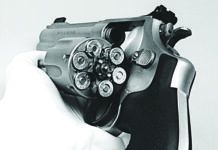
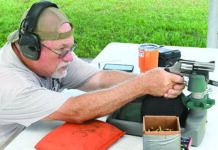






About a generation ago, the 44 Magnum reigned as the most powerful handgun in the world. It has since been toppled in size and power by other cartridges, but not before a few handguns chambered in the round became legendary. Not only with shooters, but also the general public through pop culture.
Three classic 44 Magnums we immediately think of in this vein are the Magnum Research Desert Eagle, Smith & Wesson Model 29, and Colt Anaconda. These are massive handguns. The Colt and S&W are revolvers, and the Desert Eagle is a semi-automatic. Target shooting and hunting are the main purposes for these guns.
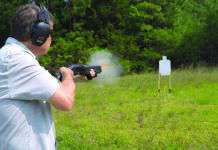
We wanted to pit these iconic handguns against each other to see which one made our day the best. We tested these guns out of the box with open sights at 10 and 25 yards. We collected accuracy data at 25 yards shooting slow fire in single action, operating the hammers manually for each shot. The 10-yard test was combat style in double action for the revolvers and flipping the safety off on the Desert Eagle and shooting single action at a tombstone target.
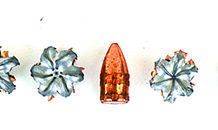
The sweet spot for 44 Magnum bullet weight is 240 grains, though there are lighter and heavier bullets weights available. For this test, on the light side was Hornady Custom rounds with 200-grain XTP bullets that screamed out of the 6-inch barrels between 1450 and 1500 fps. Yes, this round in particular provides a punch on the target and in the palm of your hand. For 240-grain ammo, we fired SIG Sauer V-Crowns with jacketed hollow-point bullets, Sellier & Bellot soft points, and Black Hills new manufacture jacketed hollow points. Shooting the 240-grain ammo was more tolerable and, in fact, pleasant in the Desert Eagle. For the Smith and Colt, 44 Special ammo is compatible, which is pleasant to the palm in the these heavy revolvers. We didn’t test 44 Specials because they are not compatible with the Desert Eagle.
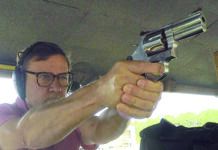
As far as technique goes, it is best to fire these heavy magnums with your elbows locked, letting your shoulders take the recoil. If you bend your elbows, the recoil may kick the gun back toward your face. These 44 Magnums are beasts to shoot, producing a lot of recoil. These are not newbie guns.
The cylinder gap test showed the S&W was bit over spec at 0.009 inches (spec is 0.004 to 0.006 inches). Still, we didn’t get any splatter when shooting the Smith. The Colt was dead in the middle at 0.005 inches. What classic 44 Magnum would we choose?
Magnum Research Desert Eagle MK XIX DE44 44 Magnum,
$1565
Gun Tests grade: A- (Our Pick)
The Desert Eagle is a soft-shooting pistol that tames 44 Mag recoil. It is accurate and ready for an optic
| Action Type | Semi-auto, gas operated, rotating bolt |
|---|---|
| Trigger Type | Single action only |
| Overall Length | 10.7 in. |
| Barrel Length | 6.0 in. |
| Overall Height | 6.2 in. |
| Maximum Width | 1.2 in. |
| Weight Unloaded | 70.0 oz. |
| Weight Loaded | 76.8 oz. |
| Capacity | 8 |
| Frame | Black oxide-finished steel |
| Barrel | Black oxide-finished steel |
| Frame Front Strap Height | 2.7 in. |
| Frame Back Strap Height | 3.0 in. |
| Slide Retraction Effort | 20.0 lbs. |
| Grip | Textured rubber |
| Grip Thickness (Maximum) | 1.3 in. |
| Grip Circumference (Maximum) | 7.3 in. |
| Front Sight | Blade |
| Rear Sight | Fixed notch |
| Trigger Pull Weight | 4.0 lbs. |
| Trigger Span | 3.5 in. |
| Magazines | 1, steel |
| Safety | Manual thumb |
| Warranty | Limited 1 year |
| Telephone | (508) 795-3919 |
| Website | MagnumResearch.com |
| Made In | U.S. |
The Desert Eagle really owes its pop-culture-icon status to movies, TV, and video games. The first Desert Eagle, the Mark I, was introduced in 1983, and by 1985, made its first cinematic appearance in the movie Year of the Dragon. Since then, it has been in countless movies and TV shows and is a regular weapon used in video games. It is easy to see why, since it is massive with brutish good looks.
Don’t think the Desert Eagle gets by on its good looks alone; they help, but these pistols perform like no other semi-automatic handgun you have fired. Our sample was a Mark XIX, the latest variant in the 44 Magnum chambering.
Unique to the Desert Eagle is the gas-operated system typically found in rifles. When a round is fired, gas is ported from the barrel to a cylinder under the barrel. The gas pushes the cylinder and slide rearward, causing the bolt to rotate and unlock after a shot is fired and a spring-loaded ejector to spit out the empty case. The slide then moves forward via twin recoil springs, chambering a round and locking the bolt. The top is an open-slide design similar to a S&W Model 41 target pistol. The barrel stays fixed when the slide cycles.
Calibers can be changed out by switching out the barrel, magazine, and bolt to the round you want to shoot, either 357 Magnum or 50 AE. Magnum Research offers a conversion kit ($562-$999; ShopKahrFirearmsGroup.com) with barrel and two magazines. The bolt ($225-$299) is sold separately. Extra magazines range from expensive to super expensive ($51-$129), depending on the finish.
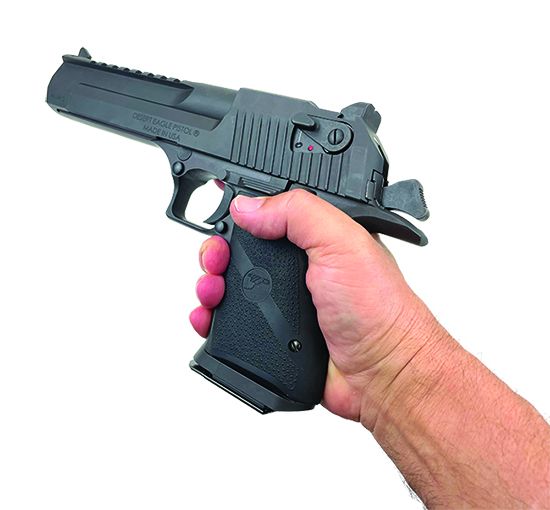
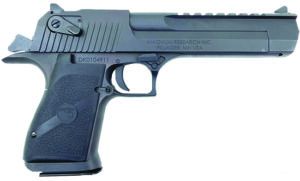
Our sample wore a matte-black finish that looks all business. In hand, the pistol is massive. The safety is large and well out of reach for someone with average-size hands. The grip is soft rubber that covers the rear backstrap. It has a pebble-finish texture. The Desert Eagle has nice balance.
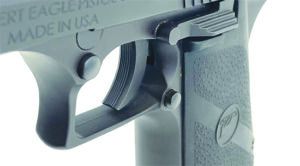
The 6-inch barrel had a Picatinny rail machined on top and a ramp front sight dovetailed into place. The rear sight is a fixed notch and is dovetailed into place on the slide. These were serviceable sights that we found shot low. The rear of the slide has coarse serrations that make the slide easy to rack. It took about 20 pounds of effort to rack the slide. The ambidextrous safety is built into the rear of the slide and takes some effort to flick it to Safe and Fire. The way that the safety lever is designed does not interfere with manipulating the rear of the slide, like it can on a Beretta 90–series pistol or S&W centerfire metal-frame pistols made from the late 1950s through the 1990s. The slide stop is long, so a righty shooter can manipulate the slide stop with the thumb of the shooting hand. The magazine-release button is small and smartly ejects the magazine.
The Desert Eagle is hammer fired, and the trigger is single action only. Pull weight was a very usable 4 pounds. There is a large beavertail built into the frame, so there is no fear of a slide bite. The front grip strap is smooth, and we found it didn’t need texture there because the rubber grip did its job. With the amount of recoil the 44 Magnum produces, texture on the front grip strap could easily be abrasive.
The steel-body magazine holds eight rounds and is easy to fill. Loading the Desert Eagle and racking the slide feels like you are manipulating a big piece of machinery, and you are. Our best accuracy group was with the hot Hornady Custom, which measured 1.21 inches, with an average for the load of 1.38 inches. With the 240-grain selections, Black Hills provided the tightest group at 1.84 inches and an average of 2.01 inches. Next was Sellier & Bellot with a best of 1.87 inches and average of 2.29 inches. SIG V-Crown gave a best of 1.99 inches and an average of 2.10 inches. There was no need to wear gloves when shooting the Desert Eagle. The gas system expends some recoil into operating the slide, making the Desert Eagle pleasant to shoot. We noticed the difference in the hot Hornady load, but the wide, soft rubber grip helped spread recoil. There is still plenty of 44 Magnum recoil to deal with, but the Desert Eagle does not bash your palms like the revolvers can.
We had one initial FTF with the first magazine, then the Desert Eagle ran with no issues.
The 10-yard test showed how fast we could get 44 mag rounds down range. We easily kept hits in the 8-inch circle. Can we shoot it as fast as a 45 Auto or 40 Auto? No, but we could shoot it much faster than a revolver.
Our Team Said: The Desert Eagle makes shooting the 44 Magnum fun and enjoyable due the reduced recoil and the heft of the pistol. The pistol’s point of impact was low, and adjustable sights would fix that. This would be an excellent pistol for handgun hunting, especially with the optic-ready Picatinny rail. It will also cause strangers to stare at you when every one else at the public range is shooting 9mm and you are launching 44 Magnums. If cost is not an option, this would be Our Pick.
| 44 MAGNUM RANGE DATA | |||
|---|---|---|---|
| Hornady Custom 200-grain XTP | Colt Anaconda | Desert Eagle MK XIX | S&W Model 29 |
| Average Velocity | 1445 fps | 1522 fps | 1455 fps |
| Muzzle Energy | 927 ft.-lbs. | 1029 ft.-lbs. | 940 ft.-lbs. |
| Smallest Group | 1.97 in. | 1.21 in. | 2.37 in. |
| Average Group | 2.36 in. | 1.38 in. | 2.72 in. |
| SIG Sauer V-Crown 240-grain JHP | Colt Anaconda | Desert Eagle MK XIX | S&W Model 29 |
| Average Velocity | 1269 fps | 1281 fps | 1280 fps |
| Muzzle Energy | 858 ft.-lbs. | 874 ft.-lbs. | 873 ft.-lbs. |
| Smallest Group | 1.06 in. | 1.99 in. | 0.99 in. |
| Average Group | 1.46 in. | 2.10 in. | 1.41 in. |
| Sellier & Bellot 240-grain SP | Colt Anaconda | Desert Eagle MK XIX | S&W Model 29 |
| Average Velocity | 1220 fps | 1084 fps | 1230 fps |
| Muzzle Energy | 793 ft.-lbs. | 627 ft.-lbs. | 806 ft.-lbs. |
| Smallest Group | 2.18 in. | 1.87 in. | 1.84 in. |
| Average Group | 2.62 in. | 2.29 in. | 2.20 in. |
| Black Hills (new) 240-grain JHP | Colt Anaconda | Desert Eagle MK XIX | S&W Model 29 |
| Average Velocity | 1249 fps | 1059 fps | 1260 fps |
| Muzzle Energy | 831 ft.-lbs. | 598 ft.-lbs. | 846 ft.-lbs. |
| Smallest Group | 1.79 in. | 1.84 in. | 2.50 in. |
| Average Group | 2.07 in. | 2.01 in. | 2.56 in. |
To collect accuracy data, we fired five-shot groups from a bench using a rest. Distance: 25 yards with open sights. Velocities and energies were recorded using a Garmin Xero C1 Pro chronograph.
Written and photographed by Robert Sadowski, using evaluations from Gun Tests Team members. GT

Interesting that the Desert Eagle gets less speed out of two 240 grain loads and the same with a third while making considerably more out of the 200 grain load. This might be a fun one to cook up some custom loads for.