

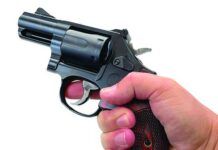






There is an axiom that is true on all firearms but is especially true for revolvers — size matters. For concealed carriers, a good wheelgun option is the 3-inch version we see making a strong comeback. Depending on the material used for the frame, weight can range from very light up to and through the 2-pound-plus range. Sight radius is a bit longer than on snubbies, allowing for more precise shooting, and these versions normally allow a full ammo load. All the while, barrel length is a bit shorter than full-length models, making them more maneuverable in a fight and capable of clearing leather more quickly in the draw. Also, the 3-inch tube normally creates enough space for a full-length ejector rod, the lack of which on snubbies can cause problems with reloads.
Our search for a good 3-inch wheelgun started with the new Colt Python BP3WTS, $1400, with a blued finish. The stainless model has been out for some time now, but we think the blued version brings the same great mechanics with the aesthetics of a genuinely well-finished handgun. As with the stainless edition, the new Python sports a vented rib on top of the barrel and a full underlug, along with a great trigger.
The Rossi RP63 2-RP639P, $380, brings a minimalist package at a minimal price. This wheelgun is smaller than our other test samples, but it still carries a full underlug to help with recoil. The polished stainless finish nicely offsets the black Hogue-style grips.
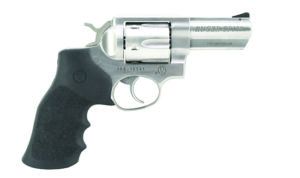
Our next selection was a Ruger GP100 01715, $820; which we could easily believe was designed for bear country. Also sporting a full-length underlug as well as a full-sized set of Hogue grips, this GP100 is sculpted to handle just about any load you could think of putting in a 357 Magnum pistol.
Our final pick was the Smith & Wesson M686-6 164300, $904. Also sporting a full-length underlug and adjustable like the Python, it offers a 7-round cylinder. That extra round could make a difference to you in the back woods.
To get started, we have a few thoughts on barrel lengths in revolvers versus a pistol — wheelguns are longer than you think. With a semi-auto pistol, the barrel length is measured from the muzzle to the rear of the chamber and includes any extension on the hood that mates up with the slide. The barrel on a revolver is measured from the crown back to the start of the forcing cone. But if you include the chambers (cylinders) in the measurement, the revolver is going to be longer than the stated length would suggest. For example, our Python has a 3-inch barrel as stated, but when the cylinder is included, length goes up to 4.5 inches. Of course, there is the cylinder gap between the cylinder and the barrel, but there is more length there than you might think.
We have mentioned that the revolver can do several things that the semi-auto can’t. The semi-auto can be very ammunition sensitive. The revolver — not so much. The operating system on the semi-auto requires that ammo pressures are generated in a specific range. If the round does not generate the correct pressure, the slide doesn’t cycle, and you have a malfunction. If the magazine doesn’t work right, there is a malfunction. If the springs get worn, there is a malfunction. Just try carrying a variety of ammunition in a semi-auto and see how well things go.
The semi-auto pistol does indeed have a great advantage over the revolver in the amount of ammo carried onboard. The revolver, however, much like a good 12-gauge pump shotgun, can carry a mix of ammunition and fire the rounds without a moment’s hesitation, depending on a perceived threat. On page 21 is a picture that shows a snake killed just outside of one of our deer stands last December. The ranch foreman holding that snake is about 6 feet 3 inches tall, so you an idea of the size of rattlers down here. As a result, the first chamber (or two) in the revolver we carry for backup while hunting and just walking around is loaded with snake shot. The CCI load uses No. 9 shot at a little over 1000 fps and should do a great job on any snake we’ve ever seen. The rest of the cylinder is loaded with 200-grain hard-cast solids from Buffalo Bore in case we get a close shot at a deer. The same load might be a good choice in bear country.
The semi-auto has other issues as well. Get it dirty, and it might malfunction. Don’t hold it right or tightly enough, and it might malfunction. The revolver doesn’t care. If it does malf, just pull the trigger again and most of your problems will be solved. Now perhaps you see why we think a good revolver is still an imminently viable self-defense handgun. Here’s how these 3-inchers did at the range.
Ruger GP100 01715 357 Magnum,
$820
Gun Tests grade: B+
Big, solid, and beefy, the Ruger GP100 was the heaviest handgun in this test. If you want a steady diet of 357 Magnums, even the top-end loads, your shooting hand might want you to pick this one.
| Action Type | Revolver |
|---|---|
| Overall Length | 8.75 in. |
| Overall Height | 5.75 in. |
| Maximum Width | 1.55 in. |
| Weight Unloaded | 35.68 oz. |
| Weight Loaded | 37.92 oz. |
| Barrel Length | 3.0 in. |
| Barrel Material | Stainless steel |
| Frame Material | Stainless steel |
| Cylinder Material | Stainless steel |
| Grip Front Strap Height | 2.5 in. |
| Grip Back Strap Height | 4.5 in. |
| Grip Thickness (Maximum) | 1.23 in. |
| Grip Circumference | 5.4 in. |
| Capacity | 6 |
| Rear Sight | Fixed |
| Front Sight | User-changeable black ramp |
| Sight Radius | 4.75 in. |
| Trigger Pull Weight (Single Action) | 3.8 lbs. |
| Trigger Pull Weight (Double Action) | 10.4 lbs. |
| Trigger Span | 3.75 in. |
| Warranty | None written |
| Telephone | (336) 949-5200 |
| Website | Ruger.com |
| Made In | U.S. |
While we can certainly cite exceptions (like with the Single Six and Wrangler lines), Ruger tends to design its revolvers more on the beefy side. For those going afield and taking a Ruger six-gun for protection, that can be a great thing. Here, the GP100’s grips are bigger, the muzzle has more weight in it, and the cylinder walls have more beef. All of these produce a handgun that is very tough and more comfortable to shoot.
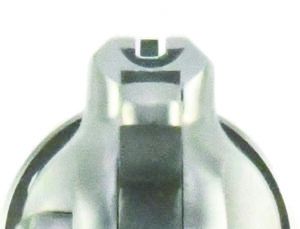
Like the Rossi RP63 and the S&W 686, this GP100 is made out of stainless steel, and Ruger applies a brushed finish to the whole unit. The top strap is grooved to help keep reflection off the front sight, which, once again, is a plain black ramp. Also held in by a roll pin, changing it should be simple. We found the gun shot slightly high across all three loads fired. The fixed rear sight is one of the best designs we have seen. It uses a deep groove and a rear face that is so well cut that it looks like it is painted black when we look through it. It isn’t, obviously, but it created a great sight picture — something we seldom say about fixed sights.
The barrel is what we would like in a short mid-weight handgun. The whole tube is fairly thick and uses a full-length underlug, as do the other revolvers in this test. We readily admit that full-house 357 Magnum loads are not fun to shoot, but it is kind of hard to carry the boat anchor that might make them comfortable to fire. Still, the GP100 does a pretty good job of providing weight out front, while still leaving a size and shape that could easily be carried. That said, a good chest holster like the one from Mission First Tactical would be a great place to store your Ruger while hiking, hunting, or fishing. Also, the muzzle has been properly beveled, as has the cylinder, making this GP100 a bit easier to shove back in your holster.
The working parts are signature Ruger. The cylinder spins freely on the ejector rod. The cylinder is thick enough to put good meat in the cylinder walls. The bolt notches are located between the cylinders, not in the middle of them. Lockup occurs with the ejector at the breech face and a second latch on the front of the crane, where it locks into the frame. The trigger is medium wide with rounded edges and a smooth face. The cylinder release on a Ruger is a lever instead of a push- or pull-button as on the others. Press down on the lever at the rear to open. The hammer is smooth faced, and the firing pin is frame mounted, so the GP100s use a transfer bar much like the Colt. Unlike the others with their removable side plates, the Ruger uses a single coil spring mounted on a stud in the grip. Once that is cleared out, the entire action can be removed from the bottom of the frame. This also allows single-piece Hogue grips to be used. Those grips completely cover the backstrap as well as the rear of the trigger guard. Recoil, as a result, is relatively easy to handle.
Our Team Said: The Ruger came in second place in the accuracy trials with an overall average of 2.04 inches — just 0.022 inch behind the Python. Speed tests put it in third place, again with a very respectable showing. Its favorite ammo was the Federal 158-grain JSP with a best group at about 1.4 inches at 15 yards. This is a well-built gun that might be your pick if you don’t mind its weight.
| 38 SPECIAL RANGE DATA | ||||
|---|---|---|---|---|
| Federal Personal Defense 110-grain Hydra-Shok JHP PD38HS3 H | Colt Python | Rossi RP63 | Ruger GP100 | S&W Model 686-6 |
| Average Velocity | 990 fps | 924 fps | 974 fps | 947 fps |
| Muzzle Energy | 322 ft.-lbs. | 281 ft.-lbs. | 312 ft.-lbs. | 295 ft.-lbs. |
| Best Group Size | 2.06 in. | 2.91 in. | 1.40 in. | 1.26 in. |
| Average Group Size | 2.51 in. | 3.23 in. | 2.13 in. | 1.71 in. |
| 357 MAGNUM RANGE DATA | ||||
|---|---|---|---|---|
| Remington UMC 125-grain JSP L357M12 | Colt Python | Rossi RP63 | Ruger GP100 | S&W Model 686-6 |
| Average Velocity | 1417 fps | 1342 fps | 1365 fps | 1361 fps |
| Muzzle Energy | 491 ft.-lbs. | 440 ft.-lbs. | 455 ft.-lbs. | 453 ft.-lbs. |
| Best Group Size | 1.81 in. | 1.07 in. | 1.34 in. | 2.39 in. |
| Average Group Size | 2.04 in. | 2.28 in. | 2.17 in. | 2.76 in. |
| Federal American Eagle 158-grain JSP AE357A | Colt Python | Rossi RP63 | Ruger GP100 | S&W Model 686-6 |
| Average Velocity | 1143 fps | 1136 fps | 1182 fps | 1159 fps |
| Muzzle Energy | 458 ft.-lbs. | 453 ft.-lbs. | 490 ft.-lbs. | 471 ft.-lbs. |
| Best Group Size | 0.93 in. | 2.31 in. | 1.46 in. | 1.73 in. |
| Average Group Size | 1.50 in. | 2.70 in. | 1.83 in. | 2.04 in. |
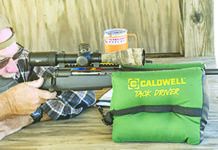
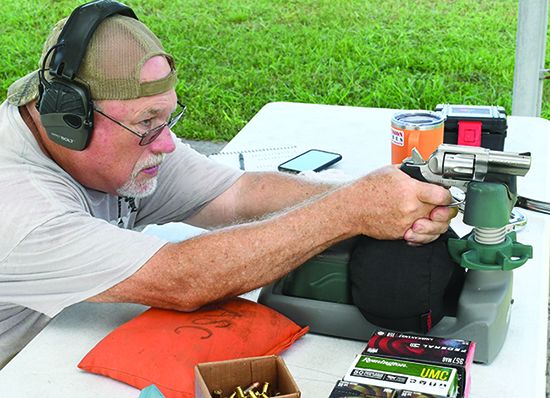
We tested at American Shooting Centers in west Houston. We fired for accuracy at 15 yards by shooting multiple five-shot groups from a well-sandbagged Caldwell Pistolero Shooting Rest (MidwayUSA.com 517357, $28) assisted by a Mini DRC Fortune Cookie from Wiebad.com ($75, MINIFC). We recorded velocities with a Garmin Xero C1 Pro chronograph ($600).
| DRILL NO. 1 DATA | |
|---|---|
| Revolver | Single Shot Average Time |
| Colt Python | 0.714 |
| Rossi RP63 | 0.765 |
| Ruger GP100 | 0.74 |
| S&W Model 686 | 0.68 |
Process: Fire one shot from low ready at a USPSA target at 5 yards. Averages are for 10 repetitions.
| DRILL NO. 2 DATA | |||
|---|---|---|---|
| Pistol | First Shot | Split Average | Total Time |
| Colt Python | 0.647 | 0.263 | 0.92 |
| Rossi RP63 | 0.807 | 0.36 | 1.15 |
| Ruger GP100 | 0.795 | 0.305 | 1.1 |
| S&W Model 686 | 0.68 | 0.267 | 0.97 |
Fire two shots from low ready at a USPSA target at 5 yards. Averages are for three repetitions.
| DRILL NO. 3 DATA | |||
|---|---|---|---|
| Pistol | First Shot | Split Average | Total Time |
| Colt Python | 0.7 | 0.278 | 1.81 |
| Rossi RP63 | 0.75 | 0.333 | 2.08 |
| Ruger GP100 | 0.75 | 0.318 | 2.02 |
| S&W Model 686 | 0.68 | 0.3 | 1.88 |
Fire five shots from low ready at a USPSA target at 5 yards. Averages are for three repetitions.
Our speed tests are not designed to show how fast a firearm can be fired, but to use the same test on multiple guns fired by the same person to look for differences in the guns’ capabilities.
Written and photographed by Joe Woolley, using evaluations from Gun Tests Team members. GT