


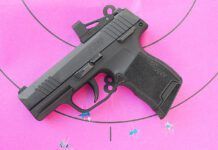










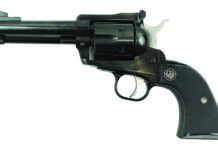
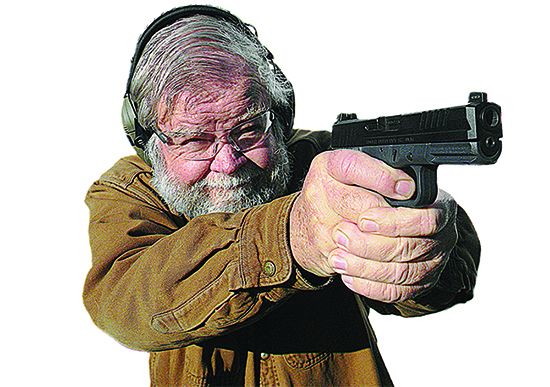
Two new recently introduced guns demanded our attention: the Ruger RXM, a pistol resembling the Glock Generation 3 Model 19, and the Springfield Armory Echelon 4.0C, a compact version of the Echelon 9mm. We elected to pitch them against the most modern version of the Glock, the G19 Generation 5 MOS. These pistols are similar in size and weight as well as capacity, and each is optics ready and has extended magazines available. All are simple to operate, with the only controls being a slide lock, magazine latch, and takedown trigger. There is no manual safety, only safety features. Outside those similarities, the Glock has the greatest aftermarket support at present, but the Ruger will build on that.
We did not make the three types of optics mounting systems a huge part of the test. However, there are differences worth discussing. Even today, every gun doesn’t accept every red dot. The more common footprints offer the most choice, and some otherwise excellent European optics using the Docter foot print are not compatible with some pistols. While all three pistols are optics ready, the Glock and Springfield seem more versatile.
The Ruger’s direct mount is fine for most uses and should be secure. But be certain to choose the red-dot optic first and be certain the handgun is compatible with the optic you want to purchase. Follow procedure, mount the red dot and torque its screw properly, and use just a dot of blue Loctite to secure the optic. Don’t allow Loctite to gravitate into the extractor channel.
The Echelon is a purpose-designed optics-ready pistol, and the red dot sits lower on it than on other pistols. The Springfield’s Echelon’s pin set up is a different mounting process from direct mounting or MOS plates. These pins seem to be the most secure, we thought.
It’s been almost 10 years since the announcement of the Glock Modular Optics System, or MOS. This system uses a series of proprietary numbered plates to adapt the Glock MOS slide from simple iron sights to any of the popular red-dot patterns. The MOS system is fairly straightforward, but it can be difficult for those who have never tried to mount an optic on a pistol before. The manual offers a detailed explanation of the process, but an early pitfall to avoid when purchasing your initial MOS kit is to make sure to purchase the kit for the width of your handgun’s slide.
Ruger RXM 19400 9mm Luger
$399
Gun Tests grade: B
The Ruger/Magpul collaboration is Glock Gen 3-compatible in many ways, including barrels, magazines, and sights. The pistol is a good shooter, outpacing the Glock in important categories. But it isn’t left-hand friendly and doesn’t have grip inserts.
| Action | Semi-auto recoil-operated locked breech, striker fired |
|---|---|
| Trigger | Safe Action, double action only |
| Overall Length | 7.15 in. |
| Overall Height | 5.06 in. |
| Maximum Width | 1.3 in. |
| Weight Unloaded | 21.5 oz. |
| Weight Loaded | 30.7 oz. |
| Barrel | 4.0 in. |
| Slide | Black-phosphate-finished steel |
| Slide Retraction Effort | 15.0 lbs. |
| Receiver | Stealth Gray MagPul polymer |
| Front Strap Height | 2.0 in. |
| Rear Strap Height | 3.6 in. |
| Barrel Length | 4.1 in. |
| Grip | Textured polymer |
| Grip Thickness | 1.25 in. |
| Grip Circumference | 5.8 in. |
| Magazines | (2) 15 round |
| Magazine Price | $13, MagPul 15 round |
| Rear Sight | Serrated notch |
| Front Sight | Fixed tritium dot |
| Sight Radius | 6.0 in. |
| Trigger Pull Weight | 4.5 lbs. |
| Trigger Span | 2.6 in. |
| Safety | Trigger lever |
| Warranty | None Written |
| Telephone | (203) 259-7843 |
| Website | Ruger.com |
| Made In | U.S. |
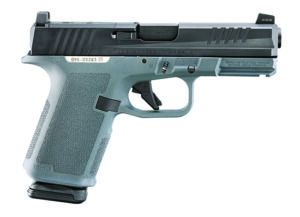
Ruger took a look at the most-popular striker-fired service pistol, the Glock, and redesigned a few items to come up with a credible pistol that seems to be a sure bet in today’s market. In most ways, the RXM is a clone of a Glock Generation 3 Model 19. The pistol is a collaboration between Ruger and MagPul, two companies with a great deal of respect in the industry and reputations for workmanlike gear. In this collaboration, Ruger supplied firearms expertise while MagPul developed the grip frame.
In this trio, the Ruger (UPC: 51655178960) is the least expensive pistol tested by at least a couple of hundred dollars. That said, while there are good features and performance, the pistol doesn’t include grip inserts in the frame or an ambidextrous slide lock. On the other hand, the RXM features a modular chassis and a fire-control unit the Glock lacks. We think $399, $100 less than its MSRP, is a very attractive price for a striker-fired polymer-frame handgun. The Ruger is American made, which means a great deal to many of us in the current economy, and to those who always want to buy American. The pistol isn’t a stripped-down Glock or a second-string pistol, according to our test results.
Ruger chose to introduce the RXM as a Glock 19-size 9mm handgun. The Glock 19 compact is larger and easier to shoot well than subcompact pistols but is also the perfect size and weight for constant carry. The pistol is supplied with two MagPul 15-round magazines. The Glock 19-sized RXM is compatible with Glock 19 holsters, magazines, and even aftermarket barrels. Those are wise choices by Ruger.
This striker-fired polymer-frame handgun features an internal removable chassis in the fashion of the Springfield. Ruger terms the fire control unit an FCI, or fire-control insert. This allows owning a single FCI while adding several frame sizes or slides and barrels. At present, the compact frame is available for $40, and others are certain to follow. As for absolute compatibility, during the test we tried and found the Glock 19 slide would not fit the Ruger frame. However, the Ruger is ostensibly a Gen 3 Glock clone, while our test Glock is a Gen 5. The barrels do interchange. So, you may purchase an aftermarket barrel, if desired, for the Ruger pistol and simply order a Glock 19 9mm barrel. Other parts must be Glock Gen 3 compatible.
The action operates in the same manner as the Glock. Rack the slide, and the action is prepped and a further press of the trigger moves the striker to the rear and fires the pistol. The double-action-only trigger is smooth and tight at 4.5 pounds. Reset is typical Glock, quick. Raters spent considerable time comparing trigger actions. The Glock Gen 5 is the best factory trigger action so far, by all reports, but ours felt like most any other Glock we have tested, outside of a Wilson Combat-modified version. The Springfield has the better trigger. The Ruger and Springfield feel better than the Glock, with the Springfield edging the Ruger out, but only slightly. In common with Glock, the Ruger features a trigger-insert safety lever that prevents lateral discharge from brushing the trigger. The pistol features an internal sear block.
The slide lock is not ambidextrous on the RXM handgun, but it is protected from the thumbs on firing. The magazine release differs from the longer magazine latch of the Glock. It feels as if it pushes straighter in than the Glock; no real difference, but half the raters preferred the Ruger magazine release. Due to the frame’s dimensions, speed was greater, to a noticeable degree, in hitting the magazine during reloads. It is equal to the very fast Springfield, in our estimation. The frame features a fairly wide molded-in magazine well. However, when measured, it actually isn’t larger than the Glock Gen 5, a surprise until we dug more deeply. The magazine well seems wider than the Glock because the Ruger grip is thinner on top of a magazine well the same width as the Glock, which has a thicker grip. It is a matter of feel. There is no provision for a grip plug, as found on the Glock.
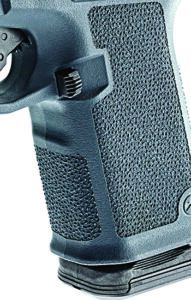
In terms of texture, MagPul designers have created what they call the Trapezoidal Surface Projection. This results in a nice, grippy handle, but not one that is abrasive to clothing. The bore axis is lowered by a dipped-out cut just behind the trigger guard. The Glock features a 22-degree grip angle that was not uncomfortable at all and was well suited to personal defense and controlling the pistol. The Ruger, however, uses superior design to make for a 20-degree grip angle. The result is noticeable in rapid fire and in hand fit. Not an overwhelming advantage, but it certainly exists. Most raters felt this was a fair trade off to have the RXM’s nicely fitting grip but no capacity for backstrap inserts. Small- to medium-size hands find the Ruger to be a good fit. Only the largest hands would need a grip insert, we think.
There was some contention concerning the Ruger’s flared magazine well. One tester felt the flare was too severe and interfered with hand fit. His hands are perhaps the largest of the team. Other testers felt speed loads are smooth and sure due to the flared grip frame. We did not rate the Ruger up or down on the magazine well, but we agreed most shooters will like the flared magazine well.
The black-nitride-finished slide is in contrast with the frame. MagPul calls the frame Stealth Gray. There are bevels on the slide and a lightening slash running through the slide from muzzle to ejection port not found on the Glock. As a result, the Ruger isn’t quite as stylish as the Springfield, but the RXM has a more pleasing appearance than the Glock, if this matters. The beveled slide is easy to holster, and the flats of the slide are more beveled than the Glock’s. There is a loaded-chamber window just behind the barrel hood.
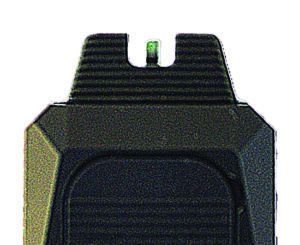
The sights are a square notch rear and a tritium-insert front post. The sights will co-witness with some, but not all, red-dot optics. They are semi-suppressor height, in the words of one shooter, although this may not be completely accurate. The sights are excellent examples of combat sights. The team felt these sights are superior to the factory Glock, considerably so, and they are on par with the Springfield’s sights for most uses. We thought the Springfield sights were slightly ahead of the Ruger’s. All three pistols featured sights properly regulated for 124-grain loads.
Firing tests were uneventful. There were no failures to feed, chamber, fire, or eject. We used both Glock and MagPul magazines in the RXM, in 15-, 17-, 19-, and 21-round capacities to confirm reliability. All fed well. The pistol is fast on target. We really liked the RXM’s improved grip frame, and as the test progressed, as we fired the Glock side by side with the Ruger, we found we consistently fired the Ruger more accurately in combat shooting. It seems the grip angle had some effect on shooting. The Springfield Echelon 4.0C edged the Ruger out in some important shooting categories, but not by a huge margin. In this case, all testers were in agreement, so it was not a case of a shooter simply firing to his ability with each gun. The differences in performance were well defined.
In bench accuracy, the Ruger RXM is nearly as accurate as the Springfield and was more precise than the Glock. We felt that the Ruger’s superior trigger and sights provided an advantage over the Glock.
Our Team Said: The Ruger clearly outperformed the Glock at a far better price. We did rate the RXM down for its lack of grip inserts and because the pistol isn’t left-hand friendly, compared to the other two. Side by side with bargain handguns we have tested in the past, the Ruger RXM looks much better. For example, it is far smoother than the SAR 9 compact the South Carolina team has previously tested, as well as Ruger’s own Security 9 pistol. This is a lot of gun for the money.
| 9MM LUGER RANGE DATA | |||
|---|---|---|---|
| Black Hills Factory New 124-grain JHP | Springfield Armory Echelon 4.0C | Ruger RXM | Glock 19 Gen 5 MOS |
| Average Velocity | 1090 fps | 1068 fps | 1101 fps |
| Muzzle Energy | 327 ft.-lbs. | 314 ft.-lbs. | 334 ft.-lbs. |
| Smallest Group | 1.9 in. | 2.3 in. | 2.4 in. |
| Average Group | 2.2 in. | 2.6 in. | 3.0 in. |
| Hornady Critical Duty 135-grain FlexLock 90236 | Springfield Armory Echelon 4.0C | Ruger RXM | Glock 19 Gen 5 MOS |
| Average Velocity | 1056 fps | 1038 fps | 1070 fps |
| Muzzle Energy | 334 ft.-lbs. | 323 ft.-lbs. | 343 ft.-lbs. |
| Smallest Group | 2.0 in. | 2.2 in. | 2.4 in. |
| Average Group | 2.4 in. | 2.6 in. | 2.8 in. |
| Federal Tactical LE 147-grain HST P9HST2 | Springfield Armory Echelon 4.0C | Ruger RXM | Glock 19 Gen 5 MOS |
| Average Velocity | 996 fps | 1004 fps | 980 fps |
| Muzzle Energy | 324 ft.-lbs. | 329 ft.-lbs. | 313 ft.-lbs. |
| Smallest Group | 2.1 in. | 2.3 in. | 2.6 in. |
| Average Group | 2.4 in. | 2.7 in. | 2.9 in. |
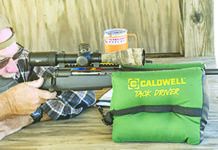
To collect accuracy data, we fired five-shot groups from a bench using an MTM Case-Gard K-Zone rest. Distance: 25 yards. We measured velocities with a Competition Electronics Pro Chrony with the first screen 10 feet from the muzzles.
Written and photographed by Bob Campbell, using evaluations from Gun Tests Team members. GT






Great Article / Evaluation!!! Thank You.
Very informative. As a novice to a new sport and hobby, your article is easy to understand and very much appreciated. Looking forward to reading more of your articles.