







Hiking, hunting, or any activity that can bring you in contact with a brown bear means you should be prepared for the encounter. Or in black-bear country in the spring, you don’t want to get between momma and her cubs. Sure, you can pack bear repellent, but we prefer something other than a peppery spray — such as six doses of 44 Magnum to stop more than 300 pounds of fur, teeth, and claws.
Two powerful revolvers that can administer 240-grain dosages are the Smith & Wesson Model 629 and the Ruger Redhawk. Both are chambered in 44 Magnum, are made of stainless steel, offer six-round capacities, have wood grips, and are fairly easy to carry in rough country. These revolvers pack some recoil depending on the load used. There is a wide assortment of 44 Magnum cartridges to choose from. You can also fire 44 Special ammo out of either of these 44 Magnums for predators with two legs. We know the trend these days is to pack a 10mm semi-auto for bear country, but a 44 Magnum can punch through just as much bear as the 10mm Auto can. And it won’t go out of battery when the bear is on top of you and using you for a chew toy.
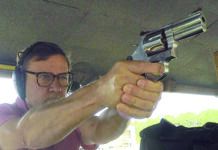
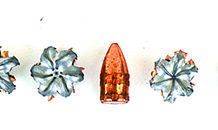
The revolvers were tested for accuracy at 15 yards and for speed at 10 yards. Accuracy was solid for both the Smith and Ruger. The 44 Special choice was Remington Wheel gun loaded with a 246-grain lead round-nose bullet. For 44 Magnum loads, we tested bullet weights ranging from 200 to 305 grains. The Hornady Custom is loaded with a 200-grain XTP jacketed hollow point. Next was PMC Bronze rounds loaded with a 240-grain TCSP (Truncated Cone Soft Point) bullet. The TCSP bullet is not a hollow point but a soft-point design that allows for controlled expansion and deep penetration. On the heavy end was an HSM Bear Load with a 305-grain hard-cast gas-checked heavy-for-caliber lead bullet. Recoil with the PMC and Hornady was a sharp impulse, made even more intense with wood grips and exposed-steel back straps. Recoil with the HSM ammo was stiff, but manageable and well tolerated. It was more of a hard push and roll than a sharp, quick rap.
What revolver would we wear in bear country? Here are our thoughts:
Ruger Redhawk 5043 44 Magnum
$1124
Gun Tests grade: A-
The Redhawk is a time-tested heavy revolver with a dated grip and sights but has good accuracy. It is overbuilt to take the abuse the 44 Magnum round doles out, which means extra carry weight.
| Action Type | Double action, single action |
|---|---|
| Overall Length | 11.0 in. |
| Barrel Length | 5.5 in. |
| Barrel Rifling Twist Rate | 1:20 in. RH |
| Sight Radius | 6.7 in. |
| Overall Height | 5.7 in. |
| Maximum Width | 1.7 in. |
| Weight Unloaded | 49.0 oz. |
| Weight Loaded | 54.2 oz. |
| Cylinder Gap | 0.008 in. |
| Capacity | 6 |
| Frame | Satin stainless steel |
| Barrel | Satin stainless steel |
| Cylinder | Satin stainless steel |
| Frame Front Strap Height | 2.4 in. |
| Frame Back Strap Height | 4.8 in. |
| Grip | Smooth hardwood |
| Grip Thickness (Maximum) | 1.3 in. |
| Grip Circumference (Maximum) | 5.7 in. |
| Front Sight | Replaceable blade |
| Rear Sight | Adjustable notch |
| Trigger Pull Weight (Double Action) | 9.8 lbs. |
| Trigger Pull Weight (Single Action) | 5.9 lbs. |
| Trigger Span (Double Action) | 3.2 in. |
| Trigger Span (Single Action) | 2.8 in. |
| Safety | Transfer bar |
| Warranty None written | Transfer bar |
| Telephone | (336) 949-5200 |
| Website | Ruger.com |
| Made In | U.S. |
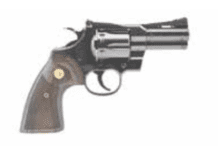
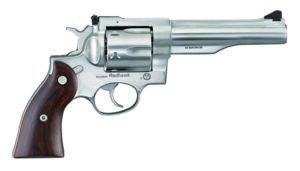
The Redhawk was introduced in 1979 and was the first large-bore double-action revolver produced by Ruger. It has good old-school looks, but in 2025, it is starting to show its age. There is no doubt the Redhawk is built to consume powerful loads. It weighs more than 3 pounds unloaded, and in hand, the balance point is just above the trigger finger. It points nice and natural.
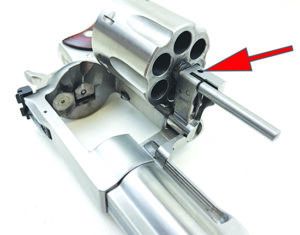
The Redhawk cylinder locks directly into the frame, both at the rear of the cylinder and at the front of the crane. The ejector rod serves as an ejector and does not rotate with the cylinder. The front edge of the cylinder has a slight bevel to ease reholstering. The chambers had slight chamfers on the inside edges, which helps in loading cartridges.
Ruger makes the Redhawk in a variety of barrel lengths, and our sample sported a 5.5-inch barrel, the top of which is serrated to reduce glare. The front sight consists of a dovetailed front ramp with a red insert. As long as the insert has light on it, it pops in the sight picture. We thought the front sight was dated and would have preferred a fiber-optic tube. The rear sight is an adjustable outlined notch. The user-facing side of the rear sight has a matte glare-free surface.
The hammer spur is small and well checkered. The trigger face is smooth, as are the edges of the trigger. Square-edged triggers can rub the user’s finger during recoil and be abrasive.
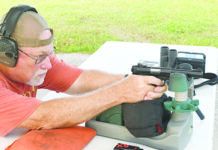
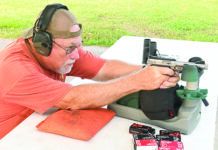
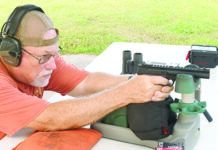
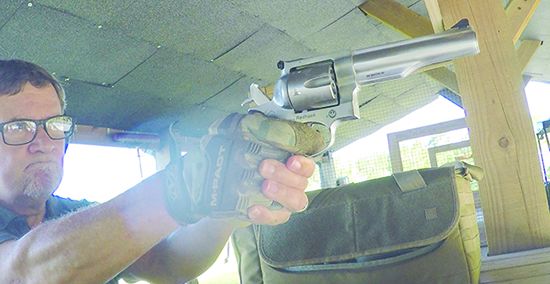
The grip is the other dated part of this massive revolver. The wood stocks are smooth hardwood and are thin, which means recoil is concentrated in a small area of your palm. We found out that the top edges of the grip were not fitted as well as they could be. The grips were not blended smoothly into the backstrap. An edge sliced a thin layer of skin off a tester’s firing-hand thumb after only a few shots with 44 Magnum ammo. If we owned this revolver, we’d blend the wood grips to be smoother with the frame to avoid the abrasion. Or, we would buy a set of rubber grips to replace the wood grips. Regardless, a little masking tape on the abrasion and padded gloves solved the issue well enough to complete the accuracy test, which we shot off our range bag for support.
The Redhawk’s single-action trigger pull was 5.9 pounds, and there was a bit of creep before the shot broke. The 9.8 pound DA trigger pull was smooth with no perceived stacking. The Redhawk is plenty accurate for bear defense, and we would even take this revolver deer or pig hunting.
At the range, the Ruger’s best five-shot group at 15 yards was with the Remington-brand 44 Special ammo with a group that measured 1.30 inches. The average was 1.75 inches. Out of the 44 Magnum loads, the best was the 305-grain HSM Bear Load with a 1.84-inch group and an average of 2.12 inches. This ammo had stout recoil, but not as sharp as the other 44 Mag ammo. Next were the PMC Bronze 240-grainers, with a best group measuring 2.54 inches and an average of 2.72 inches. Hornady Custom with the 200-grain XTP bullet had a best group of 2.70 inches and an average of 2.80 inches. Shooting a 44 Magnum fast is difficult because the shooter must manage severe recoil. At 10 yards, we kept hits in the 12-inch ring of an NRA D-1 Tombstone target, but follow-up shots were slow if we wanted to ensure an accurate subsequent-shot hit.
Our Team Said: The Redhawk is an accurate, powerful revolver. It should come with a second set of rubber grips that make the revolver more comfortable to shoot. We would have liked a front sight that popped more in low light and in bright light. The Redhawk is heavy, and that should be an asset when shooting a 44 Magnum revolver, but it can be tiring when you are carrying it on your hip or under your arm for miles at a time. We know the adage: Carrying a handgun should be comforting, not comfortable. For the price, this a suitable revolver, but it is on the heavy side.
| 44 MAGNUM RANGE DATA | ||
|---|---|---|
| Hornady Custom 200-grain XTP | Ruger Redhawk | Smith & Wesson 629 Mountain Gun |
| Average Velocity | 1562 fps | 1435 fps |
| Muzzle Energy | 1084 ft.-lbs. | 914 ft.-lbs. |
| Smallest Group | 2.70 in. | 2.50 in. |
| Average Group | 2.80 in. | 2.68 in. |
| PMC Bronze 240-grain TCSP | Ruger Redhawk | Smith & Wesson 629 Mountain Gun |
| Average Velocity | 1319 fps | 1231 fps |
| Muzzle Energy | 927 ft.-lbs. | 808 ft.-lbs. |
| Smallest Group | 2.54 in. | 2.66 in. |
| Average Group | 2.72 in. | 2.73 in. |
| HSM Bear Load 305-grain Lead WFN | Ruger Redhawk | Smith & Wesson 629 Mountain Gun |
| Average Velocity | 1212 fps | 1170 fps |
| Muzzle Energy | 996 ft.-lbs. | 927 ft.-lbs. |
| Smallest Group | 1.84 in. | 1.40 in. |
| Average Group | 2.12 in. | 2.10 in. |
| 44 SPECIAL RANGE DATA | ||
|---|---|---|
| Remington Wheel Gun 246-grain LRN | Ruger Redhawk | Smith & Wesson 629 Mountain Gun |
| Average Velocity | 700 fps | 695 fps |
| Muzzle Energy | 268 ft.-lbs. | 264 ft.-lbs. |
| Smallest Group | 1.30 in. | 1.31 in. |
| Average Group | 1.75 in. | 1.65 in. |
To collect accuracy data, we fired five-shot groups from a bench using a rest. Distance: 15 yards with open sights. Velocities and energies were recorded using a Garmin Zero C1 Pro chronograph.
Written and photographed by Robert Sadowski, using evaluations from Gun Tests Team members. GT