






About a generation ago, the 44 Magnum reigned as the most powerful handgun in the world. It has since been toppled in size and power by other cartridges, but not before a few handguns chambered in the round became legendary. Not only with shooters, but also the general public through pop culture.
Three classic 44 Magnums we immediately think of in this vein are the Magnum Research Desert Eagle, Smith & Wesson Model 29, and Colt Anaconda. These are massive handguns. The Colt and S&W are revolvers, and the Desert Eagle is a semi-automatic. Target shooting and hunting are the main purposes for these guns.
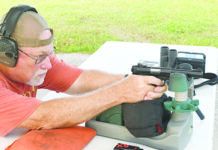
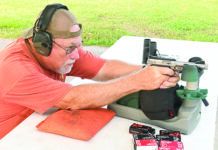
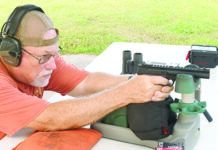
We wanted to pit these iconic handguns against each other to see which one made our day the best. We tested these guns out of the box with open sights at 10 and 25 yards. We collected accuracy data at 25 yards shooting slow fire in single action, operating the hammers manually for each shot. The 10-yard test was combat style in double action for the revolvers and flipping the safety off on the Desert Eagle and shooting single action at a tombstone target.
The sweet spot for 44 Magnum bullet weight is 240 grains, though there are lighter and heavier bullets weights available. For this test, on the light side was Hornady Custom rounds with 200-grain XTP bullets that screamed out of the 6-inch barrels between 1450 and 1500 fps. Yes, this round in particular provides a punch on the target and in the palm of your hand. For 240-grain ammo, we fired SIG Sauer V-Crowns with jacketed hollow-point bullets, Sellier & Bellot soft points, and Black Hills new manufacture jacketed hollow points. Shooting the 240-grain ammo was more tolerable and, in fact, pleasant in the Desert Eagle. For the Smith and Colt, 44 Special ammo is compatible, which is pleasant to the palm in the these heavy revolvers. We didn’t test 44 Specials because they are not compatible with the Desert Eagle.
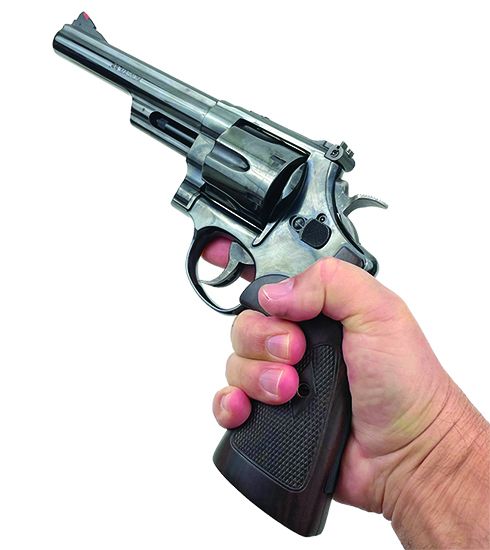
As far as technique goes, it is best to fire these heavy magnums with your elbows locked, letting your shoulders take the recoil. If you bend your elbows, the recoil may kick the gun back toward your face. These 44 Magnums are beasts to shoot, producing a lot of recoil. These are not newbie guns.
The cylinder gap test showed the S&W was bit over spec at 0.009 inches (spec is 0.004 to 0.006 inches). Still, we didn’t get any splatter when shooting the Smith. The Colt was dead in the middle at 0.005 inches. What classic 44 Magnum would we choose?
Smith & Wesson Model 29 Classic 150145 44 Magnum,
$1299
Gun Tests grade: A-
The Model 29 is an iconic retro revolver that was as capable then as it is now for hunting and target shooting. Accuracy was good. The grip needs an update. Trigger was heavy in both double action and single action.
| Action Type | Revolver |
|---|---|
| Trigger Type | Double action/single action |
| Overall Length | 12.0 in. |
| Barrel Length | 6.5 in. |
| Overall Height | 6.1 in. |
| Maximum Width | 1.7 in. |
| Weight Unloaded | 48.0 oz. |
| Weight Loaded | 58.28 oz. |
| Cylinder Gap | 0.009 in. |
| Capacity | 6 |
| Frame | Blued steel |
| Barrel | Blued steel |
| Cylinder | Blued steel |
| Frame Front Strap Height | 2.8 in. |
| Frame Back Strap Height | 4.0 in. |
| Grip | Checkered wood |
| Grip Thickness (Maximum) | 1.3 in. |
| Grip Circumference (Maximum) | 6.2 in. |
| Front Sight | Ramp w/red insert |
| Rear Sight | Adj. notch |
| Trigger Pull Weight (Double Action) | 12.0 lbs. |
| Trigger Pull Weight (Single Action) | 5.3 lbs. |
| Trigger Span (Double Action) | 3.2 in. |
| Trigger Span (Single Action) | 2.8 in. |
| Safety | Hammer stop |
| Warranty | Limited |
| Telephone | (800) 331-0852 |
| Website | Smith-Wesson.com |
| Made In | U.S. |
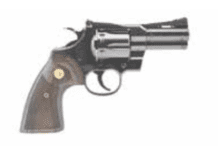
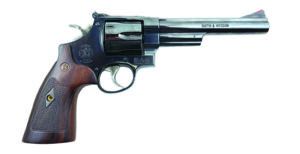
The Model 29 Classic has the retro look of Smith’s guns made in the 1970s and 1980s. This is a 29-10, which means this revolver has the 10th round of engineering revisions. Long gone is the pinned barrel on M29s of yore. This M29 also has an internal lock to deactivate the revolver when not in use. We have never actually used that “safety” feature.
The Model 29 debuted in 1955 and was popular with handgun hunters. When the Dirty Harry movie franchise started in 1971, everyone wanted to be like Clint and dealers couldn’t keep Model 29s on the shelf. We suppose many of those wannabe Dirty Harrys didn’t shoot their newly bought N-frames much once they experienced the recoil. Since then, the Model 29 has been in many movies, TV shows, and video games.
The metal on our sample wears a deep-blue finish, and the hammer and trigger are casehardened colors. The top of the barrel has a matte-blue finish. Grips are a take on the old-school target grips, except this newer evolution is thinner and not as user friendly. The stocks look nice, but, as we found in use, they are thinner and concentrate more recoil into the palm of your hand. Larger target stocks are wider and spread the recoil better in your hand. The gun comes with a hard plastic case and a blue velvet-lined wood presentation box. The Model 29 does look sexy snuggled in the blue velvet.
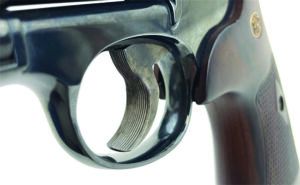
The wide hammer spur, like those found on target revolvers, is checkered and offers great texture to cock and uncock the piece. The trigger is finely serrated and wide, and your finger glides on the trigger face during the double-action stroke. The double-action pull weight is more than 12 pounds, and it feels like it. Though the trigger pull is smooth, it is too heavy, in our opinion. The single-action trigger pull averaged 5.3 pounds and, again, that is too heavy for a target pistol.
The ramp front sight is equipped with a red insert that makes picking up the sight easier on a dark target. The rear sight is fully adjustable and uses a white-outlined notch. The shooter-facing side is also serrated to reduce glare. The ramp front sight is serrated for the same reason. These are good sights. Under the rear sight, the top strap is drilled and tapped to carry an optic.
The crane-to-frame fit was nearly seamless, and we found just a hint of cylinder wiggle. This revolver locks up as tightly as a miser’s wallet.
In hand, the Model 29 has nice balance. Staging the trigger was easy with the right finger control. Staging the trigger is the act of pulling the trigger rearward and stopping just short of the point where the hammer falls and fires the revolver. The last bit of pull makes the trigger pull feel lighter.
Accuracy data showed the best five-shot group at 25 yards was with SIG V-Crown ammo, 0.99 inch, and an average of 1.41 inches. This was the best group out of all the groups we fired. Next best in this gun was Sellier & Bellot ammunition with a best of 1.84 inches and an average of 2.20 inches. The other 240-grain ammo, Black Hills, had a best of 2.50 inches and a 2.56-inch average group size. The best with the hotter Hornady Custom load was 2.37 inches and the average was 2.70 inches. During accuracy testing, we used Mechanic Wear M-Pact Tactical Gloves to deal with recoil. See the January 2025 issue for details on shooting gloves if you plan to shoot magnum revolvers.
Moving to the 10-yard double-action test, we found the M29 fairly easy to control and keep shots in an 8-inch circle, even with the powerhouse Hornady ammo. The trigger pull was smooth and heavy, but we staged the trigger to ensure we hit inside the circle. There was plenty of muzzle flip during recoil.
Our Team Said: The Model 29 Classic easily fits into target and hunting roles. It has a retro look and is equipped as such. Accuracy was good, and we wouldn’t think twice about using this handgun for hunting. If we owned it, we would swap out the factory stock for fuller stocks like the Altamont Coke Bottle Target stocks ($98; AltamontCo.com) and give the Model 29 a even more retro look while adding more shooting comfort. If you are a fan of the Dirty Harry movies, this is the 44 Magnum to own.
| 44 MAGNUM RANGE DATA | |||
|---|---|---|---|
| Hornady Custom 200-grain XTP | Colt Anaconda | Desert Eagle MK XIX | S&W Model 29 |
| Average Velocity | 1445 fps | 1522 fps | 1455 fps |
| Muzzle Energy | 927 ft.-lbs. | 1029 ft.-lbs. | 940 ft.-lbs. |
| Smallest Group | 1.97 in. | 1.21 in. | 2.37 in. |
| Average Group | 2.36 in. | 1.38 in. | 2.72 in. |
| SIG Sauer V-Crown 240-grain JHP | Colt Anaconda | Desert Eagle MK XIX | S&W Model 29 |
| Average Velocity | 1269 fps | 1281 fps | 1280 fps |
| Muzzle Energy | 858 ft.-lbs. | 874 ft.-lbs. | 873 ft.-lbs. |
| Smallest Group | 1.06 in. | 1.99 in. | 0.99 in. |
| Average Group | 1.46 in. | 2.10 in. | 1.41 in. |
| Sellier & Bellot 240-grain SP | Colt Anaconda | Desert Eagle MK XIX | S&W Model 29 |
| Average Velocity | 1220 fps | 1084 fps | 1230 fps |
| Muzzle Energy | 793 ft.-lbs. | 627 ft.-lbs. | 806 ft.-lbs. |
| Smallest Group | 2.18 in. | 1.87 in. | 1.84 in. |
| Average Group | 2.62 in. | 2.29 in. | 2.20 in. |
| Black Hills (new) 240-grain JHP | Colt Anaconda | Desert Eagle MK XIX | S&W Model 29 |
| Average Velocity | 1249 fps | 1059 fps | 1260 fps |
| Muzzle Energy | 831 ft.-lbs. | 598 ft.-lbs. | 846 ft.-lbs. |
| Smallest Group | 1.79 in. | 1.84 in. | 2.50 in. |
| Average Group | 2.07 in. | 2.01 in. | 2.56 in. |
To collect accuracy data, we fired five-shot groups from a bench using a rest. Distance: 25 yards with open sights. Velocities and energies were recorded using a Garmin Xero C1 Pro chronograph.
Written and photographed by Robert Sadowski, using evaluations from Gun Tests Team members. GT

Recoil vs. barrel length question:
My hand can tolerate the recoil of my 3″ S&W 629 but hurts much more from the recoil of my 4″ S&M 629.
Similarly, my hand can tolerate the recoil of my 4″ Colt Anaconda but hurts much more from the recoil of my 6″ Anaconda.
Curiously, my hand can tolerate shooting my Glock 21 easily but hurts much more from the recoil of my Glock 30.
Barrel length, speculations about the amount of powder burned efficiently, or leverage upward from the barrel lengths alone, cannot explain the difference in experienced recoil impulse into the web of my hand.
Do you or your expert shooters have an explanation?
[Please do not use my full name in your reply. The licensing board for my profession in my state may consider my question a resurgence of the brute mind.]