














Introduced by Winchester in 1959, the 22 Winchester Magnum Rimfire (WMR) cartridge, more commonly called 22 Magnum, was designed to bridge the difference between the popular 22 LR rimfire cartridge and more powerful and expensive 22-caliber centerfire rounds. On the low end of the spectrum, the ubiquitous 22 LR can usually push a 30- to 40-grain bullet at 1000 to 1200 fps. On the opposite end, centerfire rounds ranging from the 22 Hornet to the 220 Swift can send 40- and 50-grain bullets anywhere from 2400 to 4000 fps. In between, the 22 WMR round will push a 30- to 40-grain bullet out at 1800 to 2100 fps. Then we ran the energy numbers and found out the diminutive 22 WMR could generate energy approximately equal to a decent 9mm Luger pistol round at those speeds. With newfound respect for the cartridge, we started shopping for rifles chambered in 22 Magnum.
In this feature, we present three different 22 Magnum rifles with three different feature sets and three different price points. The first is a Christensen Arms MPR Rimfire that is truly match worthy but arrives at a near $2k cost. A Ruger American comes in at a much better price, but it is more suited to a life of roaming the woods looking for squirrels and varmints. The third entry is a Savage Minimalist, available at an even better price for what might be a truck or saddle gun.
In more detail, the MPR Rimfire from Christensen Arms, $1726, sports a folding aluminum chassis, full-length slotted fore end, and a Trigger Tech trigger. The MPR Rimfire is designed for competition and any other precision work you need. Second is the Ruger American 08370, $490, which offers a polymer stock with removable pieces that can provide a proper length of pull and cheek height for most needs. Last is a Savage rifle called the Minimalist, and it is. Weighing in at a mere 5.25 pounds loaded, the little Savage Minimalist handles well and was very accurate, we found. Interestingly, all three of these 22 Magnum rifles are threaded for suppressor use, though we didn’t shoot them with a can.
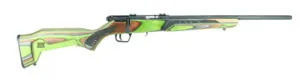
Savage Model 93 Minimalist BNS-SR 22 WMR,
$349
GUN TESTS GRADE: B-
Light, easy to maneuver, and accurate, the Minimalist had problems feeding both of the hollow-point rounds we tried. There were many things we liked about the rifle, but misfeeds are a big downgrade.
| Action Type | Bolt |
|---|---|
| Overall Length | 37.25 in. |
| Barrel | 18 in. long, 1:16 twist |
| Overall Height w/o Scope Mount | 7.25 in. |
| Weight Unloaded | 5.1 lbs. |
| Weight Loaded | 5.25 lbs. |
| Sight Radius | NA |
| Action Finish | Matte blue |
| Barrel Finish | Matte blue |
| Magazine Capacity | 5 |
| Magazine Type | Detachable box |
| Stock | Wood laminate |
| Stock Drop at Comb | 1.0 in. |
| Stock Drop at Heel | 1.0 in. |
| Stock Bedding | None |
| Stock Buttplate | Hard plastic |
| Stock Length of Pull | 13.75 in. |
| Receiver Scope-Base Pattern | 2-piece Weaver bases |
| Trigger Pull Weight | 1.39 lbs. |
| Safety | Two-position thumb rocker |
| Warranty | 1-year limited |
| Telephone | (800) 370-0708 |
| Website | SavageArms.com |
| Made In | U.S. |
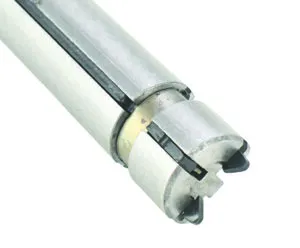
Savage starts off the Minimalist rifle with a slightly different concept on the barrels versus the Christensen and the Ruger in that it is longer at 18 inches and has a slower 1:16 twist. Our dial calipers measured barrel diameter at the action around 0.68 inch and 0.63 inch at the muzzle, showing very little taper on the tube. Like the other 22 Magnum rifles in this test, the Savage’s muzzle is threaded 1⁄2×28 and includes a good metal thread protector.
The receiver is another virtually straight-walled tube into which the barrel is threaded. No Savage-style barrel nut on this one. The top of the receiver is drilled and tapped for Warne-style mounts, which come installed on the rifle.
The working parts are also kept as simple as possible. The safety is a two-position rocker switch located behind the bolt on the right side of the receiver. The trigger is the expected Savage Accutrigger. We’ve had a few issues with those in getting them adjusted properly for our set of trigger snobs. We didn’t have to touch this one. Average required compression from 10 pulls on our Lyman digital trigger gauge was a mere 1.39 pounds, and we loved it. The bolt body has two primary pieces, both of which, again, are the same diameter. It uses dual extractors and the ejector is fixed inside the receiver. Bolt removal requires the shooter to check to verify the rifle is empty, and then, while the rifle is pointed in a safe direction, pull the bolt straight to the rear while depressing the trigger.
The bottom metal really is metal and comes in two parts. The first covers the trigger, and that is all. Not too big and not too small, it worked fine for us. The forward plate serves to guide and protect the magazine along with the magazine release. Both the rear and the forward plates are threaded into pillars which are attached directly to the action.
The magazine release is a lever in front of the trigger guard and at the rear of the magazine. We had no issues securing or accessing the five-round single-stack magazine.
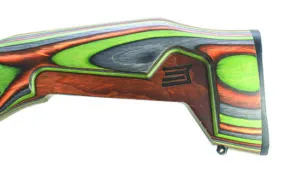
The multi-colored laminated stock looked good and functioned well for us. All the inletting was crisp and smooth. The exterior parts mated with it well. The Savage design on this stock managed to accomplish two things that can be mutually exclusive; the portion covering the receiver was thin and easy to carry while the fore end was flared, flat, and worked well off a sandbag. The rear of the stock was dished out, reminding us very much of a Grayboe Trekker stock. While that carve out saves a little weight, it also makes a great notch for your rear support bag. Two sling-swivel studs are included. Savage saved a bit more money with a thin, hard-plastic buttpad, but recoil isn’t exactly an issue.
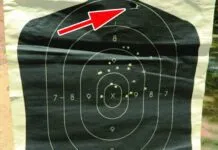
This little Savage shot well, compiling a 0.50-inch average group size. The CCI TNT was the favorite with a 0.340-inch average, while the CCI 40-grain Target and the Speer 40-grain Gold Dot posted 0.52-inch and 0.64-inch averages, respectively.
While the rifle shot and handled well overall, we had trouble with the hollow-point loads. Very few, if any, of the rimfire rifles we’ve inspected have formal feed ramps to help the cartridge transition from the magazine to the chamber. In most cases, as it was with all three rifles in this test, the forward edge of the magazine served as a pseudo feed ramp. The Christensen and the Ruger did just fine with that arrangement. The Savage, however, was having problems with the CCI and Speer hollow points as we watched the bullet nose frequently strike the breech end of the Minimalist’s barrel instead of feeding into the chamber. We’re not sure if it was that particular magazine or something endemic that Savage needs to address. That said, the CCI 30-grain TNT Varmint loads were nails in this rifle.
Our Team Said: The Savage was a lot of good things, mainly light and maneuverable. But the feeding problems irritated us, as we think they would you.
| 22 WMR RANGE DATA | |||
|---|---|---|---|
| CCI Varmint 30-grain VNT | Christensen MPR Rimfire | Ruger American Rimfire | Savage Minimalist |
| Average Velocity | 2165 fps | 2127 fps | 2128 fps |
| Muzzle Energy | 312 ft.-lbs. | 301 ft.-lbs. | 302 ft.-lbs. |
| Best Group Size | 0.21 in. | 0.70 in. | 0.26 in. |
| Average Group Size | 0.31 in. | 0.79 in. | 0.34 in. |
| CCI Maxi Mag 40-grain TMJ | Christensen MPR Rimfire | Ruger American Rimfire | Savage Minimalist |
| Average Velocity | 1891 fps | 1886 fps | 1888 fps |
| Muzzle Energy | 318 ft.-lbs. | 316 ft.-lbs. | 317 ft.-lbs. |
| Best Group Size | 0.24 in. | 0.38 in. | 0.44 in. |
| Average Group Size | 0.36 in. | 0.68 in. | 0.53 in. |
| Speer Gold Dot 40-grain Hollow Point | Christensen MPR Rimfire | Ruger American Rimfire | Savage Minimalist |
| Average Velocity | 1953 fps | 1883 fps | 1935 fps |
| Muzzle Energy | 339 ft.-lbs. | 315 ft.-lbs. | 333 ft.-lbs. |
| Best Group Size | 0.29 in. | 0.54 in. | 0.55 in. |
| Average Group Size | 0.35 in. | 0.62 in. | 0.64 in. |
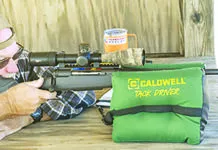
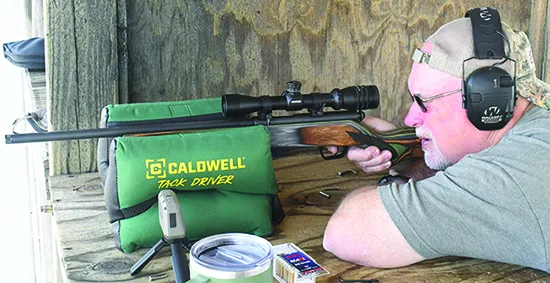
We shot for group and function using three different types of ammo, all available from MidwayUSA.com. The first were 30-grain varmint loads with polymer tips from CCI. The second was a 40-grain total-metal-jacket Target load, also from CCI. The last was a 40-grain Gold Dot hollow-point load from Speer. Our team tested at American Shooting Centers in west Houston. We supported the rifles in a Caldwell TackDriver Pro (Brownells 100-027-023, $49), further supported by a large rear bag, heavy from Tab Gear (TabGear.com, $34). We fired three-shot groups at 50 yards. We measured velocities with a Garmin Xero C1 Pro (Garmin.com, $600). For optics, we used a Redfield Battlezone Tac-22 scope with 2-7x34mm magnification, $250.
Written and photographed by Joe Woolley, using evaluations from Gun Tests Team members. GT