







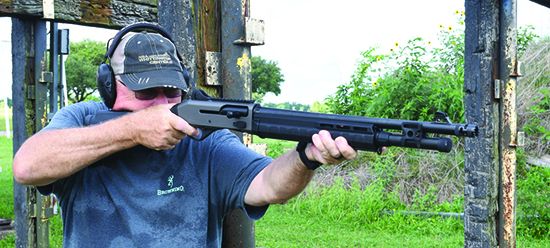
Forty years ago, those of us who were trying to learn how to shoot handguns quickly and accurately decided we wanted to be able to do the same type of sport with rifles and shotguns. The rise of the AR-15 for competition has been well documented — shotguns not so much. Still, the desire to shoot a shotgun fast has driven the development of scatterguns just as with rifles. The result has been technology that is great for self-defense shotguns as well as those for competition.
Our early solution was to take a Remington 1100 and saw the barrel off at a very legal 20-inch length. Then we added a two- or three-round magazine extension tube, put on a new front sight, made sure that we had new O-rings in the gas system, and called it a day. Competition/self-defense shotguns have progressed several generations past that, and we wanted to see what the latest models had to offer, especially because we remembered what we once used. We picked up three of the latest and greatest and went to work.
The first is the Mossberg 940 Pro Tactical 85162, $970, which comes with an 18.5-inch barrel, an eight-round magazine, oversized bolt handle and bolt release, along with receiver-mounted sights, and the receiver is also milled for a red-dot sight.
Next, we acquired a Savage Renegauge 57786, $1649. Designed a bit more for competition, we wondered if the 24-inch barrel would necessarily disqualify if for self-defense use, especially since it offers much the same list of features as the Mossberg.
Our last choice was a Stoeger Model 3000 Tactical FS 36075FS, $640. Now part of the same corporate umbrella as Benelli, and the firm’s famous shotguns, the Model 3000 also uses an inertia-driven action as does its more famous Benelli cousin. Replete with excellent sights, an extended magazine, oversized controls, a Picatinny rail, and a breaching choke, we wanted to see how the inertia-driven action compared to the gas-operated actions of the Savage and the Mossberg.
Stoeger 3000 Tactical FS 36075FS 12 Gauge
$640
Gun Tests grade: A- [best buy]
Even with a slightly sharper recoil impulse than the other two shotguns, the Stoeger was very fast and controllable. It may not be a Benelli, but for under $700, we think this is a heck of a shotgun.
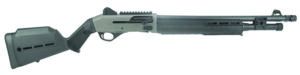
| Action Type | Semi-auto |
|---|---|
| Overall Length | 41.75 in. |
| Barrel Length | 18.5 in. |
| Overall Height w/o Scope Mount | 9.0 in. |
| Weight Unloaded | 7.1 lbs. |
| Weight Loaded | 7.8 lbs. |
| Sight Radius | 24.0 in. |
| Action Finish | Cerakote |
| Barrel Finish | Cerakote |
| Magazine Capacity | 7 rounds |
| Magazine Type | Tube |
| Stock Material | Synthetic |
| Stock Drop at Comb | 0.5 in. |
| Stock Drop at Heel | 0.75 in. |
| Stock Buttplate | Rubber |
| Stock Length of Pull | 13.75 in. |
| Receiver Scope-Base Pattern | Picatinny rail |
| Trigger Pull Weight | 4.49 lbs. |
| Safety | Crossbolt |
| Warranty | 5-year limited |
| Telephone | (800) 264-4962 |
| Website | StoegerIndustries.com |
| Made In | Turkey |
Most of the folks familiar with these pages are going to recognize the Benelli M4 shotgun. Selected by the U.S., British, and Italian militaries, the M4 is a fast-working, smooth-shooting scattergun well suited to harsh requirements. Civilian models cost in the $2200 range and, sometimes, can be difficult to find. Did you know that the same corporation (Beretta) also produces a similar product under a different name? Oh, and this one costs less than $700?
Stoeger, with manufacturing facilities in Turkey, was once part of the Sako Oy stable and was acquired by Beretta at the same time they purchased Sako, Tikka, and a few other brands. Benelli is made in Italy, and we won’t try to say they are the same shotgun. The Stoeger is made to slightly looser tolerances, and there aren’t as many bells and whistles as on the Benelli, which has fittings to allow changing cast, drop, and cheek height, as one example. The Stoeger also uses a recoil spring that is located under the fore end instead of in the stock. Think of Stoeger as Honda to the Benelli Acura. That said, several members of this test group are very pleased with their quite nice, less expensive Hondas.
The differences between the Stoeger, the Savage, and the Mossberg start with the action and the operating system the Stoeger uses. The Mossberg and Savage employ gas-operated systems, whereby some gas is bled off from the ignition of the powder, then redirected back through ports and pistons to move the parts of the action. Like the Benelli, the Stoeger uses an inertia-driven system.
According to the Stoeger video, they tried to create a simple operating system designed around basic physics. One of the recognized laws of physics states that an object at rest tends to stay at rest, and so it is with the bolt on the Stoeger. The trigger is pressed, the hammer falls, powder ignites, the shot column moves forward, and the shotgun moves to the rear — at least the fixed parts do. The bolt — not a fixed part — stays in place momentarily, while the rest of the firearm recoils to the rear. The difference in movement compresses a very stout spring between the bolt body and the bolt head. As the shot charge leaves the barrel and the rearward force diminishes, the spring rebounds vigorously, throwing the bolt body to the rear with enough force to unlock the rotating bolt. Everything moves back forward, cocking the hammer, lifting the shell into alignment with the chamber, inserting it, and then rotating the bolt head back into the extension on the barrel. The system essentially uses only three parts: the bolt body, spring, and bolt head. Simple and effective, systems like this tend to be very forgiving about feeding different kinds of ammunition. We’ve tested Turkish-made shotguns before to good review and were looking forward to testing the Stoeger.
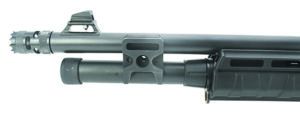
Our three tactical 12 gauges seem to share much of the same feature set. The Stoeger also has an 18.5-inch barrel threaded for choke tubes. Our sample came equipped with a breaching choke. With little constriction — usually not very different from Cylinder bore — the breaching choke uses a very pointed extension good for two purposes. The first is for actually breaching a locked door. The vented extension on the tube allows the muzzle to be placed directly against hinges or locks. One or two shots will remove most hardware from any further interference with your task. The prongs on the leading edge of the choke not only help anchor the muzzle in place for a breaching shot, they can also serve as a very definite pain compliance device if the altercation gets up close and personal. The Stoeger uses the Beretta/Benelli Mobil Choke system, meaning other Benelli or Beretta chokes you have should work well.
The blued 18.5-inch barrel on the Stoeger mates up with a tungsten Cerakoted receiver. The attachments are what we would expect. The barrel is capped with a prominent front sight. The front-sight blade shows a single white dot and, along with its protective wings, sits in a dovetail slot that allows some lateral movement for windage adjustments. The whole assembly is permanently mounted to the top of the barrel. The taller front sight is required due to the receiver design. Our other two shotguns use receivers where the top and the barrel are almost the same height. For the Stoeger, there is a step down from the receiver to the barrel extension necessitating a little more rise on the front sight. A barrel clamp secures the two-shot extension to the barrel and provides two more M-Lok slots for accessories.
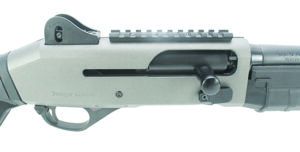
The rear sight contains two parts that should allow the shooter to do just about anything they need. First is a 10-slot Picatinny rail that secures to the top of the receiver using four screws. There is plenty of real estate there for red-dot sights. The rear sight is just behind the Pic rail and consists of a Ghost Ring aperture that is protected by wings and is adjustable for windage and elevation. The mount for the rear sight can also be used to direct-mount a red dot, and two adapter plates are included with the shotgun.
Most tactical-style firearms are equipped with controls that use gross motor skills for activation instead of the fine motor skills that always seem to depart when we are excited. The bolt handle is large, round, and extended for easy grasping. The bolt release is a largish paddle located just below the bolt handle that is also easy to find and manipulate. The Stoeger also uses a cross-bolt safety just behind the trigger. As with the Savage, the Stoeger requires the activation of one more button to feed a round into the chamber. Where Savage calls it a cartridge-release elver, Stoeger has named it the cartridge-drop lever. Located in a similar location above the front web of the trigger guard, the lever must be pushed to allow a loaded round to be ejected from the magazine tube and placed on the lifter for insertion in the chamber.
Part of the versatility people like about using a shotgun for self-defense is the variety of ammunition that can be run through it. A good scattergun won’t care if you are running birdshot, high-brass buck shot, or slugs. To do so, however, requires that the shooter be able to easily change the ammunition — specifically, the round in the chamber — to another type and get back in the fight. The Stoeger allows the shooter to pull back on the bolt handle to remove the currently loaded round and then slip another onto the lifter for immediate chambering without having to deal with an additional round popping out of the magazine. Very helpful.
The fore end is a black synthetic as is the buttstock. Sporting coarse ribs, it provides M-Lok slots at 3, 6, and 9 o’clock. The pistol grip on the buttstock reminded us of the unit on the Savage. Angling down at about a 45-degree angle with good stippling, we found it comfortable and easy to control. The buttstock also provides a raised cheek piece, but with the higher sights, we weren’t about to get a good cheek weld with the unit on the shotgun. That said, a good chin weld can work just fine, and shotguns with too high a rear stock can beat your face to pieces when firing heavy loads. Given the choice, we’ll take the slightly lower stock. The stock also adds in a thick recoil pad, more M-lok slots, two QD cups, and a location for a sling swivel.
The difference in action type was evident when we were shooting. To us, the inertia-driven system produces a sharper recoil impulse than the two gas-guns. The surprising thing to us was that it didn’t affect how quickly we could run the gun. More recoil usually has a negative effect on speed, but not with the Stoeger. It produced the fastest time on the plate rack. These are five 6-inch plates that we shot from 8 yards. Start position was low ready. The Stoeger cleaned all five in just 1.31 seconds. It also did this with a surprising lack of muzzle flip. We even did the speed run with the 00 buck at 5 yards. Only one round out of 10 fired hit outside the 5-by-11-inch A Zone.
Our Team Said: We hear that the Stoegers are made to a slightly lower standard than the Benelli’s made in a different factory. Still, this Stoeger worked very well, and we would love to see how it would hold up for an endurance test against its much more expensive cousin.
| DRILL NO. 1 DATA | |
|---|---|
| Shotgun | Average Time |
| Mossberg 940 Pro Tactical | 1.24 |
| Savage Renegauge | 1.24 |
| Stoeger 3000 Tactical FS | 1.25 |
Process: Using 00 buckshot, fire five rounds at 7 yards at a 9-inch paper plate.
| DRILL NO. 2 DATA | |
|---|---|
| Shotgun | Average Time |
| Mossberg 940 Pro Tactical | 1.84 |
| Savage Renegauge | 1.36 |
| Stoeger 3000 Tactical FS | 1.31 |
Process: Using No. 7½ shot, fire five rounds at 6-inch steel plates at 8 yards.
Our speed tests are not designed to show how fast a firearm can be fired, but to use the same test on multiple guns fired by the same person to look for differences in the guns’ capabilities.
| 12-GAUGE RANGE DATA | |||
|---|---|---|---|
| Winchester Super-Target 2¾-inch No. 7½ Shot 1 oz. | Mossberg 940 Pro Tactical | Savage Renegauge | Stoeger 3000 Tactical FS |
| Average Velocity | 1370 fps | 1332 fps | 1342 fps |
| Muzzle Energy | 1824 ft.-lbs. | 1724 ft.-lbs. | 1750 ft.-lbs. |
| Federal Power-Shok 2¾-inch No. 4 Buckshot | Mossberg 940 Pro Tactical | Savage Renegauge | Stoeger 3000 Tactical FS |
| Average Velocity | 1245 fps | 1300 fps | 1221 fps |
| Muzzle Energy | 1959 ft.-lbs. | 2136 ft.-lbs. | 1883 ft.-lbs. |
| Hornady Black 2¾-inch No. 00 Buckshot | Mossberg 940 Pro Tactical | Savage Renegauge | Stoeger 3000 Tactical FS |
| Average Velocity | 1505 fps | 1616m fps | 1528 fps |
| Muzzle Energy | 1981 ft.-lbs. | 2286 ft.-lbs. | 2043 ft.-lbs. |
Additional specifications: Winchester Super-Target TRGT13507. Factory muzzle velocity: 1350 fps. Federal Power-Shok F127 4B, 27 lead pellets, .24 caliber. Factory muzzle velocity: 1325 fps. Hornady Black 86249, eight lead pellets, .33 caliber. Factory muzzle velocity: 1600 fps.
Written and photographed by Joe Woolley, using evaluations from Gun Tests Team members. GT