











The 32 H&R Magnum has recently received a new home in the Smith & Wesson/Lipsey’s Exclusive Model 632. Announced in early 2025, the 632 J-frame wasn’t just chambered in the rare and uncommon 32 H&R Magnum cartridge, the revolver itself has gone through some enhancements to improve performance. With a new 32-caliber revolver available, we thought it would be a good to time to revisit the round and match it up against the longer and more powerful 327 Federal Magnum, another cartridge that lacks enthusiast attention. Is the lack of attention due to the mousy size of the bullet, or have 32 calibers had their day a century ago and are fading away like the 40 S&W cartridge? In our opinion, either of the 32-caliber magnums would make a viable alternative to 38 Special or 357 Magnum revolvers of the same size. The 32-caliber guns typically have a six-shot capacity compared to a five-shot capacity of the 38s and 357s. There is less recoil with the 32 magnums, yet the cartridges still provide a substantial punch. Remember, a snubnose revolver, like a subcompact semi-auto, is a get-off-me gun that provides the user a way to get out of a dire situation. They are not designed for extended gun fights with multiple reloads.
With that in mind, we pitted a Ruger LCR in 327 Federal Magnum against the S&W Model 632 in 32 H&R Magnum and discovered a newfound appreciation for these rounds. Sure, the bullet size is diminutive, but between the longer cases and extra powder, it is not the size of the bullet that matters, but how you shoot it and how it hits that count.
Both of these revolvers are double action only, feature fixed sights, have six-round capacities, and are easy to conceal. We looked at these revolvers for ease of use, smoothness of the DAO trigger pull, ease of conceal carry, and accuracy.
Both the 32 H&R Mag and the 327 Fed Mag are versatile because you are able to shoot both 32 S&W and 32 S&W Long in revolvers chambered for these two magnums. You can also fire the 32 H&R Mag in a revolver chambered for 327 Fed Mag. You can’t fire 327 Fed Mag in a 32 H&R Mag because the 327 Fed Mag cases are too long. We fired two types of 32 S&W Long ammo: Fiocchi 97-grain FMJs and Sellier & Bellot 100-grain LFNs, which offer minimal recoil and pretty darn good accuracy from DAO snubnose revolvers. Moving up the power ladder to 32 H&R Mag, we used Hornady Critical Defense with an 80-grain FTX bullet and fired a +P load with a 100-grain JHP from Buffalo Bore. The next rung up in power is the 327 Fed Mag, so we fired Hornady Critical Defense with an 80-grain FTX bullet and Federal American Eagle with a 100-grain JSP in the Ruger. We found that certain ammo worked great, while with others, empty cases jammed the chambers, and one made 6-inch groups with keyholing bullets.
Accuracy with a DAO snubnose is almost a misnomer, but we tested accuracy at 10 yards using a rest, and we can vouch that the DAO triggers in both of these revolvers are very good, with smooth pulls and hardly any stacking. The true test of these snubbies is close-range shooting, so we performed the Failure Drill with them, which we feel is an excellent drill to test target acquisition, trigger press, speed shooting, and accuracy.
Also, we carried each revolver for a few weeks in high heat and humidity, both riding in a Galco StuckOn-U pocket holster ($34; GalcoGunLeather.com) in cargo shorts, along with Tuff Products eight-round QuickStrips (two sets for $12; TuffProducts.com). We found that both of these 32-caliber revolvers were comfortable to carry, even while we were wearing cargo shorts and T-shirts. The QuickStrips lay flat in your pocket and allow you to load two chambers at a time. They are not as fast at reloading as round speed loaders, but they are still quicker than loading a round at a time.
After the brass cooled, we found we liked to carry the S&W Model 632 better, but we liked the versatility of ammo choices with the Ruger LCR. Here are the details.
Ruger LCR 5452 327 Federal Magnum,
$675
Gun Tests grade: A- [best buy]
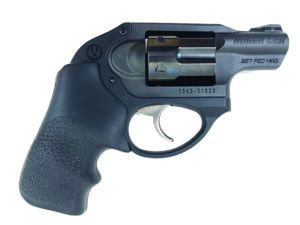
The LCR has been adapted to a variety of cartridges, and in our opinion, this 327 Fed Mag version is a good combination power, capacity, and concealability.
| Action Type | Double action only, revolver |
| Overall Length | 6.5 in. |
| Barrel Length | 1.8 in. |
| Barrel Rifling Twist Rate | 1:16 in. RH |
| Sight Radius | 3.5 in. |
| Overall Height | 4.5 in. |
| Maximum Width | 1.3 in. |
| Weight Unloaded | 17.0 oz. |
| Weight Loaded | 19.3 oz. |
| Cylinder Gap | 0.010 in. |
| Capacity | 6 |
| Frame | Stainless steel/polymer |
| Barrel | Steel |
| Cylinder | Stainless steel |
| Frame Front Strap Height | 1.7 in. |
| Frame Back Strap Height | 3.0 in. |
| Grip | Hogue Tamer Monogrip |
| Grip Thickness (Maximum) | 1.2 in. |
| Grip Circumference (Maximum) | 5.2 in. |
| Front Sight | Replaceable white bar blade |
| Rear Sight | Fixed notch |
| Trigger Pull Weight | 10.4 lbs. |
| Trigger Span | 2.8 in. |
| Safety | Transfer bar |
| Warranty | None stated |
| Telephone | (336) 949-5200 |
| Website | Ruger.com |
| Made In | U.S. |
The LCR has been chambered in a number of cartridges by Ruger, and we have tested many of those variants, from 22 LR and 9mm to 38 Special and 357 Magnum. To be truthful, shooting 357 Magnum ammo out of a lightweight snubnose revolver is not fun. So we were looking forward to trying the LCR in 327 Federal Magnum, a step up in power over the 32 H&R Magnum and a leap above the 32 S&W Long. The 327 Fed Mag version of the LCR is on the hefty side at 17 ounces unloaded; the 38 Special +P variant weighs only 13.5 ounces. That’s heavier than the 632 by 4 ounces, so the LCR was noticeably heavier to carry in a pocket. Any heavier and it would be better to carry in a belt holster, we thought. The way the LCR is built, it is also bulkier than the 632.
The LCR uses a stainless-steel cylinder and frame and a polymer fire-control housing. The metal wears a nice PVD finish, and the smooth trigger has a matte-stainless finish. The LCR’s looks are all business. The trigger uses a friction-reducing cam, which is unique for a revolver. Though the trigger pull averaged 10.4 pounds, it felt less, with no stacking. The trigger was easily staged.
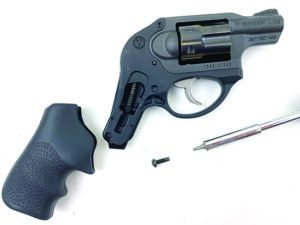
The grip, which is a Hogue Tamer Monogrip, sits on a peg, so there is plenty of rubber to help absorb recoil. The grip has a pebble finish that offers good adhesion and no abrasion. The finger-groove design allows the user to grab the revolver high, with a firm hold. The ramp front sight is pinned in place, so it is easy to customize. The ramp has a white insert, which is easy to acquire, even in dim light. The rear sight is a wide, fixed groove, below which the frame and fire control housing appear.
The LCR had the smallest group with the 32 S&W Fiocchi that measured 0.64 inch and averaged 1.17 inches. That group was impressive out of a DAO stubby-barrel revolver. The Sellier & Bellot had a best group of 2.46 inches and an average of 2.95 inches. The 32 H&R Mag ammo had a best of 2.28 inches and an average of 2.41 inches. The +P Buffalo Bore had a best group of 2.30 inches and average of 2.90 inches. However, the Buffalo Bore cases stuck in the cylinder, requiring us to ram the ejector rod against the wood bench to dislodge the empty cases. The 327 Fed Mag ammo was significantly hotter, with more recoil, than the 32 H&R Mag. Our best group with the Federal American Eagle measured 2.54 inches and averaged 2.87 inches. Surprisingly, the Hornady ammo keyholed, making perfect side-profile cutouts of the bullets in groups that measured larger than 6 inches. We assume the rifling in the LCR, which is 1:16 inches, didn’t jive with the 327 FM bullet, even though the same size and type of bullet in the Hornady 32 H&R Mag worked fine. The barrel crown was also perfect. Maybe the bullets were undersized? The two 327 Fed Mag ammo brands tested both had a similar muzzle velocity, but the 100-grain jacketed soft point by Federal stabilized. Across all ammo choices, the point of impact varied depending on how mild or hot the load, so that was something we needed to compensate for when aiming.
The two fast shots to the center of the target in the Failure Drill were easy to perform with the mild 32 S&W rounds. The hot 327 FM rounds required more concentration. Recoil was noticeable, but tolerable, due to the LCR’s grip design. All ammo except the Buffalo Bores ejected with no issues. The short ejector rod on the LCR does not fully push out the cases, so we used gravity to spill them out.
Using the QuickStrips means loading two rounds at a time in the chambers and twisting the flexible strip to free the rounds and allow them to drop into the chambers.
The LCR was heavier in our pockets, but it was still concealable, even in lightweight cargo shorts.
Our Team Said: The LCR is a workhorse 32 capable of utilizing a range of 32-caliber ammos. Even though point of impact changes by cartridge speed, this allows you to train or teach someone with a mild-recoiling round and working them up to hotter magnum ammo. We liked the smooth trigger and the six-round capacity. This is a Best Buy due to the versatility of ammo options, smooth trigger, and relative ease in conceal carrying. If you always wanted to get into an LCR but didn’t want to deal with the recoil in larger centerfire options, then this is good model to buy.
| 32 S&W LONG RANGE DATA | ||
| Fiocchi 97-grain FMJ | Ruger LCR | S&W Model 632 |
| Average Velocity | 736 fps | 738 fps |
| Muzzle Energy | 117 ft.-lbs. | 117 ft.-lbs. |
| Smallest Group | 0.64 in. | 1.00 in. |
| Average Group | 1.17 in. | 1.08 in. |
| Sellier & Bellot 100-grain LFN | Ruger LCR | S&W Model 632 |
| Average Velocity | 779 fps | 571 fps |
| Muzzle Energy | 135 ft.-lbs. | 125 ft.-lbs. |
| Smallest Group | 2.46 in. | 1.88 in. |
| Average Group | 2.95 in. | 2.10 in. |
| 32 H&R MAGNUM RANGE DATA | ||
| Hornady Critical Defense 80-grain FTX | Ruger LCR | S&W Model 632 |
| Average Velocity | 965 fps | 979 fps |
| Muzzle Energy | 165 ft.-lbs. | 170 ft.-lbs. |
| Smallest Group | 2.28 in. | 1.46 in. |
| Average Group | 2.41 in. | 1.78 in. |
| 32 H&R MAGNUM +P RANGE DATA | ||
| Buffalo Bore 100-grain JHP | Ruger LCR | S&W Model 632 |
| Average Velocity | 1238 fps | 1090 fps |
| Muzzle Energy | 341 ft.-lbs. | 263 ft.-lbs. |
| Smallest Group | 2.30 in. | 1.15 in. |
| Average Group | 2.90 in. | 1.57 in. |
| 327 FEDERAL MAGNUM RANGE DATA | |
| Hornady Critical Defense 80-grain FTX | Ruger LCR |
| Average Velocity | 1273 fps |
| Muzzle Energy | 288 ft.-lbs. |
| Smallest Group | NA |
| Average Group | NA |
| Federal American Eagle 100-grain JSP | Ruger LCR |
| Average Velocity | 1272 fps |
| Muzzle Energy | 359 ft.-lbs. |
| Smallest Group | 2.54 in. |
| Average Group | 2.87 in. |
To collect accuracy data, we fired five-shot groups from a bench using a rest. Distance: 10 yards with open sights. We recorded velocities and energies using a Garmin Xero C1 Pro chronograph.
Written and photographed by Robert Sadowski, using evaluations from Gun Tests Team members. GT