





Analysis: 2d Amendment Extension Likely
Who Was Missing from Press Club Meet? Gun Owners, Of Course
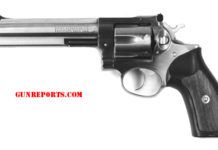
Ruger GP-100 .357 Magnum, $474
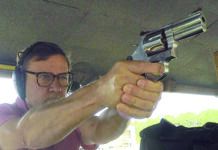
The Ruger GP100s grips were black rubber without grooves, but the sides had decorative inserts of brown wood-like material (which some actually found attractive) that give the gun a distinctive look. The grips felt just great in both aimed single-action fire and in rapid-fire double action. Recoil was spread over a large area of the hand and that made for good shooting comfort, even with the heaviest loads.
The controls all functioned well and positively, and we found this to be a pleasant gun to handle and shoot. The trigger was well curved and smooth, and the double-action cycling was just slightly heavier than that of the Smith & Wesson. Trigger movement was even and smooth enough to permit good accuracy when shooting it slowly in the double-action mode.

Full-Size 9mm 1911-Style Pistols: Kimber, Springfield, STI
It could be said that the Browning 1911 pistol has evolved more than any other design. The operating principal remains the same, but alternate configurations have been applied to nearly every facet of its execution. In fact, it is now commonplace to buy over the counter what not long ago would have been considered a full-blown custom pistol. We all know about beveled magazine wells, frame checkering, undercutting the trigger guard for a higher grip, high-arch memory groove grip safeties, extended magazine releases, aluminum triggers adjustable for overtravel, light rails on the dust cover, extended and/or ambidextrous safeties, checkered slide stops, skeletonized hammers, titanium firing pins, front and rear serrations on the slide, weight reducing slide cuts, lowered and flared ejection ports, full length guide rods, bull barrels, multi-spring recoil systems, external extractors, spring-loaded internal extractors, ramped barrels, adjustable sights for target, adjustable low-mount sights for carry, light-gathering-filament sights, or self-illuminating modules for front and rear sights.
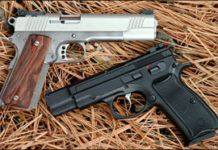
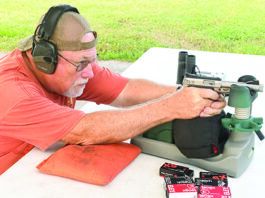
In this test we will evaluate three full-size 1911-style pistols that include several of the above-mentioned features. A few years ago we would have called them factory customs, but that term is obsolete. The most distinguishing characteristic of our trio was that all were chambered for 9X19 shells, aka 9mm Parabellum or simply 9mm. They are the $1299 STI Duty One, Springfield Armory's $1277 Loaded Full Size Stainless Steel 9X19 No. PX9130LP, and the $1277 Kimber Custom Aegis II. All three guns shipped with and fed from identical 9-round MetalForm-brand single-stack magazines. Otherwise, there were significant differences between the pistols. Each gun represented a different viewpoint of what a 9mm 1911 should be. As a result, each gun had a slightly different personality, which we took into account in our grading.
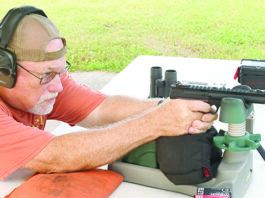
The holiday season was upon us and the radio was playing old favorites like "Baby It's Cold Outside." So we accepted an offer from Houston's Top Gun Training Center to conduct our test indoors. The range was under renovation, so while the ActionTarget.com folks were working their magic on one shooting bay, we set up targets at the other end of the building. Test distance was 15 yards and Black Hills ammunition was used exclusively in our tests. For break in we opened a case of 124-grain FMJ ammunition packed in blue boxes (remanufactured). Both our 115-grain FMJ and 124-grain JHP rounds were new manufacture (packaged in red boxes). We brought in a portable shooting bench and went to work firing five-shot groups. Here is what we learned.
Glock GL23 .40 S&W
C.O. Arms Introduces Scorpion, Stinger 1911s
Two Gun Tests Guns Available on GunBroker.com
Mac-Style Handgun Now Available in 22LR
Ruger 50th Year New Model Blackhawk Flat Top, $583
The all-steel Ruger flat top 50th Year Blackhawk had remarkably clean lines and comfortable Colt-size grips. The Micro sight didn't need to be touched. The Ruger laid 'em in there a touch better than two others, and looked great doing it. The front of the cylinder was beveled to ease holstering.
California Man Open Carries, Gets Booted from Store
Kimber, CZ Compete: 22 LR Conversions for Centerfire Guns