


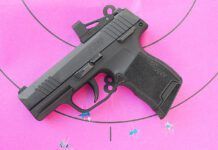
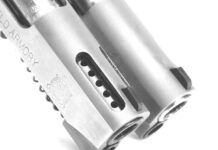






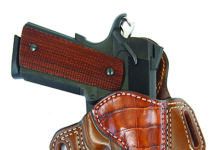




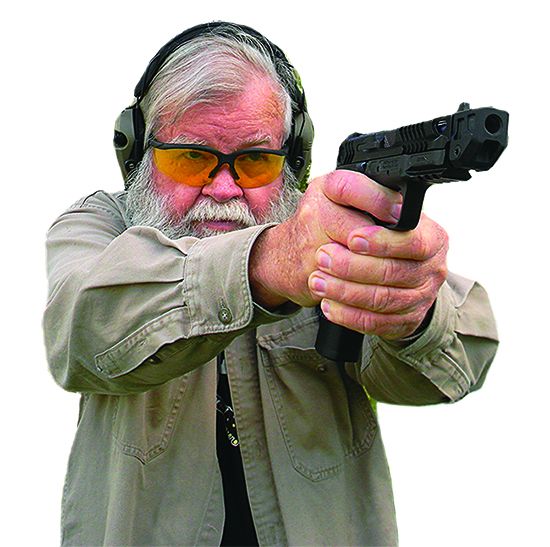
Here we test two handguns suited to Action Pistol competition, one a relatively recent introduction from Canik, the TTI Combat, $900, and the other, Smith & Wesson’s Spec Series V M&P Metal HD, $1500. Both have heavier frames, long barrels, striker-fired mechanisms, and compensators. With all these features, they should make a 9mm handgun a truly enjoyable firing experience. Ramp up the sights and add a good trigger action, and you have a handgun well suited to many types of Action competition.
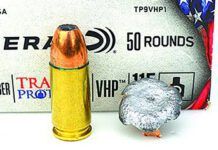
For the firing tests, we used five different types of 9mm Luger ammunition, a good spread from affordable full metal jackets to match-grade loads and one defense load. These were the Fiocchi Range Dynamics 147-grain FMJs, Blazer 115-grain Brass Case FMJs, Federal Premium Gold Medal Action Pistol 147-grain FMJs, and Winchester Super Suppressed 147-grain subsonic FMJ “encapsulated.” This odd terminology means that Winchester inserts a brass disc under the base of the bullet core to reduce lead fouling in barrels and suppressors. The sole defense load was Black Hills Ammunition’s 124-grain JHP +P. This gave us a wide range of performance. We fired one box each of the four FMJ loads in each handgun, a total of 200 rounds in each gun. We fired 20 rounds of the Black Hills Ammunition +P loads in each gun to gauge reliability. Our shooters fired combat style at torso silhouette targets at 7, 10, 15, and 25 yards and bullseye targets both offhand and from a benchrest. During the test, we had no failures to feed, chamber, or eject. Initially, the Canik had several incidents of failing to set the trigger. One tester called it a failure to go into battery. The Canik’s owners manual recommends a 150-round break-in period, so we didn’t dock it for the failures inside that shot window. Just the same, most guns these days don’t require a break in.
For accuracy testing, we used three loads, the Federal Gold Match 147 grain, Black Hills 124-grain +P, and Blazer 115-grain FMJ.
We considered whether the guns are left-hand friendly. Each has no problem with changing the magazine release to left-hand use. Also, the two pistols feature ambidextrous slide locks. The triggers are not right- or left-hand oriented. In the end, the pistols are as left-hand friendly as possible for a right-ejecting semi-automatic, but even then there wasn’t a problem. Firing left handed with right-hand ejection didn’t cause a problem for our shooters.
In our evaluation, we found one gun would be a suitable entry-level competition piece, while the other would be Our Pick for defensive and service use. Here’s how they performed in our side-by-side shooting evaluation:
Smith& Wesson Spec Series V M&P 9 Metal HD 14284 9mm Luger,
$1500
Gun Tests grade: A [our pick]
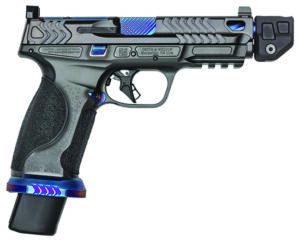
The Series V is more than a steel-frame Spec Series. The trigger is one of the best striker-fired types we have tested. There’s nothing to criticize when the pistol’s target role is considered.
| Action Type | Double action semi-auto |
|---|---|
| Overall Length | 8.5 in. |
| Overall Height | 5.5 in |
| Maximum Width | 1.3 in. |
| Weight Unloaded | 39.6 oz. |
| Weight Loaded | 45.8 oz. |
| Barrel Length | 4.8 in. |
| Slide | Armornite finish |
| Slide Retraction Effort | 18.6 lbs. |
| Receiver | Black-finish stainless steel |
| Front Strap Height | 2.5 in. |
| Rear Strap Height | 3.75 in. |
| Grip Thickness | 1.2 in. |
| Grip Circumference | 5.75 in. |
| Magazines | (3) 23 round |
| Magazine Price | $43 |
| Rear Sight | 2-dot tritium |
| Front Sight | Single-dot tritium |
| Trigger Pull Weight | 3.5 lbs. |
| Trigger Span | 2.75 in. |
| Sight Radius | 6.25 in. |
| Safety | None |
| Warranty | 1 year |
| Telephone | (800) 331-0852 |
| Website | Smith-Wesson.com |
| Made In | U.S. |
We previously tested the Smith & Wesson Spec full-size 9mm Military & Police handgun with compensator. That version of the Spec series is a metal-frame pistol making use of aluminum alloy. The new HD Spec V version is manufactured with a stainless-steel frame. The result is a pistol weighing nearly 40 ounces on our scale, about the same as a full-size 1911 45 ACP. The Smith & Wesson is actually heavier than a loaded Government Model 45 steel-frame handgun when fully loaded. While this may be a drag on the hip if carried, when firing the pistol, the weight makes for a very pleasant experience.
The pistol is a 2.0 Military & Police, which means it has the improved flat-face trigger, improved cocking serrations, and improved grip treatment over the previous M&P handgun. The trigger is considerably better than most Military & Police pistols, breaking at a clean 3.5 pounds. This compares to the 5.4-pound trigger of the Smith & Wesson Spec series previously tested. This points out that Smith & Wesson has done more than simply provide a stainless-steel frame on this expensive handgun. The pistol is supplied with a hard case, accessories, and a challenge coin. The package includes three 23-round magazines as well as a total of seven optics-mounting plates, additional back straps, and a thread protector for the threaded muzzle under the compensator. The optics plates outnumber the Canik’s, and there is one additional magazine with the Smith & Wesson. However, the Canik has a range-ready holster. The Smith & Wesson package also included a Spec Series knife, where the Canik has a tool kit.
The initial handling and dry-fire evaluation of the Spec V confirms that the steel frame adds significant mass to the design. This means greater stability in slow fire, and one tester also felt that the weight limited overtorquing and overcorrection in fast runs. The Spec V is stable in slow fire and also remains stable in fast runs on multiple targets.
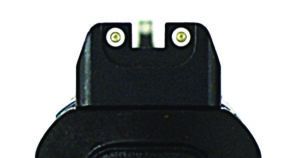
We like the flat trigger, and while the double-action-only mechanism offers a different feel than the single-action Canik, the trigger press is lighter and the reset sharp. The pistol features tritium-insert sights that the Canik does not, another advantage if the handgun is pressed into home-defense use.
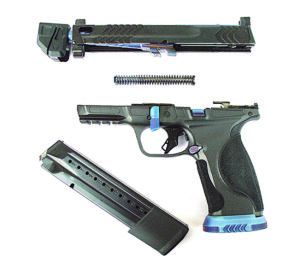
There was some debate over the grip angle. Smith & Wesson developed an 18-degree grip angle in the 2.0-series guns. This angle is very comfortable and feels good in the hand. The majority of testers preferred the Smith & Wesson grip, while a single tester with large hands liked the Canik better. We did not need to change the grip inserts, although a total of four are provided. The system to change the inserts is simple. Turn a plastic rod in the grip frame to unlock the grip insert, then press the insert out. Also, with that plastic rod out of the frame, the magwell can easily be slid off the butt. We like this type of set up better than the Canik design, which requires a pin to be punched out.
The Smith & Wesson features an Armornite coating on the stainless-steel slide and frame with bright metallic Cerakote on some surfaces. It was durable in our testing, and we can’t speculate about which finish would last longer.
We did not shoot the guns without the compensators because that’s how they’re sold, though it’s possible to remove the compensators for cleaning or disassembly. But it’s not necessary for routine cleaning or changing out springs, so why complicate the process? Our recommendation would be to leave the compensator attached for most shooting, certainly on targets.
The firing test proceeded without a single failure to feed, chamber, fire, or eject, and there were no failures of the striker or trigger to reset. In reliability, then, the Smith & Wesson was superior to the Canik in our testing. In fast combat shooting, the pistols were comparable, with the compensator of each gun really making a difference in handling compared to standard pistols. The heavier Smith & Wesson was more comfortable to fire. This really began to show up after 200 rounds of ammunition. The 9mm Luger isn’t a heavy kicker at all, it is the opposite, but after a few boxes of ammunition, recoil impulse begins to show up in the wrists. The Smith &Wesson pistol was easier to get hits with at the longer the range as well, with even less muzzle flip than the Canik. When it came to bench accuracy, the Smith & Wesson did not lord over the Canik, but the Spec was more accurate and consistently more precise with two of the three bench loads. The Federal Gold Medal load was virtually tied in each handgun, with the Spec having a narrow 0.1-inch advantage. The Spec had only a 0.3-inch advantage with the Blazers and a 0.5-inch better group average with the Black Hills self-defense load.
In terms of mounting a red-dot sight, neither was ahead of the other, both pistols were easily fitted up. Some handguns have a superior grip angle for mounting red dots, as proved out in a recent test of the Ruger RXM, which seemed to present the red dot in a superior angle. Here, though, these pistols were similar, and we saw no real advantage of one over the other.
Our Team Said: The Smith & Wesson performed better in this test, without any type of break-in malfunction and superior control and great accuracy. One of our match-trained shooters did make some of the other testers feel humble with these guns, so we recognize a trained shooter will benefit from them more than an amateur. The Smith & Wesson has the better performance. If price is no object, this is the gun to have.
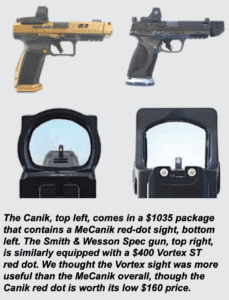
It’s worth noting that there’s a $1035 package Canik out there that contains a MeCanik red-dot sight. That’s a good deal because most Caniks without the red dot sell for around $900, like our test gun reviewed nearby. The red dot alone is usually $160, so the package seems to include a slight discount on the sight. But how is the red dot? We had access to a MeCanik during the test and thought it was well worth the price. The window is large and offers a bold and fast aiming point. It seemed a viable choice for competition, with performance in line with the Holosun 507. If purchased in the package offering with a red dot, the Canik is $465 less than the Smith & Wesson without a dot sight. That would buy a lot of ammunition. To shoot the guns side by side and similarly equipped, we fitted a Vortex ST red dot to the Smith & Wesson during testing. This would have added $400 to the price of the Smith & Wesson, putting that package at $1900, but of course there are red dots that cost more and some that cost less. We thought the Vortex sight was more useful than the MeCanik in overall performance and settings, while the Canik red dot is worth its price. We did not explore the optics option a great deal, but we did enough to find that each pistol was well suited to red-dot use. Left: The MeCanik red dot features a wide window and makes for fast, accurate shooting. As befits the gun’s design, the MeCanik is designed more for competition than concealed carry. Right: The large window of the Vortex ST on the Smith Spec Series is well suited to competition use as well.
| Federal Premium Gold Medal Action Pistol 147-grain FMJ GMAP1 | Smith & Wesson Spec Series V M&P 9 Metal HD | Canik TTI Combat |
|---|---|---|
| Average Velocity | 890 fps | 915 fps |
| Muzzle Energy | 259 ft.-lbs. | 273 ft.-lbs. |
| Small Group | 1.5 in. | 1.5 in. |
| Average Group | 2.0 in. | 2.1 in. |
| Blazer Ammunition 115-grain FMJ 5200 | Smith & Wesson Spec Series V M&P 9 Metal HD | Canik TTI Combat |
| Average Velocity | 1139 fps | 1156 fps |
| Muzzle Energy | 331 ft.-lbs. | 341 ft.-lbs. |
| Small Group | 2.0 in. | 2.4 in. |
| Average Group | 2.5 in. | 2.8 in. |
| Black Hills Ammunition Factory New 124-grain JHP +P | Smith & Wesson Spec Series V M&P 9 Metal HD | Canik TTI Combat |
| Average Velocity | 1199 fps | 1217 fps |
| Muzzle Energy | 396 ft.-lbs. | 408 ft.-lbs. |
| Small Group | 1.6 in. | 2.1 in. |
| Average Group | 2.1 in. | 2.6 in. |
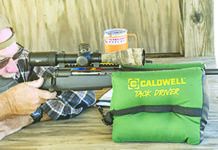
To collect accuracy data, we fired five-shot groups from a bench using an MTM Case-Gard K-Zone rest. Distance: 25 yards. We measured velocities with a Competition Electronics Pro Chrony with the first screen 10 feet from the muzzles.
Written and photographed by Bob Campbell, using evaluations from Gun Tests Team members. GT