









Despite the popularity of high-capacity 9mm, 1911, and Magnum handguns, the snubnose 38 Special revolver remains popular. Lightweight, simple to load and unload, reliable, and powerful enough for defense use, the short-barrel revolver has many advantages. Heritage Manufacturing has introduced a new handgun that builds on the popularity of the revolver and the nickname Roscoe for a 38 carry gun. The new gun is a nicely blued revolver with walnut grips and a traditional five-shot cylinder. This revolver is designed for those who prefer a traditional appearance, and also those who intend to put it to the use it was intended, that is, in personal defense. To test this new revolver, we matched the Roscoe against a likely rival on a price-point basis. The Taurus 85 is a classic revolver in many ways, with a blued-steel finish and walnut grips. The Heritage Roscoe is a stablemate, or cousin, manufactured in the Taurus factory, but branded Heritage. Taurus owns Heritage Manufacturing and produces a steady stream of single-action revolvers. The Roscoe is a new introduction intended to compete in the personal-defense market. But is it simply a rebranded Taurus 85? In some good ways, yes, but in other ways, not at all. The differences are intriguing.
We obtained a Heritage Roscoe with a 2-inch barrel, at retail. The revolver is also offered with a 3-inch barrel. We elected to test the new Roscoe against a Taurus Model 85 with similar blued finish and five-shot 38 Special cylinder. We ran across a snag because the Taurus 85 is only available in the used market. The Taurus 856 has replaced the Taurus 85, but the 856 is a small six-shot revolver. To get a true head to head with the blued Roscoe’s 2-inch-barrel five-shot set up, we found a good-condition Taurus 85 for only $20 more than the Roscoe and did a head-to-head test fire.
We like to note that revolvers are left-hand and right-hand neutral once they are loaded and fired. However, a left-handed shooter must make allowances when the gun is empty. Loading a revolver usually requires switching to the right hand for loading. When using a revolver, the proper sequence for left-handed shooters is to shoot the revolver dry, switch to the right hand where the cylinder is opened, the left hand hits the ejector rod, and the left hand loads the revolver. In the case of these two wheelguns, they are only slightly slower, even for a right-handed shooter fumbling a left-hand load.
Here’s more about the two guns individually:
Taurus 85 2-inch 38 Special,
$345
Gun Tests grade: A
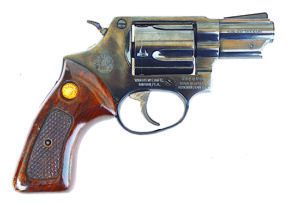
The Taurus 85 is a good revolver in the snubnose category. We liked the fit, finish, and smoothness. The piece performed well, but we prefer the Heritage.
| Action Type | Double action, single action |
|---|---|
| Overall Length | 6.56 in. |
| Barrel Length | 2.0 in. |
| Sight Radius | 3.7 in. |
| Overall Height | 4.8 in. |
| Max Width | 1.4 in. |
| Weight Unloaded | 23.0 oz. |
| Weight Loaded | 23.9 oz. |
| Cylinder gap | 0.006 in. |
| Capacity | 5 |
| Frame Finish | Bright blue |
| Barrel Cylinder Finish | Bright blue |
| Frame Front Strap Height | 2.2 in. |
| Frame Rear Strap Height | 3.1 in. |
| Grip | Brazilian walnut |
| Grip Thickness | 1.1 in. |
| Grip Circumference | 4.8 in. |
| Front sight | Serrated ramp, fixed |
| Rear Sight | Groove, fixed |
| Trigger Pull Weight Double Action | 12.0 lbs. |
| Trigger Pull Weight Single Action | 4.75 lbs. |
| Safety | Internal hammer block |
| Warranty | Unlimited lifetime |
| Telephone | (229) 515-8464 |
| Website | TaurusUSA.com |
| Made In | Brazil |
The older Taurus revolvers with nice blued finishes and larger hand-filling wood grips are in demand despite having one less cartridge in the cylinder than the new six-shot Taurus 856. We have run across such things before, and there are older guns now out of production that bring higher prices because some genuinely appreciate, such as S&W revolvers without the action lock and Colt Series 70 1911 pistols, as well as the original Hi-Power pistols. It is your money, but we generally find some old revolvers very well suited to personal defense. We would see how the Roscoe compares to the Taurus 85, and at the same time figure out if there were a reason to seek out a used Taurus 85 in preference to a new Roscoe.
The Taurus 85’s blued finish was nice and even and hardly worn, although the revolver was about a decade old. There are differences between this revolver and the Roscoe. The ramp front sight of the Taurus 85 is longer, the barrel heavier, and the ejector rod is shrouded. Depends on personal preference, but a shrouded ejector rod is often seen as a deluxe feature. The sights are a simple trough in the top strap. These sights are better than the shallow groove on some revolvers, but they are adequate and nothing more. The sights of the Taurus are slightly tighter than the Roscoe, and our shooters said the more open rear-sight groove of the Roscoe provides a better sight picture. The difference is small, but it exists.
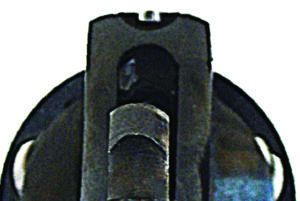
The double-action trigger of the Taurus is smooth from start to finish and without a hitch — but then, it is a decade-old gun. Perhaps it has smoothed with use. The double-action trigger-pull weight is a grit-free 12 pounds, exactly 1 pound lighter than the Heritage Roscoe. The Roscoe’s single-action trigger was hands down the better one at a very smooth and crisp 3.2-pound break, compared to the Taurus at 4.75 pounds in single action. The cylinder release on each is positive in operation, and each cylinder locks up tightly. There were no snags or binding in the double-action trigger press of either revolver.
In hand, we liked the grips of the Taurus 85. The walnut grips are smooth where they meet the palm and fingers, as far as recoil goes, but the checkering allows for good control. The exposed hammer is checkered on the hammer spur in a similar manner to the Heritage revolver.
We took the grips off the Taurus — they are both Taurus revolvers with the Heritage being marked Taurus Armas — and took a good look at the coil spring. The original Taurus 85 and Heritage Roscoe recoil springs behave the same, and the revolver would be disassembled in the same manner, but the parts differ. The Heritage has a smaller plastic keeper for the recoil spring in the grip frame, and the two parts do not interchange. The frame is cut differently in the grip frame area. Neither do the grips interchange. In fact, the Heritage grips were difficult to remove. They are held in place by a single screw in the manner of the Taurus revolver, but they also feature locating pins. It should be noted the new Colt Python uses this type of grip lock up. This makes for a very stable arrangement, but it doesn’t allow for easy changing of the grips. We found no fault with the Taurus 85’s grips. We emphasize that these grip panels do not interchange, so be careful if you order aftermarket grips for your Taurus 85.
We used one load for most of the offhand accuracy shooting. We fired a box of Federal 130-grain FMJ loads in each revolver. This is a mild 770 fps load. We fired for speed at 5, 7, and 10 yards. Recoil was modest. We also fired two cylinders, 10 shots, in each revolver of the Federal 130-grain Hydra-Shok Deep to gauge offhand control with a heavier loading. The Taurus 85 fired well, without any hitches. The action is smooth, and the sights are well regulated typical fixed sights. At close range, a focus on the front sight alone, holding the sight slightly above the rear sight, was used. The Taurus did about as well as the Heritage. However, the Heritage, with its broader rear sight, turned in slightly tighter combat groups.
The short ejector rods of each revolver required pointing the muzzle up in the air and hitting the ejector rod to eject spent cartridges. At times, more than one hit on the ejector rod was needed to eject all the cartridges with either revolver. This is standard operating procedure for small-frame short-barrel revolvers, so we were fine with the operation.
Moving to bench accuracy at 15 yards, we put the revolver on an MTM Caseguard K-Zone rest and fired three cartridge brands. First was the Fiocchi 110-grain JHP. Marked +P in red, this is a strong load. Also, we fired the Federal 130-grain Hydra-Shok Deep and the Hornady Critical Defense Non +P 110-grain load. Results were what we expected from a snubnose 38 fired single action from a rest. Five-shot groups hovered around 2.5 inches, with the heavier-kicking Hydra-Shok Deep providing a stellar 1.9-inch group. Recoil impulse was similar to the Roscoe, with neither having a clear advantage. Accuracy was adequate for personal defense.
Our Team Said: We liked the Taurus 85. It is a credible revolver with good reliability. Still, we would not purchase a used Taurus 85 over the Heritage Roscoe or a Taurus 856 unless the price was considerably lower than the tariff paid for this gun. Not long after the test, we ran across another Taurus 85 in a pawn shop in the original box, a little nicer than ours, for $250. That would be more like it, but then, unless we were cash strapped, we would still purchase the $325 Heritage Roscoe over a used revolver.
| 38 SPECIAL RANGE DATA | ||
|---|---|---|
| Federal Premium Personal Defense 130-grain Hydra-Shok Deep P38HSD1 | Taurus Model 85 | Heritage Roscoe |
| Average Velocity | 880 fps | 864 fps |
| Muzzle Energy | 224 ft.-lbs. | 215 ft.-lbs. |
| Smallest Group | 1.9 in. | 2.0 in. |
| Average Group | 2.8 in. | 2.75 in. |
| Fiocchi Ammunition 110-grain XTP HP 38XTP25 | Taurus Model 85 | Heritage Roscoe |
| Average Velocity | 940 fps | 957 fps |
| Muzzle Energy | 216 ft.-lbs. | 224 ft.-lbs. |
| Smallest Group | 2.5 in. | 2.2 in. |
| Average Group | 3.25 in. | 2.8 in |
| Hornady Critical Defense 110-grain FTX +P 90311 | Taurus Model 85 | Heritage Roscoe |
| Average Velocity | 839 fps | 855 fps |
| Muzzle Energy | 172 ft.-lbs. | 179 ft.-lbs. |
| Smallest Group | 2.6 in. | 2.0 in. |
| Average Group | 3.25 in. | 2.5 in. |
To collect accuracy data, we fired five-shot groups from a bench using an MTM Case-Gard K-Zone rest. Distance: 15 yards. We measured velocities with a Competition Electronics Pro Chrony with the first screen 10 feet from the muzzles.
Written and photographed by Bob Campbell, using evaluations from Gun Tests Team members. GT