







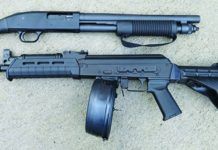
Over-the-Counter Exotics from Mossberg and Century Arms
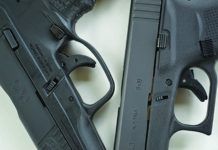
Compact 9mms from Glock, Honor Defense, S&W, Walther
Our retailer friends tell us that the most popular carry gun in America is the compact 9mm self-loading pistol with a single-column magazine. These handguns are handy, concealable, and powerful enough for personal defense. They deliver acceptable ballistics without harsh recoil and are affordable. Most are based on service-size handguns. The engineering in downsizing the pistols has been faultless in many, but not all, renditions, so everyone wants to know if Compact Pistol "A" is as reliable for practical use as any full-size pistol. And if Compact Pistol "A" is that reliable, it makes it easier to narrow down the many choices to the best choice for you. We get a lot of questions about such handguns, and this lineup includes four handguns readers have asked us to test.
The Smith & Wesson and the Glock are based on service guns, while the Honor Defense Honor Guard and Walther PPS are purpose-designed compacts with no service-sized big brother.
When we first tested the Glock 43 Subcompact Slimline G43 two years ago (August 2015), it earned a B+ in our evaluation when it was paired with the Walther CCP head to head. In that evaluation, we noticed that the slide was narrow and nicely beveled. Glock did not simply stick a Glock 19 slide on a slim frame. The locked-breech operating system and trigger action are preserved. Anyone owning a Glock of any size or frame will be able to use this handgun in the same manner because the action is identical to all other Glock pistols. The sights were standard Glock, with a white outline rear and white dot forward, the same as the test gun this round. They proved adequate for combat firing and were reasonably good for accuracy work at 15 yards. We also noted then that there is a shelf under the slide on the frame that protects the slide lock from a finger contacting the slide lock during recoil. It is common for the support-hand thumb to bump the slide lock and lock the slide to the rear when firing a hard-kicking compact. The shelf seems to eliminate this problem, then and now. Also, the Glock frame does not incorporate a light rail for a combat light.
In both guns, the Glocks featured a spring-within-a-spring guide rod that we feel does an excellent job of containing recoil. Once on target, however, the Glock was handicapped by a 6.75-pound trigger pull. This time around, the G43's pull was more than a pound lighter. Two years ago, we also noted that due to its polygonal rifling, you should rule out lead-bullet handloads.
In November 2016, we looked at a specialized version of the gun, a Glock G43 Limited Edition ProGlo TALO Edition UI4350501. TALO is a wholesale buying cooperative that creates special edition firearms, which have to be ordered from a local dealer. On this Glock 43, the pistol's slide was standard save for the sights, which were made by AmeriGlo and featured a brilliant orange post around a white-insert tritium front. The rear sight featured a U-notch for rapid target engagement, and the rear face of the rear sight was serrated to reduce glare. Even with these upgrades, we gave the Glock a B grade.
Our only time to have tested an S&W M&P9 Shield 9mm Luger was in the March 2013 issue, so this update is overdue for a handgun that so many people seem to like. Four years ago, we called it a pleasant, compact, slim, nicely made handgun. Then, as now, we said it was easy enough to get it into a pocket of reasonable dimensions. There was nothing sticking out of the Shield to get caught on clothing. The magazines were easy to get out and back into the gun. They had a somewhat staggered design that made them more compact for their capacity. The gun was matte black with semi-slick pebbly inserts on front and rear of the grip straps.
The Shield had an external safety on its left side. The sights were excellent, dovetailed into the slide, and tritium is an option. The rear was secured with a screw so you could adjust the windage. The front was held solely by friction in the dovetail. The trigger pull was heavy and consistent at about 7.5 pounds, and the trigger rebound was short.
Takedown required locking the slide back and applying manly force to the takedown lever to rotate it 90 degrees. Then the slide could be let down to its normal position, the trigger pulled, and the slide comes off the front. Removing the captive double recoil spring was extremely easy. There's no danger of parts flying across the room, or losing an eye when you put it all back together. We noted a significant fillet on the hook of the S&W's extractor. It also had a slight pocket to help catch the incoming rounds as they feed from mag to chamber. The striker-locking safety plunger inside the slide is cammed upward by the trigger arm, which actively forces the plunger out of the way.
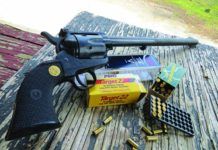
A Trio of Unusual Revolvers: Worth the Trouble and Money?
Most gun owners want firearms they can shoot and have fun with, even their life-and-death carry guns. Some of us also want the unusual because we like a walk on the wild side, irrespective of whether it has any use beyond messing around with or plinking. In this Special Report, we take a look at three wheelguns for which there are little or no match ups to find, so head-to-head testing isn't possible. But even without something to shoot beside them, we can learn plenty about whether some unique, or nearly unique, handguns are worth the time and trouble to find and add to your collection as a real, firing item.
Herewith then, we look at the Nagant M1895 7.62x38mmR, the Smith & Wesson Model 929 9mm Luger, and the Chiappa Buntline 22 LR.

Surplus 1911s Might Be Back
The U.S. House of Representatives has passed H.R. 2810, the National Defense Authorization Act (NDAA) for Fiscal Year 2018. Included in the bill is a provision that would make U.S. Army surplus 1911 45 ACP pistols available to the American public through the Civilian Marksmanship program (CMP), according to an NRA release. In November 2015, then-President Obama signed the NDAA for Fiscal Year 2016 into law with language that authorized the Secretary of Defense to transfer 1911s no longer in service to the CMP for public sale. That language made the transfers subject to the Secretary's discretion and capped them at 10,000 per year. Unsurprisingly, no actual transfers were made under the program while Obama remained in the White House.
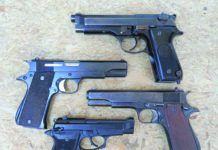
Surplus 9mm Pistols From Star and Beretta: Worth the Cash?
The idea of what constitutes a "surplus firearm" has different meanings depending where you are in the world. Surplus firearms in the U.S. means extra on hand or dated equipment. In other countries, it could mean one step away from scrap metal. We try to avoid the latter, but we are always on the lookout for a diamond in the rough, and thought we'd look at a few surplus 9mm Luger and 9mm Kurz (380 Auto) pistols. We wanted to look at these pistols through the lens of an inexpensive pistol that would be suited as a sand pit plinker, but in a pinch, it perhaps could be called on to defend the ranch. The problem with older surplus pistols is the lack or scarcity of spare parts, including magazines. By definition, all surplus weapons have been used, and some used more than others.
We chose four pistols that are fairly common and easy to find online to go bargain hunting: Two are Berettas, a Model 92S and Model 85F, made in Italy by P. Beretta S.P.A., and two are Star pistols, made in Spain by Star Bonifacio Echeverria, S.A., a Model Super B and Model B. The Star Model Super B looks like it is ready for the scrap yard and the older Model B looked well used, but as we found out, both still had some teeth. The Beretta 92S is a second-generation 92, which evolved into the 92FS. The 92S is a lot more of a European gun than the 92FS, which definitely has US influence. The Beretta 85F is a smaller version of the 92FS and is the most modern of the pistols tested.
In past issues we have tested some old-school combat pistols and found them lacking, which makes sense. A horse worked a century and a half ago; but now we (can) drive Hummers. Accordingly, we had to make some accommodations for these guns' age. Since these are older pistols, we did not test with proofing loads or +P+ loads. These pistols were not designed for that type of high-pressure ammunition, and we had no desire to taste Italian or Spanish steel. Not that we are implying these are substandard pistols. These pistols are safe when used with ammunition originally intended for them. What we did want to find out was if different bullets types would impact performance. For instance, the Star pistols were manufactured before hollow-point bullets were popular, and we figured they might choke on hollow-point ammunition. We also wanted to see if different bullet weights would cause a stovepipe jam or failure to eject. We used off-the-shelf 9mm Luger ammo consisting of Hornady American Gunner with 115-grain XTP jacketed hollow points ($47/75 rounds), Aguila 124-grain FMJs ($17/50), and SIG Sauer 115-grain FMJ ($18/50). We found all three ammo types cycled flawlessly through the pistols with no issues. In the Beretta 85F, we fired 91-grain FMJs from Tula, 90-grain Speer Gold Dot hollow points, and Hornady Critical Defense 90-grain XTPs, which feature a hollow-point bullet with a polymer insert to facilitate expansion.
For accuracy testing, we placed the pistols on a bench rest to fire at targets set at 25 yards. In speed-firing exercises, we shot at targets at 7 yards, performing both Bill Drills and Mozambique Drills. The object with the Bill Drill is to fire as fast and as accurately as possible to hit an 8-inch zone. The Mozambique requires two fast shots to center of mass and a one to the head. All must be within their zones to be successful. This is what we found out when we exercised these old pistols.

Ruger Recalls Most Mark IVs
Ruger has issued a wide recall of all Mark IV and 22/45 models because of a problem with the safety and sear and has told owners that the pistols should not be used.
The issue is: In some cases, if the trigger is pulled while the safety lever is midway between the "safe" and "fire" positions and not full engaged in either, the pistol may or may not fire when the trigger is pulled.
If the gun doesn't fire when the trigger is pulled, it may fire if the user then pushes the safety to the "fire" position without the trigger being activated.
Here's a statement from a Ruger press release on the company's website:
"Although only a small percentage of pistols appear to be affected and we are not aware of any injuries, Ruger is firmly committed to safety and would like to retrofit all potentially affected pistols with an updated safety mechanism. Until your Mark IV pistol has been retrofitted or you verify that it is not subject to the recall, we strongly recommend that you not use your pistol."
Ruger says they have received a "small number" of reports from the field indicating the problem exists. Additional testing confirmed the issue and the recall was issued.
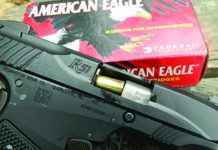
The Return of Remingtons R51 Semi-Auto: How Does It Fare?
We recently tested four single-stack 9mm Luger defense-oriented handguns, among the most popular carry guns in America. Three were single-action pistols and one was a double-action-only model. The spread in expense was pronounced, from less than $200 to more than $700. As always, when we're evaluating carry pistols, handling and accuracy mean a lot, but reliability is the bottom line, and we start with a pistol that has had a mark beside its name for being unreliable. In the lineup was a pistol taking its second bite at the apple, Remington's R51 96430 9mm Luger, which has undergone a recall and revamp and is now back on dealer shelves. Pitted against it were a SIG Sauer P938 Engraved Rosewood Micro-Compact 938-9-ESR, a Taurus 709 Slim 1-709031FS, and a Kel-Tec PF-9.
All of these handguns have a history with us. Most recently, the R51 did well in its initial test in our pages, but was recalled shortly thereafter. In the August 2014 issue, we said, "The Remington R51 was a handy, comfortable pistol of just the right size for its power. Felt recoil with the hottest ammo was amazingly light, and muzzle flip was almost non-existent. It had an odd takedown procedure that was easily mastered. The gun had enough accuracy for its intended purpose. It worked well, was not too expensive, had a great trigger and great sights, and we really liked the concept.
"Though our FFL advised us that other shooters were having function problems with the R51, our test gun simply did not exhibit those problems. Because we only report what happens in our tests and base our grades on our own experiences, we could not fault the R51 for issues other people were having.
"However, after publication of the August print issue, we learned that the R51 had been recalled by Remington. We adjusted the grade on the R51 to an F and returned our test gun to the factory under the recall program."
Then, late last year, Remington Arms Company announced that the R51 had returned to the market with enhancements that included updated slide internals, precision-engineered extractor, locking snag-free sights, tuned recoil spring, hard-chromed barrel bushing, a single-action trigger, and two semi-flush 7+1 round magazines. At the time of the re-release, Remington said the pistol had been extensively tested. The company again touted the R51's features and benefits, including a lightweight aluminum frame with rounded edges for comfortable conceal carry, a grip safety, low bore axis for reduced recoil/muzzle flip, a concealed carry trigger that was a light, crisp single action, low slide racking-force for ease of manipulation, an ambidextrous magazine release, locking drift-adjustable sights, and optimized grip angle. Our test gun, a full replacement of the original, has a suggested retail price of $448.
The last time we looked at the Kel-Tec PF-9 9mm was in April 2011. Of the PF-9, we said, "All business-like flat black, the blued Kel-Tec PF-9 is slim and easily concealable. It was a bit too big for most trouser pockets, but would fit most overcoat pockets. The fixed sights gave an excellent picture that we thought could be improved by widening the rear notch. There were three white dots. The rear sight was adjustable for windage, and by shimming for elevation. An Allen screw secured it. Both the front and rear sights were polymer, as was the trigger and, of course, most of the frame.
"The integral grips had a coarse checkerboard pattern that provided excellent traction, and the front and rear grip straps had vertical serrations. The magazine release was a steel button that was not easy to hit accidentally, but let the mag come out easily when intentionally pressed. The gun could be fired with the magazine removed.
"In our testing we came to love the trigger of the Kel-Tec. We had no trouble whatsoever with short-stroking the trigger in rapid shooting. In fact, the recoil seemed to blow the gun backwards and our trigger finger forward. We were unaware of the trigger needing to be carefully allowed to go all the way forward. We essentially had no problems at all with the Kel-Tec PF-9. We had one failure for the slide to lock back on empty with the first magazine-full through it, but that never happened again. We think this is one mighty fine 9mm handgun, but it is not for the recoil-sensitive person."
About a year later (March 2012) we test-fired the Taurus 709B Slim No. 1-709031. Back then, we said of the handgun, "We never suffered a failure to ignite or any other type of malfunction, so all shots in our tests were performed using the single-action trigger. From the 10-yard bench, only two groups measured 2 inches wide or larger. Overall average size for all groups fired in our tests computed to about 1.5 inches.
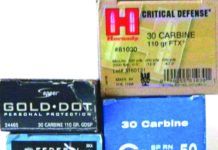
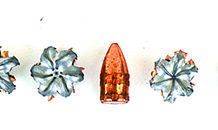
30 Carbine Picks: Hornady, Speer, Buffalo Bore Loads Tested
The 30 Carbine cartridge is an interesting and historically significant round. The M1 Carbine was the first little-maintenance firearm issued to the U.S. Army and was also among the first firearms that might correctly be called a Personal Defense Weapon (PDW). Designed for military officers, back-area troops, truck drivers and other personnel not usually armed with a rifle, it was specifically intended to allow officers to carry a lightweight rifle that was more powerful and accurate than a handgun. The carbine was not a short-barrel full-power rifle as earlier carbines had been, being instead designed for a lower-powered cartridge compared to the 30-06 cartridge used in the M1 Garand. Compared to the Russian M44 or the British No. 5 carbine, the M1 carbine is much easier to use well and handle. The M1 Carbine was designed for close-range area defense and personal defense. The concept was successful, and eventually, the army manufactured more than 6 million carbines. Numerous police agencies used the M1 carbine, including post-war Berlin and the NYPD. For close-range battle, the M1 carbine has much to offer.
We feel that the attributes of the M1 Carbine might make it even better suited to home defense than the typical AR-15 rifle. For hunting use and predator control, not so much. We cannot recommend the energy level of the 30 Carbines for deer-sized game, but its low recoil and low muzzle flash are essential for home defense, and the 30 Carbine offers both, but with 357 Magnum energy. The rifle is ergonomic and provides high hit probability. We admit the standard 110-grain FMJ load at about 2000 fps isn't the best choice for home defense, based on over penetration and a lack of wound potential. There have been 110-grain jacketed soft points and jacketed hollowpoints used by police agencies, but most of these loads seem out of production by old mainstays Winchester and Remington. Still, we were able to collect loads using modern expanding bullets and compare them for accuracy penetration and expansion. What we found was that accuracy is good to excellent for all loads, although some were more accurate than others. For use in the home or area defense and animal defense against feral dogs and coyotes to 50 yards or more, the little rifle is plenty accurate. While we find there was something to recommend about all the loads tested, there are standouts. The Buffalo Bore full-power load and the Speer Gold Dot are at the top of the pack for home defense, with the Critical Defense load a strong contender for tactical use.
In this test, we fired 50 cartridges of each load, which included three cartridges each for penetration and expansion testing and fifteen cartridges (three five-shot groups) for accuracy. The remaining 32 rounds were fired in off hand shooting for personal defense work at 5, 7, and 25 yards. We tested accuracy from 25 yards. The rifle was a vintage Israel Arms International carbine. Here are the results.

American-Made 9mms: Ruger, Springfield, and Honor Defense
When it comes to 9mm carry pistols, there are several characteristics that immediately come to mind. Polymer frame, striker fired, wide grips, and high capacity. Recently we found three, or should we say three and a half pistols, that didn't quite fit that description.
The first was Ruger's $579 American Compact model 8633 that featured thumb-operated safeties on both sides.
Next were products from Honor Defense, one of the newer makers on the market. The $499 Honor Guard HG9CLE is a single-stack double-action-only pistol. The LE suffix stands for law enforcement. This gun was a variation on the original Honor Defense pistol, but it lacks a Picatinny accessory rail to favor inside-the-waistband carry for undercover work. Our 3.8-inch-long-barreled Compact LE pistol arrived with a second top end ($250, sold separately) that housed a 3.2-inch-long barrel. The shared receiver boasted unique grip contours, and both top ends utilized the same guide rod and recoil spring.
Third was the $1220 Springfield Armory 1911 EMP 4-inch Conceal Carry Contour pistol, which arrived with three 9-round magazines. The EMP operates with a single-action trigger, and this might have been our first test wherein a single-stack 1911 pistol packed more rounds than its polymer-framed competitors. Its descriptive name referred to the gun's backstrap, which has been sliced diagonally, making the rear of the grip about of an inch shorter than if it were continued in a straight line to the heel of the magazine well. This made the pistol more concealable, specifically when holstered with a butt forward (or muzzle back) cant.
Our test sessions began and ended on the reactive targets located on Steel Alley at American Shooting Centers in Houston. Accuracy data was collected from a distance of 15 yards with the guns supported by a Caldwell Matrix rest. Our choice of test ammunition consisted of Browning's new 147-grain BXP X-point jacketed hollowpoints and three different rounds from Black Hills Ammunition of Rapid City, South Dakota. They were the 115-grain JHP EXPs that were designed for maximum performance in guns not rated for +P ammunition, a 124-grain JHP +P choice, and a new subsonic round, the 125-grain non-expanding HoneyBadger ammunition. We tracked the velocity of each combination using an Oehler 35P (printing) chronograph.
All three guns were recent releases, so we really didn't know what to expect. As always our goal was to reveal reliability and accuracy as well as handling characteristics. Would we find versatility or would the accuracy of each gun be limited to a single bullet weight? Our job was to deliver to point of aim every time we pulled the trigger. Would any of these guns make that job easier than the others? Here is what we learned.
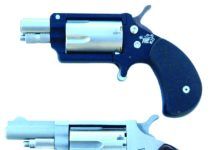
Mouse Gun Shoot Out: Three Tiny Pocket Pistols Compete
Love them or despise them, mouse guns — aka very small pocket pistols — are an important part of the self-defense landscape by virtue of their sheer numbers. For example, the North American Arms Mini Revolver is a popular handgun that has created a niche all its own. It is offered in several versions, with relatively long barrels as well as the traditional short barrel. We were interested in what type of accuracy a trained shooter could wring out of the Mini Revolver because a 6.5-ounce 22 Magnum just might have appeal as a pocket revolver or backup. We also tested a newcomer and competitor to the Mini Revolver. The PTAC Bullfrog is a copy of the NAA revolver in some ways but is mechanically different in others. We also added a small automatic pistol to the test. The Beretta 950 25 ACP handgun is a widely used pistol and can be called a standard among pocket pistols. For safety, each of the revolvers and the Beretta self-loader demand that the hammer be cocked before the pistol may be fired. Each also features a single-action trigger, although the revolvers must be cocked for each shot. In the end, we thought one gun offers a good-enough chance at stopping hostile action, but to be frank, members of our team would still be reluctant to buy it.
.410 Bore Self-Defense Choices
The decision of which self-defense .410 firearm is the correct choice for up-close-and-personal situations encountered in the home often comes down to a handgun in one hand or a short-barreled pump-action shotgun in the other. Because of their ease of handling, two revolvers that are capable of firing both .410 loads and handgun rounds are becoming quite popular; and pistol-grip short-barrel shotguns remain a favored option in self-defense circles. The question arises about which type of close-range firearm is the most effective with the diminutive .410 loads, including those that have recently been developed with short-barreled revolvers in mind.
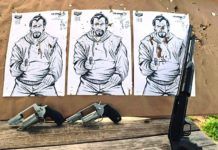
Acting on a reader request, we conducted a multitude of tests on a trio of readily available self-defense firearms that included a Taurus Judge (handles .410-bore shotshells and 45 Colt) that retails for $629; a Smith & Wesson Governor (handles .410, 45 Colt, and 45 ACP) that retails for $809; and a Mossberg Model 500 Cruiser that sells for $467 and fires .410-bore shotshells.
Each of the firearms (all have been examined in previous GT reviews) is specifically designed for close-quarters action, such as when an intruder has illegally entered a residence, placing the people living in the home in a potentially life-threatening situation. In such a life-or-death scenario, a reliable, easy-to-handle, and effective self-defense tool is essential.
In this part of the GT evaluation and match-up, our focus was on the handling ability of the three firearms and their patterning performance at close-quarters ranges. We attempted to walk the fine line that divides ease of handling with putting the pattern in the right place to evaluate the two revolvers and the pump-action.
We tested the firearms on the range with targets set at two ranges used in concealed carry courses to simulate typical home-defense scenarios. The close targets were set at 9 feet (3 yards) and the second set of targets was shot at 21 feet (7 yards). Here are our findings.
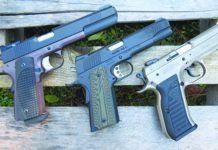
10mms: How About the P220?
Neat comparison of 10mms; kinda hoping you'd toss the SIG P220 in 10mm into the mix. I thought your comments on the Kimber TLE II grips were interesting. I haven't shot that model, but I own a Kimber Custom Eclipse II in 10mm and have no such issue with my grips when firing up to 100 rounds in a session. For those who would like the edges less raspy, I use blue buffing on a buffing wheel mounted in my drill press to polish out G10 revolver and knife grips. It's not too aggressive, and you could take a little edge off without substantially changing the grip's appearance. Clean up with a little denatured alcohol and a toothbrush and you're ready for the range.