

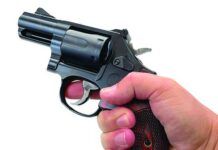







There is an axiom that is true on all firearms but is especially true for revolvers — size matters. For concealed carriers, a good wheelgun option is the 3-inch version we see making a strong comeback. Depending on the material used for the frame, weight can range from very light up to and through the 2-pound-plus range. Sight radius is a bit longer than on snubbies, allowing for more precise shooting, and these versions normally allow a full ammo load. All the while, barrel length is a bit shorter than full-length models, making them more maneuverable in a fight and capable of clearing leather more quickly in the draw. Also, the 3-inch tube normally creates enough space for a full-length ejector rod, the lack of which on snubbies can cause problems with reloads.
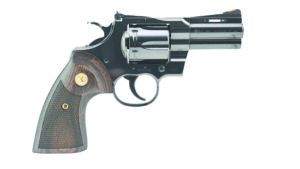
Our search for a good 3-inch wheelgun started with the new Colt Python BP3WTS, $1400, with a blued finish. The stainless model has been out for some time now, but we think the blued version brings the same great mechanics with the aesthetics of a genuinely well-finished handgun. As with the stainless edition, the new Python sports a vented rib on top of the barrel and a full underlug, along with a great trigger.
The Rossi RP63 2-RP639P, $380, brings a minimalist package at a minimal price. This wheelgun is smaller than our other test samples, but it still carries a full underlug to help with recoil. The polished stainless finish nicely offsets the black Hogue-style grips.
Our next selection was a Ruger GP100 01715, $820; which we could easily believe was designed for bear country. Also sporting a full-length underlug as well as a full-sized set of Hogue grips, this GP100 is sculpted to handle just about any load you could think of putting in a 357 Magnum pistol.
Our final pick was the Smith & Wesson M686-6 164300, $904. Also sporting a full-length underlug and adjustable like the Python, it offers a 7-round cylinder. That extra round could make a difference to you in the back woods.
To get started, we have a few thoughts on barrel lengths in revolvers versus a pistol — wheelguns are longer than you think. With a semi-auto pistol, the barrel length is measured from the muzzle to the rear of the chamber and includes any extension on the hood that mates up with the slide. The barrel on a revolver is measured from the crown back to the start of the forcing cone. But if you include the chambers (cylinders) in the measurement, the revolver is going to be longer than the stated length would suggest. For example, our Python has a 3-inch barrel as stated, but when the cylinder is included, length goes up to 4.5 inches. Of course, there is the cylinder gap between the cylinder and the barrel, but there is more length there than you might think.
We have mentioned that the revolver can do several things that the semi-auto can’t. The semi-auto can be very ammunition sensitive. The revolver — not so much. The operating system on the semi-auto requires that ammo pressures are generated in a specific range. If the round does not generate the correct pressure, the slide doesn’t cycle, and you have a malfunction. If the magazine doesn’t work right, there is a malfunction. If the springs get worn, there is a malfunction. Just try carrying a variety of ammunition in a semi-auto and see how well things go.
The semi-auto pistol does indeed have a great advantage over the revolver in the amount of ammo carried onboard. The revolver, however, much like a good 12-gauge pump shotgun, can carry a mix of ammunition and fire the rounds without a moment’s hesitation, depending on a perceived threat. On page 21 is a picture that shows a snake killed just outside of one of our deer stands last December. The ranch foreman holding that snake is about 6 feet 3 inches tall, so you an idea of the size of rattlers down here. As a result, the first chamber (or two) in the revolver we carry for backup while hunting and just walking around is loaded with snake shot. The CCI load uses No. 9 shot at a little over 1000 fps and should do a great job on any snake we’ve ever seen. The rest of the cylinder is loaded with 200-grain hard-cast solids from Buffalo Bore in case we get a close shot at a deer. The same load might be a good choice in bear country.
The semi-auto has other issues as well. Get it dirty, and it might malfunction. Don’t hold it right or tightly enough, and it might malfunction. The revolver doesn’t care. If it does malf, just pull the trigger again and most of your problems will be solved. Now perhaps you see why we think a good revolver is still an imminently viable self-defense handgun. Here’s how these 3-inchers did at the range.
Colt Python BP3WTS 357 Magnum,
$1400
Gun Tests grade: A- [Our Pick]
We thought the deeply-blued finish was the most pleasing of the pistols tested, while we recognize that it won’t be as corrosion resistant as the others. Pricey, the Python was the fastest and most accurate, making it our choice.
| Action Type | Revolver |
|---|---|
| Overall Length | 8.3 in. |
| Overall Height | 5.7 in. |
| Maximum Width | 1.55 in. |
| Weight Unloaded | 38.72 oz. |
| Weight Loaded | 41.44 oz. |
| Barrel Length | 3.0 in. |
| Barrel Material | Carbon steel |
| Frame Material | Carbon steel |
| Cylinder Material | Carbon steel |
| Grip Front Strap Height | 2.25 in. |
| Grip Back Strap Height | 4.5 in. |
| Grip Thickness (Maximum) | 1.31 in. |
| Grip Circumference | 5.75 in. |
| Capacity | 6 |
| Rear Sight | Adjustable |
| Front Sight | User-changeable red ramp |
| Sight Radius | 4.75 in. |
| Trigger Pull Weight (Single Action) | 4.9 lbs. |
| Trigger Pull Weight (Double Action) | 7.7 lbs. |
| Trigger Span | 3.5 in. |
| Warranty | Limited 1 year, non-transferrable |
| Telephone | (800) 241-2485 |
| Website | Colt.com |
| Made In | U.S. |
The Colt Python was introduced in 1955 and stayed in production (on its first run) until 2005. It was described by historian R. L. Wilson as “the Rolls-Royce of Colt revolvers,” and firearms historian Ian Hogg referred to it as the “best revolver in the world.” High praise indeed for a firearm that was eventually discontinued, and the supply constricted, because the effort (hand time) that went into its production finally priced it out of the market. Potential buyers groaned, and collectors jumped for joy at the increase in prices. Values jumped from the $1500 range to well over $3000 as the supply dried up. At least until 2020.
Enter the new Python. Much of the look was the same. It is easy to tell the difference in the cylinder, for example, but most of the exterior features of the new Python were very similar. The first samples of the new model were stainless steel and wore 6- or 4.25-inch barrels. Just fyi, the 4.25-inch barrel, instead of the more common 4-inch variety, was chosen to meet a minimum-barrel length for export contracts.
We must confess that the stainless-steel components make the Pythons more desirable for extended use outdoors. The stainless steel is very durable, as would be proven by its usage in the other three revolvers we selected for this test. Were we to contemplate carrying this revolver out in the weather for long walks in the woods, we think that we would absolutely choose the stainless model. That said, stainless steel, in our opinion, doesn’t exhibit the warmth that good blued steel will. The new stainless versions are beautiful. The latest blued version tested here, even with less polishing than the original models, is still stunning. The depth of the color is remarkable. Beauty aside, there are things we would change on the Python.
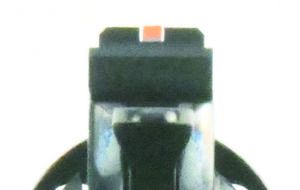
The Python starts with that 3-inch tube which, just as with the original version, sports a full-length 2.2-inch rib on top and a full-length underlug on the bottom. These two parts can add some weight for recoil control, and it pushes the balance a little farther forward. The muzzle ends with a very nice crown to protect the rifling. The front sight is a user-changeable red ramp. The rear sight might be perfect, or it might not, depending on your requirements for it. The question is created by the inclusion of an adjustable rear sight. This allows the shooter to sight in his Python with a variety of loads — different bullet weights hit different points of impact. Without the adjustable rear, the only real option is to settle on a particular load and then experiment with different front sights until the round hits where desired. The Python’s rear sight even has a screw by the left side of the rear blade that allows the rear sight to be adjusted and then locked down. While this arrangement will be more versatile, it will also be more fragile. The shooter who wishes his rear sight to be as rock solid as possible might want to look at the fixed sight versions from Rossi or Ruger.
The action has also been updated on the new version. The current Python has a redesigned hammer, cylinder, and interior lockwork. This latest iteration brings a bolt and notches that are aligned off center on the cylinder to allow things to lock up where the metal is the thickest.
The single-action trigger press was the heaviest of the four samples at 4.9 pounds, as determined by 10 measurements from our Lyman digital trigger gauge. A bit heavy for our tastes, it was also very smooth. Then we tested for the double-action pull and found the lightest pull in the group, requiring only 7.7 pounds of pressure. Contrary to some of the earlier models we’ve shot, there was very little stacking in the double-action pull. We know Colt changed the style of the mainspring on these latest models. Something sure worked. We would, however, like to see a smooth trigger face instead of the grooved piece on this gun. We like to run double-action triggers smoothly and quickly, so we found the grooves to be abrasive.
Safety mechanisms on revolvers can vary. Virtually all modern versions now employ some time of rebounding hammer, whereby the hammer (with or without a mounted firing pin) are mechanically withdrawn from potential contact with the primer. Most new models should, therefore, be drop safe. The Python adds a layer to that where a bar rises as the hammer is cocked, bringing it into position to serve as a filler for the gap between the lowered hammer and the firing pin. If that bar does not lift, the hammer never makes contact with the firing pin. We’ll never say that this removes all chance of an accidental or negligent discharge from a dropped handgun, but it dramatically reduces it.
The handles are full-size black-walnut grips adorned with the gold Colt logo. The overall fit to the frame was very good, and the checkering in the grip panels was very precise. Note that these are full-sized target grips made more for comfortable shooting and less for concealment. Carrying the Python begs for a good belt holster like those from Galco or Simply Rugged Holsters. It would also be a good candidate for the chest rig we have from Mission First Tactical.
The bluing, even without all of the hand polishing that went into earlier models, was still something to see. While not the finish we would see on a 1955 Python, the polishing was still very good, and the final product was very pleasing to behold.
Our Team Said: The Python recorded a very close second place to the S&W 686 on first-shot times, being about 0.02 to 0.03 seconds slower to come up from a low ready and fire the initial round. On subsequent rounds, the Python beat the S&W by the same small margin. The sights were fast to acquire, and the trigger stroke was fast and smooth. The grooved trigger we whined about did indeed leave our fingers a little sore, but practice would obviate that. The pistol’s favorite load was the Federal 158-grain jacketed soft point, with a best group of 0.93 inches for five shots at 15 yards and an average of 1.5 inch. This was Our Pick from the guns in this test.
| 38 SPECIAL RANGE DATA | ||||
|---|---|---|---|---|
| Federal Personal Defense 110-grain Hydra-Shok JHP PD38HS3 H | Colt Python | Rossi RP63 | Ruger GP100 | S&W Model 686-6 |
| Average Velocity | 990 fps | 924 fps | 974 fps | 947 fps |
| Muzzle Energy | 322 ft.-lbs. | 281 ft.-lbs. | 312 ft.-lbs. | 295 ft.-lbs. |
| Best Group Size | 2.06 in. | 2.91 in. | 1.40 in. | 1.26 in. |
| Average Group Size | 2.51 in. | 3.23 in. | 2.13 in. | 1.71 in. |
| 357 MAGNUM RANGE DATA | ||||
|---|---|---|---|---|
| Remington UMC 125-grain JSP L357M12 | Colt Python | Rossi RP63 | Ruger GP100 | S&W Model 686-6 |
| Average Velocity | 1417 fps | 1342 fps | 1365 fps | 1361 fps |
| Muzzle Energy | 491 ft.-lbs. | 440 ft.-lbs. | 455 ft.-lbs. | 453 ft.-lbs. |
| Best Group Size | 1.81 in. | 1.07 in. | 1.34 in. | 2.39 in. |
| Average Group Size | 2.04 in. | 2.28 in. | 2.17 in. | 2.76 in. |
| Federal American Eagle 158-grain JSP AE357A | Colt Python | Rossi RP63 | Ruger GP100 | S&W Model 686-6 |
| Average Velocity | 1143 fps | 1136 fps | 1182 fps | 1159 fps |
| Muzzle Energy | 458 ft.-lbs. | 453 ft.-lbs. | 490 ft.-lbs. | 471 ft.-lbs. |
| Best Group Size | 0.93 in. | 2.31 in. | 1.46 in. | 1.73 in. |
| Average Group Size | 1.50 in. | 2.70 in. | 1.83 in. | 2.04 in. |
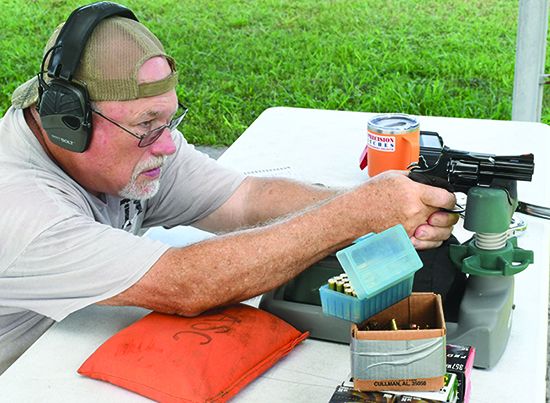
We tested at American Shooting Centers in west Houston. We fired for accuracy at 15 yards by shooting multiple five-shot groups from a well-sandbagged Caldwell Pistolero Shooting Rest (MidwayUSA.com 517357, $28) assisted by a Mini DRC Fortune Cookie from Wiebad.com ($75, MINIFC). We recorded velocities with a Garmin Xero C1 Pro chronograph ($600).
| DRILL NO. 1 DATA | |
|---|---|
| Revolver | Single Shot Average Time |
| Colt Python | 0.714 |
| Rossi RP63 | 0.765 |
| Ruger GP100 | 0.74 |
| S&W Model 686 | 0.68 |
Process: Fire one shot from low ready at a USPSA target at 5 yards. Averages are for 10 repetitions.
| DRILL NO. 2 DATA | |||
|---|---|---|---|
| Pistol | First Shot | Split Average | Total Time |
| Colt Python | 0.647 | 0.263 | 0.92 |
| Rossi RP63 | 0.807 | 0.36 | 1.15 |
| Ruger GP100 | 0.795 | 0.305 | 1.1 |
| S&W Model 686 | 0.68 | 0.267 | 0.97 |
Fire two shots from low ready at a USPSA target at 5 yards. Averages are for three repetitions.
| DRILL NO. 3 DATA | |||
|---|---|---|---|
| Pistol | First Shot | Split Average | Total Time |
| Colt Python | 0.7 | 0.278 | 1.81 |
| Rossi RP63 | 0.75 | 0.333 | 2.08 |
| Ruger GP100 | 0.75 | 0.318 | 2.02 |
| S&W Model 686 | 0.68 | 0.3 | 1.88 |
Fire five shots from low ready at a USPSA target at 5 yards. Averages are for three repetitions.
Our speed tests are not designed to show how fast a firearm can be fired, but to use the same test on multiple guns fired by the same person to look for differences in the guns’ capabilities.
Written and photographed by Joe Woolley, using evaluations from Gun Tests Team members. GT