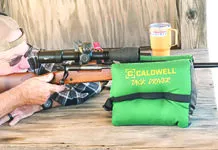







Recent emails from readers requested that we look at modern muzzleloading rifles, and with the introduction of Federal’s Firestick technology in 2020, we also think it is a good time. We chose two well-known muzzleloading brands with a pedigree for evolving muzzleloader technology: Traditions and CVA. The Traditions NitroFire Pro Series uses Federal’s Firestick ignition, and the CVA Optima uses powder pellets or loose powder. Both are .50 caliber and have 26-inch fluted barrels. They feature break actions and are hammer fired. Stocks are polymer, and finishes are weather resistant as well as corrosion resistant.
Load Development
With muzzleloaders, the user has to decide the load combination of bullet, powder, and primer. The process is simple, even if you are not a ballistics junky. First let’s talk about powder, all of which we sourced at Midway.com.
We chose 100-grain Firesticks to use in the NitroFire. They cost $30 for a 10 pack. Firesticks feature a polymer cartridge filled with Hodgdon Triple Eight powder in 80-, 100- or 120-grain amounts. For the CVA, we used both Triple Seven ($40 for 100 pack) and White Hots ($34 for 72 pack) pellets. One White Hots or Triple Seven pellet is 50 grains, therefore two pellets are loaded for a total of 100 grains, or three pellets can be loaded for 150 grains.
All of the pellet propellants offer higher velocities and easier clean up without too much of the rotten-egg smell of original black powder. Because the powder charge in the Firesticks is encased in a polymer cartridge, they offer a higher level of convenience over pellets by protecting against moisture and are easier loading and unloading. As deer hunters know, unloading a muzzleloader means either shooting the loaded round or removing the breech block and the powder charge. With loose powder, the charge is wasted and many times, pellets are tainted from gun oil and handling. In our opinion, the Traditions NitroFire with Firestick technology offers the most convenience, while the CVA Optima offers the ability to customize the powder charge for optimal accuracy and power, if you choose to go the loose-powder route. The trade off with pellets and Firesticks is that you can’t tweak the charge for maximum velocity and accuracy like you can with loose powder, but you have the convenience of a pellet. If you are new to muzzleloaders or don’t want to be bothered measuring loose powder, then using pellets or Firesticks are two options. Firesticks also add a level of safety because loading a double charge is impossible.
Next are primers, which have evolved from plain 209 shotgun primers. Muzzleloading primers are designed for hot ignition and offer moisture resistance and reduced fouling. Federal Muzzleloading 209MZ primers ($19 for a 100 pack at Sportsmans.com) were used to ignite the Firesticks. We used Winchester Triple Seven primers ($18 for a 100 pack at Midway.com) with the Triple Seven and White Hots pellets.
Finally, there are also a slew of muzzleloader projectile options. The bullets used in this match up included sabot-style and belted projectiles. Sabot projectiles use a polymer cup with petals that encase the bullet. Belted rounds use a polymer base that the bullet sits in. In the sabot camp, we used Hornady SST Low Drag Sabots loaded with a 250-grain .45-caliber SST‑ML bullet with a Flex Tip ($23 for a 20 pack at Muzzle-Loaders.com) and Traditions Smackdown Carnivores with 250-grain .45-caliber bullets ($19 for 15 pack at Muzzle-Loaders.com). Belted bullets included Powerbelt Bullets 270-grain ELR (Extended Long Range) projectiles ($27 for 15 pack at Muzzle-Loaders.com) and Hornady’s Bore Driver with a 290-grain Flex-Tip bullet ($27 for 20 pack at Muzzle-Loaders.com). The Powerbelt projectile has a high ballistic coefficient, so it maintains velocity and accuracy at longer distances. It has a steep-tapered point compared to the other projectiles and required a special seating attachment to the ramrod, which is included with each pack of bullets.
During the test we were looking for accuracy, ease of loading, fast ignition, and ease in unloading and cleaning. We swabbed rifle barrels after three shots to remove fouling with Traditions pre-saturated cleaning patches ($10 for 100 at TraditionsFirearms.com). To ease loading, we used a Traditions Ultimate Loading/Cleaning Rod ($34 at TraditionsFirearms.com. This rod is sturdier than the ramrods that come with the rifles, and it made starting the bullet down the barrel and loading easy. We had no fear the ramrods that came with their rifles would bend when loading the rifles; the heavy-duty rod just eased the process. It also helps to swab and clean the barrel. This rod breaks down into three pieces and has a sturdy T-handle. We liked this rod a lot and recommend one.
After slinging heavy slugs downrange, we have a newfound respect for these modern inline muzzleloaders. When the smoke cleared — and it takes a second or two with muzzleloaders — this is what we discovered.
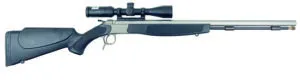
CVA Optima V2 PR2020SM .50 Caliber
$298
Gun Tests grade: A-
The Optima V2 is an accurate, easy-to-use muzzleloader that is convenient to load with pelletized powder or allows the user to fine-tune the load with loose powder. Cleaning is more labor intensive.
| Action Type | Break, hammer fire |
|---|---|
| Overall Length | 41.1 in. |
| Barrel Length | 26.0 in. |
| Barrel Rifling Twist Rate | 1:28 in. |
| Weight w/Scope | 5.7 lbs. |
| Receiver | Stainless steel |
| Barrel | Stainless steel, fluted |
| Stock | Black polymer, checkered |
| Stock Length of Pull | 14.0 in. |
| Stock Drop at Comb | 1.0 in. |
| Stock Drop at Heel | 1.6 in. |
| Stock Buttplate | Textured rubber |
| Sights | None, optics ready |
| Trigger Pull Weight | 2.8 lbs. |
| Safety | None |
| Warranty | Limited lifetime |
| Telephone | (770) 449-4687 |
| Website | BPIOutdoors.com |
| Made In | Spain |
Our Optima V2 had a matte-stainless-steel finish and black-polymer stock and fore end. The gripping areas on the stock are checkered and offer a good grip. The rifle was comfortable to shoulder. The CrushZone recoil pad really helped tone down felt recoil. Sling studs are provided.
Our sample came from the factory with a DuraSight DEAD-ON one-piece scope mount, to which we mounted a Hawke Vantage IR 3-9x40mm scope ($219; US.HawkeOptics.com). This scope has a reticle calibrated for projectile speeds of 1300 to 2400 fps. The illuminated reticle (either red or green) is a modified German No. 4 style with aiming points for distance shots at the bottom portion of the vertical strata. It is designed for slug guns, straight-wall cartridges, and muzzleloaders, and the reticle is simple to use and uncluttered. The glass was clear and sharp, and for the cost, this is a decent scope that won’t break the bank.
The Optima features a tool-less breech plug, which makes cleaning the rifle easy. Even after 30 or so shots, the breech plug could be unscrewed by hand. The ramrod is an aluminum tube that is captured by two ferrules and is secure in the rifle. It did inch its way out due to the recoil of a shot. CVA includes a palm-saver plastic piece that screws onto the loading jag while in the field. It needs to be unscrewed and used on the opposite end of the ramrod when loading. It worked fine and fit in the palm of our hand to more easily seat the bullet. Also included is an extended cleaning jag and a combination tool to remove the firing pin and the 209 primer.
To load, drop two pellets down the muzzle for a 100-grain charge and then press a projectile into the muzzle by hand. The muzzle section of the bore does not have rifling, so it is easy to start the bullet. Then use the ramrod to seat the bullet firmly on top of the powder. The next step is to open the action and insert a primer, then close the action and cock the hammer. The Optima is now ready to fire. The primer hole is slightly oversized so the primer easily fits. Working with small primers can be tricky for folks with thick fingers, so make sure you have extra primers in the event you drop one.
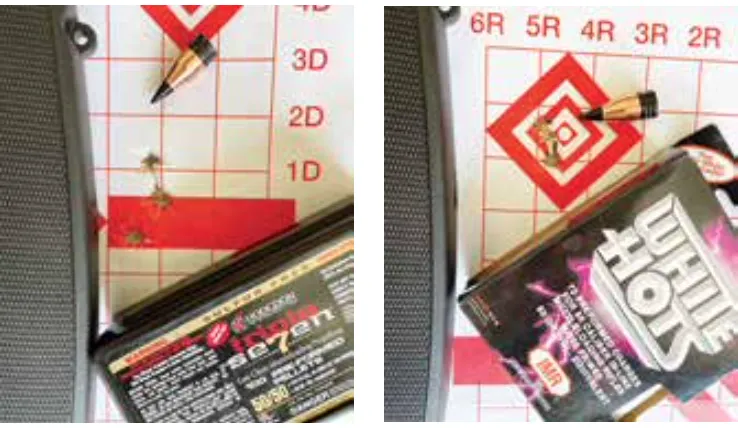
We loaded White Hots pellets first. The smallest group with the sabot bullets were with Traditions 250-grain Smackdown Carnivores. These projectiles have a ribbed sabot that Traditions calls a Ridgeback Sabot, which creates a gas seal and reduces friction in the barrel. The best three-shot group measured 1.25 inches, and the average was 1.31 inches. The Hornady SST Sabot bullets had a best group that measured 1.44 inches and an average of 1.48 inches. Good accuracy we thought.
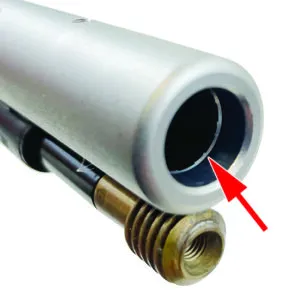
Moving to the belted bullets, the best was the Powerbelt ELR 270-grain projectiles, with a best group that measured 1.00 inches and an average of 1.30 inches. Hornady Bore Driver 290-grain bullets had a best of 1.50 inches and an average of 1.54 inches. The Powerbelt ELR bullets were impressive. Ignition was perfect, there were no hang-fire shots, and velocity ranged only about 100 fps between the lowest and highest readings. We noticed that the White Hots produced slightly less smoke than the Triple Seven pellets. We could actually fire about five rounds before loading became a chore, so we kept our process to three shots and then swabbed the barrel.
Moving on to Triple Seven pellets, we noticed a slight increase in velocity when compared to the White Hots. The best belted bullet group came from Powerbelt ELR with a 1.29-inch group and an average of 1.53 inches. Hornady Bore Drivers had a best group that measured 1.37 inches and an average of 1.75 inches. The best sabot bullet group came from the Traditions Smackdown Carnivores with a 1.43-inch best group and an average group of 1.64 inches. The Hornady SST Sabot load had a best group of 1.76 inches and averaged 1.97 inches. This is good accuracy for deer hunting. All shots had perfect ignition. We did have one misfire after cleaning the rifle and returning to the range. We loaded another primer and the shot fired. We attribute this to debris in the flash hole and a less-than-perfect cleaning job. It is also a good idea to snap the hammer on just a primer or two after cleaning to be sure the flash hole is debris free. The trigger was crisp with no creep and broke at a nice 2.8 pounds.
The spur on the trigger guard offered good leverage to open the action. There was a clear seam along the outside of the trigger guard. This could have been blended better, and in our opinion makes the rifle look cheap. The recoil pad helped manage recoil.
Cleaning the CVA was more of a chore than the Traditions. You need a flat-blade screw driver to remove the fore end and then remove the barrel from the action. We would have liked the screw to be captured by the fore end so it can’t be lost. The breech plug needed to be soaked in solvent and a scraper used to remove crud. White Hots pellets had less crud build up compared to Triple Seven. We left the rifle for a few days after shooting both types of powder to see if corrosion appeared, and there was no rust, so the finish on the rifle is doing its job. Unloading the Optima means you don’t have to fire a shot, but you lose a powder charge.
Our Team Said: The CVA Optima V2 is accurate for deer hunting, has a nice trigger, is easy to load and unload, but was a chore to clean. Recoil is very tolerable. For the price, this is a good rifle that we would not hesitate to use for deer hunting. If you like the idea of having the ability to use loose powder and pellets, this would be a good option.
| TRADITIONS NITROFIRE PRO RANGE DATA | ||
|---|---|---|
| Bullet Powder Primer | Hornady SST Sabot 250-grain (.45 cal.) Firestick 100-grain Federal 209MZ | Hornady Bore Driver 290-grain (.50 cal.) Firestick 100-grain Federal 209MZ |
| Muzzle Velocity | 2020 fps | 1817 fps |
| Muzzle Energy | 2266 ft.-lbs. | 2270 ft.-lbs. |
| Smallest Group 1.44 in. | 1.44 in. | 1.50 in. |
| Average Group | 1.48 in. | 1.54 in. |
| Bullet Powder Primer | Powerbelt ELR 270-grain (.50 cal.) Firestick 100-grain Federal 209MZ | Traditions Smackdown Carnivore 250-grain Firestick 100-grain Federal 209MZ |
| Muzzle Velocity | 1905 fps | 2000 fps |
| Muzzle Energy | 2338 ft.-lbs. | 2220 fps |
| Smallest Group | 0.40 in. | 1.15 in. |
| Average Group | 0.50 in. | 1.43 in. |
To collect accuracy data for both rifles, we fired three-shot groups from a bench using a rest. Distance: 100 yards with a scope. Velocities and energies were recorded using a Garmin Xero C1 Pro chronograph.
| CVA OPTIMA V2 RANGE DATA | ||
|---|---|---|
| Bullet Powder Primer | Hornady SST Sabot 250-grain (.45 cal.) White Hot 100-grain Winchester 209 Triple 7 | Hornady Bore Driver 290-grain (.50 cal.) White Hot 100-grain Winchester 209 Triple 7 |
| Muzzle Velocity | 1531 fps | 1466 fps |
| Muzzle Energy | 1301 ft.-lbs. | 1389 ft.-lbs. |
| Smallest Group | 1.44 in. | 1.50 in. |
| Average Group | 1.48 in. | 1.54 in. |
| Bullet Powder Primer | Powerbelt ELR 270-grain (.50 cal.) White Hot 100-grain Winchester 209 Triple 7 | Traditions Smackdown Carnivore 250-grain White Hot 100-grain Winchester 209 Triple 7 |
| Muzzle Velocity | 1510 fps | 1530 fps |
| Muzzle Energy | 1367 ft.-lbs. | 1300 ft.-lbs. |
| Smallest Group | 1.00 in. | 1.25 in. |
| Average Group | 1.30 in. | 1.31 in. |
| Bullet Powder Primer | Hornady SST Sabot 250-grain (.45 cal.) Triple Seven 100-grain Winchester 209 Triple 7 | Hornady Bore Driver 290-grain (.50 cal.) Triple Seven 100-grain Winchester 209 Triple 7 |
| Muzzle Velocity | 1541 fps | 1422 fps |
| Muzzle Energy | 1318 ft.-lbs. | 1304 ft.-lbs. |
| Smallest Group | 1.76 in. | 1.37 in. |
| Average Group | 1.97 in. | 1.75 in. |
| Bullet Powder Primer | Powerbelt ELR 270-grain (.50 cal.) Triple Seven 100-grain Winchester 209 Triple 7 | Traditions Smackdown Carnivore 250-grain Triple Seven 100-grain Winchester 209 Triple 7 |
| Muzzle Velocity | 1529 fps | 1535 fps |
| Muzzle Energy | 1401 ft.-lbs. | 1308 ft.-lbs. |
| Smallest Group | 1.29 in. | 1.43 in. |
| Average Group | 1.53 in. | 1.64 in. |
Written and photographed by Robert Sadowski, using evaluations from Gun Tests Team members. GT