











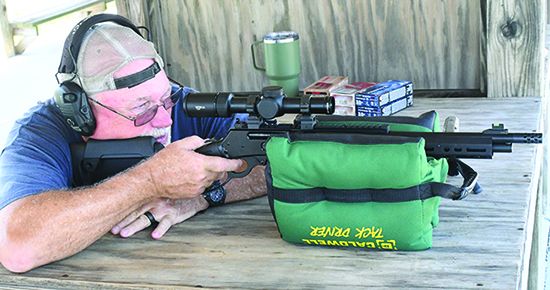
More than a century and a half after the introduction of lever-action rifles, the American shooting public seems to be discovering these guns anew. And the latest craze is the tactical lever gun — something we would have called an oxymoron in years past. Now, we see the usefulness of the concept. New lever-action models bring different stocks, threaded muzzles, and better sights to the platform, so we grabbed samples of two of the most interesting tactical lever guns chambered in 30-30 Winchester to test. The first is the Rossi R95 Triple Black 953030161TB, $950. Unlike Rossi’s more conventional lever guns, this model brings an adjustable peep sight mounted on a Picatinny rail, a brass-bead front sight, a large-loop lever, and is threaded for a suppressor. Then we added the Marlin Model 336 Dark 70902, $1260, which sports a redesigned loop, a polymer stock with a good recoil pad and M-Lok slots, along with an octagonal fore end also festooned with M-Lok slots.
Optics
We realize that a lever-action 30-30 will never be a long-range precision rifle, but we wanted to see what these rifles could do beyond what iron sights or a red dot could deliver. So we made the decision to use low-powered optics and saw at once that was going to cause some problems. The rifles’ taller rear sights — that we really liked — sit right where we need to mount the ocular lens of the scope. But we found two good solutions that would work for us.
The first was to use a standard LPVO scope in high rings. We grabbed a Vortex PST II 1-6×24, $600, from our battery. This is an optic we’ve used many times with great results. Possessing very clear glass and a great reticle marked in 1-mil stadia lines, the 1-6 magnification gave us everything we needed. We used A.R.M.S. rings (ARMSMounts.com, $219) that lifted the optic above the line of the sights and almost pulled our cheeks off the stock. Marlin, in its wisdom, included a cheek riser in the package that allowed at least a good chin weld, if not a full cheek weld.
We also tested a Burris 2.75x20mm fixed-power extended-eye-relief optic (BurrisOptics.com, $350). Mounting it forward of the rear sight in a scout-scope style, we were able to keep our heads in a much more natural position. For this test, we actually liked the Burris better because it delivered low-head-position both-eyes-open operation. That said, while we would have been fine taking the lower-powered Burris afield, we didn’t feel that it provided enough magnification for testing. Accordingly, we used the Vortex for accuracy tests on both rifles.
Marlin Dark Series Model 336 70902 30-30 Winchester
$1260
Gun Tests grade: A- Our Pick
Lever guns aren’t known for their gilt-edged accuracy, but this tricked-out Marlin managed to average sub-2-inch groups. Short, light, and easy to carry, this could be a great woods gun or defensive carbine.
| Action Type | Lever |
|---|---|
| Overall Length | 35.5 in. |
| Barrel Length | 16.17 in., 1:11 twist |
| Overall Height w/o Scope Mount | 7.5 in. |
| Weight Unloaded | 6.89 lbs. |
| Weight Loaded | 7.16 lbs. |
| Sight Radius | 18.0 in. |
| Action Finish | Satin black |
| Barrel Finish | Satin black |
| Magazine Capacity | 5 |
| Magazine Type | Tube |
| Stock | Nylon-reinforced polymer |
| Drop at Comb | 0.5 in. |
| Drop at Heel | 0.6 in. |
| Buttplate | Rubber |
| Length of Pull | 13.6 in. |
| Receiver Scope-Base Pattern | Picatinny rail |
| Trigger Pull Weight | 4.2 lbs. |
| Safety | Crossbolt |
| Warranty | None written |
| Telephone | (336) 949-5200 |
| Website | Ruger.com |
| Made In | U.S. |
Marlin Firearms was founded in 1872 by John Marlin. Most of us are familiar with the company’s lever-action rifles, but they had more in their product lines than just a competitor to the 1894 Winchester. During WWI, Marlin was one of largest producers of machine guns for the Allies, starting with the 1895 Colt/Browning machine gun and progressing through models designed for use in airplanes.
Remington Firearms bought Marlin out in 2007, and problems began. Historically, groups that are interested only in maximizing the bottom line do a very poor job on managing firearms manufacturers, and this was no exception. Not only did Remington’s C-suite lower Marlin’s product quality, they moved the production plant away from their skilled work force. By 2020, Remington had worked its way — unsuccessfully — through multiple bankruptcies and filed for a complete liquidation. Several entities purchased various assets of the company. The one we’re interested in is Ruger, which purchased all the assets and rights to Marlin in September 2020.
Initially optimistic, Ruger soon found that they had a real job on their hands. Sources say that Ruger bought almost 150 truckloads of raw materials, parts, and heavy equipment. Much of that equipment was on its last legs and had to be replaced. Firearms had to be re-engineered to correct for the poor quality of the last rifles made by Remington and to allow for more modern production methods. Ruger’s first introduction from their rebuilt line was the Marlin 1895 SBL in December 2021. Chambered in 45-70 and showing the popular large-loop lever, Marlin was back. Subsequent intros have added more 1895 and 1894 models to high acclaim. We were very pleased with a Marlin 1894 carbine in 44 Magnum we reviewed in the July 2024 issue.
Historical interest aside, we think a lever-action carbine in 30-30 Winchester, 45-70 Government, 357 Magnum, or 44 Magnum makes very good sense. They are thin, light, easy-to-carry by hand or on horseback, possess energy sufficient for many needs and, generally, have a decent ammunition supply. Lever-actions provide a marvelous hunting firearm while, especially in magazine-restricted states, they can also be a very desirable defensive firearm. The latest iterations cater toward that crowd with black finishes, better sights, improved triggers, and mounts for optics.
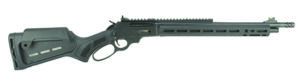
The first sample for this test is the Marlin Dark Series Model 336 in 30-30. The series name describes much of what you’ll see. The stock is a black nylon-reinforced polymer, and all the metal carries a satin-black finish. The only color on the entire rifle is the safety and the front sight.
Our gun arrived with a 16.17-inch barrel attached. That is straight from their specs. We would have called it 161⁄8 inch and moved on, but we also wanted to be precise. Their specs also show a 1:11-inch twist. Checking back in some old reloading manuals that list the barrel/firearm and twist used to test for the data, we found a 1:12 twist to be more common. Perhaps Ruger is trying to get a little more rotation to stabilize today’s modern longer bullets. The barrel is threaded 5⁄8×24. A thread protector was included, but our sample came with a radial muzzle brake attached. We realize that brakes make the firearm louder, especially when used in a deer blind, but we liked this one. Not only does this set the rifle up for use with a suppressor, but the brake itself turns what is normally a mild-recoiling rifle into a pussycat to shoot. This could easily be a great first rifle for recoil- or noise-sensitive shooters.
The other attachments to the barrel are what turn this into the Dark Series. The front sight is a green fiber optic, surrounded by a white donut securely attached to the barrel. It mates up well with the ghost ring rear. Adjustable for windage via a screw on the side of the sight body or elevation through loosening a set screw and turning the ring up or down half a turn at a time, we found the sights to be very sturdy, visible, and easy to correct. The rear sight is mounted on an octagonal fore end with M-Lok slots at 3, 6, and 9 o’clock. There are also quick-detach holes on both sides just back of the muzzle. Attached via four screws, we found the mount to be very solid, though it also raised the sights above the plane normally found with conventional buckhorn sights. The additional height required that we use high scope rings to go along with the Vortex PST Viper 1-6×24 scope we mounted. Getting the scope high enough to clear the rear sight requires a much higher cheek weld than normal, but Marlin recognized that potential problem and included a snap-on cheek piece with the rifle.
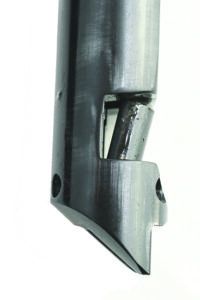
The receiver was what we expected to see in an 1895 Marlin. The top of the receiver, of course, is closed, making it easy to mount scopes and Pic rails. Takedown is easy by removing the hinge pin on the lever and then sliding everything out. Ruger still uses the tubular bolt with a two-piece firing pin. They redesigned the loop, making it a bit more oval and flattening the bottom edge. That made it much more comfortable to operate the lever. At first, we thought that the lever was sticking closed on us, but much of that smoothed out quickly. We discovered that, as long as we operated the lever with the rifle mounted in our shoulders, everything was fine. The loading gate operated smoothly without biting our thumbs or the cartridges.
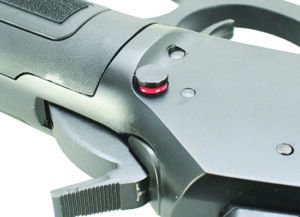
The hammer is the expected design, and the box includes a spur to be mounted to the hammer to make it easier to manipulate with a scope attached. It provides three positions. First, all the way down with the face resting on the firing pin, second, at half-cock — not resting on the firing pin, and third, full-cock waiting to be released via the trigger. We are fine with the half-cock notch as our safety but, like it or not, the Marlin Dark 336 also mounts a cross-bolt safety located between the trigger and the hammer. Pushing it right to left puts the gun on Fire.
The stock is a nylon-reinforced polymer unit. The wrist has a slight drop to it as well as stippling that is sharp enough to be effective without being overly abrasive. The buttstock is hollowed out with a flat center and three more M-Lok slots. Need to attach a spare ammo pouch? There you go. Once again, it provides QD holes left and right.
Looking for favorites, we tested three loads with different weights. The first was a Barnes Pioneer round with a 150-grain TSX all-copper flat-nose bullet designed for use in lever-gun tubular magazines. That compiled an average of 1.53 inches with one group at 0.85 inch. The Hornady 160-grain FTX averaged a tad more than 2 inches and did so at almost 2300 fps, yielding more than 1800 foot-pounds of energy out of a short-barreled 30-30. The final load was the 170-grain jacketed-soft-point round nose from Federal. That load also averaged sub-2-inch groups. All in, this Marlin averaged three-shot groups less than 2 inches.
Our Team Said: Even with a trigger that required more than 4 pounds of compression to fire, the Marlin shot well — as well as we would hope for in a 30-30 at 100 yards with a low-powered scope. Feeding and ejection were perfect.
| 30-30 WINCHESTER RANGE DATA | ||
|---|---|---|
| Barnes Pioneer 150-grain TSX FN FB | Marlin 336 Dark Series | Rossi R95 Triple Black |
| Average Velocity | 2189 fps | 2087 fps |
| Muzzle Energy | 1596 ft.-lbs. | 1452 ft.-lbs. |
| Best Group | 0.85 in. | 1.73 in. |
| Average Group | 1.53 in. | 1.95 in. |
| Hornady LEVERevolution 160-grain FTX | Marlin 336 Dark Series | Rossi R95 Triple Black |
| Average Velocity | 2265 fps | 2156 fps |
| Muzzle Energy | 1824 ft.-lbs. | 1651 ft.-lbs. |
| Best Group | 1.21 in. | 1.40 in. |
| Average Group | 2.08 in. | 1.99 in. |
| Federal Power-Shok 170-grain JSPRN | Marlin 336 Dark Series | Rossi R95 Triple Black |
| Average Velocity | 2092 fps | 2001 fps |
| Muzzle Energy | 1653 ft.-lbs. . | 1512 ft.-lbs |
| Best Group | 1.94 in. | 1.46 in. |
| Average Group | 1.97 in. | 2.19 in. |
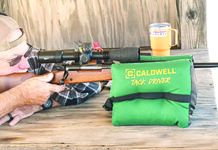
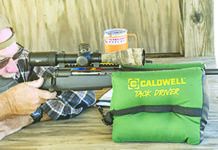
We tested with a variety of ammunition that would cover the spectrum of weights commonly used for whitetail hunting. We started with Barnes Pioneer 150-grain TSX Flat Nose Flat Base 32137 all-copper hollow points. Then we moved up to Hornady LEVERevolution 82730 160-grain FTX rounds, and topped off our list with Federal Power-Shok 30308 170-grain jacketed soft-point round-nose ammo. We test-fired at American Shooting Centers in Houston using a well-sandbagged Caldwell TackDriver Pro (Brownells 100-027-023, $49), further supported by a Tab Gear large rear bag, heavy (TabGear.com, $34). We used a Garmin Xero C1 Pro chronograph (Garmin.com, $600) to measure velocities. We used a Vortex Viper PSTII 1-6×24 scope for all the accuracy shooting.
Written and photographed by Joe Woolley, using evaluations from Gun Tests Team members. GT