










Benelli’s patent on the M4 semi-automatic shotgun’s ARGO gas system expired around 2021, while Benelli’s inertia systems patents expired in the mid-2000s. This allowed other shotgun manufacturers to produce their own M4 and M2 clones. We have had numerous readers email us asking for a review on Benelli M4 clones, so we acquired three lookalikes: the 1014 Wood from MAC, an M4 from Panzer Arms, and the Gatlander from GForce Arms. These shotguns are made in Turkey by Özerbas Makine, Panzer Arms, and Radikal, respectively, and look like Benelli M4 shotguns. The Panzer Arms and MAC use the ARGO (Auto-Regulating Gas-Operated) system, while the GForce Arms shotgun looks like an M4 due to the fake extended magazine tube and ghost ring sights on an 18.5-inch barrel, but uses an inertia recoil system like a Benelli M2. We thought this would be a good opportunity to compare the M4 gas action to the M2 inertia action as well as assess the guns side by side.
The ARGO system uses dual short-stroke pistons that operate on gas from a fired shell. Benelli located the gas ports just forward of the chamber, because, in theory, the gases are hotter and cleaner so there is less fouling, and the shotgun will cycle more reliably. Inertia systems use the shotgun’s recoil to cycle the action by employing a bolt head and a bolt body connected by a stiff, internal inertia spring. There are pros and cons to both systems. Inertia systems run cleaner and are ultra reliable, but produce more felt recoil. The ARGO system is also reliable and produces less felt recoil, but requires more maintenance because it runs off gases from a fired shell.
All three of these copycat shotguns are designed for defense work, though we could see using them for turkey and deer hunting. They are chambered in 12 gauge with 3-inch chambers, 18.5-inch barrels with screw-in choke tubes, and are equipped with traditional-style stocks made of polymer or wood. Capacities are 5+1; their extended magazine tubes are just for looks. Sights are also similar across the three shotguns: adjustable ghost ring rears, windage-adjustable post front sights with protective wings, and Picatinny/Weaver-style rails to mount red dots. Mounting a red dot means your cheek weld will be slightly higher so your eye can align with the dot. We opted to test these guns without a red-dot optic because the sights are very user friendly and robust.
The first thing we noticed is that the true M4 clones — the MAC and Panzer — are heavier and have thicker fore ends. The M2 clone — the GForce — is slightly lighter and has a much thinner fore end. The reason for the chubby fore end is because the dual-piston gas system is located under the fore end. There is nothing under the GForce M2 clone’s fore end except a magazine tube.
We read the manuals and found different ammo recommendations for each shotgun. The GForce recommended a break-in of 150 to 200 rounds and to only run ammo with a velocity of 1250 to 1400 fps. The MAC recommends a break-in of 100 rounds at 1350 fps and suggests using only ammo with 1350 fps minimum velocity and minimum of 11⁄8 ounce payload. Panzer states the shotgun may not run on light target loads, and no specific minimum-velocity recommendation was stated, but the manual did state not to exceed 1600 fps with any weight load or 13⁄4-ounce loads at any velocity. Despite the warning, we still fed these guns a light load to check for function. We saw the Fiocchi Shooting Dynamics target load clock in at 1165 fps, and the result was the shotguns had FTE jams. We also used shells with muzzle velocities within the guidelines of the manuals: Federal’s Game Load (1290 fps), two buckshot loads, one from Panzer Defense (1350 fps, and not related to the gun) and one from Hornady Critical Defense (1600 fps), and slug round, Federal Tactical Low Recoil ammo (1300 fps). We also threw in a bunch of orphan/widow hunting and tactical loads that were left over to see what kind of mischief they caused.
To check pattern sizes, we placed NRA D-1 tombstone-style targets at 15 yards and fired rounds off hand. For slug data, we moved the targets to 25 yards and used a rest to fire groups. Full-choke tubes were installed in each shotgun. We fired the shotguns from the shoulder and from the hip. We wanted to see if the lack of resistance when shooting from the hip would trip up the shotguns, and it did initially. The GForce inertia gun and the MAC and Panzer gas guns jammed with light loads early in the testing, with failures to eject or feed when we fired them from the hip. When fired from the shoulder, the guns ran perfectly. So we followed directions and ran a few boxes of higher-velocity Federal Game Loads and then went back to the light loads. All the shotguns cycled the light loads fired from the shoulder or hip. We also fired the shotguns so ejection was straight up or straight down. We didn’t baby these shotguns at all. After the very few initial jams with light target loads, the shotguns ran perfectly. There were a few pinched thumbs during loading, and we really appreciate the oversized charging handles. The shotguns were loaded from underneath with our support hand while grasping the pistol grip with our firing hand as well as flipped so the loading port was facing up. Trigger-pull weights were awfully heavy across all the shotguns, and we have come to dislike small bolt-release buttons. We also noted that the magazine caps loosened under heavy shooting, which is to be expected. In the end, we feel any of these shotguns would be a good home-defense option. We like the ability to get an M4-style shotgun for a song, and in our opinion, the manufacturers produced decent shotguns, but they missed an opportunity to improve on the classic M4 design. Here are the details.
MAC 1014 Wood 21000155 12 Gauge,
$380
Gun Tests grade: A- [our pick]
The 1014 Wood operated smoothly. The gas system reduced felt recoil. We didn’t like the tiny bolt-release button. For easy carry, it comes with a nylon sling, a sling stud, and a sling loop on the mag tube.
| Action Type | Semi-auto, gas operated |
|---|---|
| Chamber Size | 3.0 in. |
| Overall Length | 40.0 in. |
| Capacity | 5+1 |
| Weight Unloaded | 8.3 lbs. |
| Weight Loaded | 8.7 lbs. |
| Barrel Length | 18.5 in. |
| Finish | Anodized black |
| Choke Tubes | F, M, C |
| Stock | Textured wood, solid rubber recoil pad |
| Stock Length of Pull | 14.0 in. |
| Stock Drop at Comb | 1.2 in. |
| Stock Drop at Heel | 1.8 in. |
| Fore End | Ribbed wood |
| Front Sight | White dot bead |
| Rear Sight | Adj. ghost ring |
| Optic Rail | Yes, installed |
| Trigger Pull Weight | 8.3 lbs. |
| Safety | Manual trigger block |
| Warranty | 5 years |
| Telephone | (865) 604-6894 |
| Website | SDSArms.com |
| Made In | Turkey |
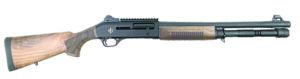
The MAC 1014 Wood features an ARGO-style gas system. It has a classic look, with decent wood for the butt stock and fore end. The MAC can’t compete with wood found on a Browning or Beretta shotgun, but it is nicer than any economy-brand shotgun. A stippled texture was in the right places on the pistol grip, and the fore end was ribbed with stippling between the ribs. A solid, yet soft, rubber recoil pad was fitted nicely to the stock. The edges of the pad were sharp, but they did not snag on clothing when the shotgun was shouldered. The stock has a sling-swivel stud attached, and a sling loop is fitted to the magazine tube. In the cardboard box was a small hard-plastic case with three screw-in choke tubes and wrench. A nylon sling is also included.
The metal wore an anodized matte-black finish that looked nice. Screwed on to the top side of the receiver was a Picatinny/Weaver-style rail and adjustable ghost-ring sight. Arrows near the screws provided sight-adjustment direction, which is helpful. Two white dots straddled the rear aperture. The front-sight post also wore a white dot, and the post was adjustable for windage. We liked these sights, and it showed when slugs were fired.
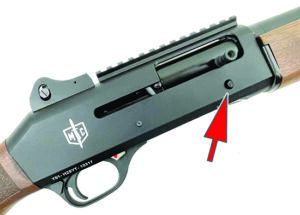
The charging handle is rounded and makes racking the bolt easy. The action was slick. The bolt-release button is a tiny dot, too small for our tastes. The top is serrated and it is extended, but it was more difficult to operate than a large oversized bolt-release button. The cartridge drop lever is just forward of the trigger guard. A red dot is exposed indicating the hammer is cocked. With the hammer cocked, the bolt does not lock back. Press the lever button to lock back the bolt. The trigger safety is a triangular button that is right-hand friendly and located behind the trigger. The edges of the loading port were not sharp, but had an edge. We did not pinch our thumbs on the carrier when loading shells. The trigger group is polymer, and the one-stage trigger broke on average at 8.3 pounds, which is about double of we’d like.
The extended magazine tube is ribbed to reduce capacity to five shells in the tube. Loading shells was smooth. The magazine follower is red, providing a visual that the magazine is free of shells.
Starting with the odd assortment of shells, the MAC cycled whatever was loaded into it — birdshot, buckshot, or slugs. When the Fiocchi Target loads (1129 fps) were fired from the hip, we experienced a couple of FTE jams. We ran more higher-velocity ammo, then returned to the light Fiocchi load and experienced no issues. We attribute the jams to the MAC needing a break-in period.
The MAC is a hefty shotgun at 8.3 pounds with the balance point on your support hand just forward of the receiver. The extra weight helps mitigate recoil as does the gas system. Running the MAC fast, the weight and the gas system are assets. The large sights made aiming the MAC a breeze; shots with buckshot were surgical. The hot Hornady Critical Defense 00 Buck load (1600 fps) produced 3.5-inch patterns at 15 yards, which is impressive. The Panzer Defense 00 buck load (1300 fps) pattern was nearly three times larger at 9 inches. The difference in recoil was noticeable between the two loads. The Federal Game Loads (1290 fps) produced an 11-inch pattern with No. 7.5 shot; the Fiocchi Target Load (1165 fps) with No. 8 shot produced a 12-inch pattern. The MAC cycled nicely and loading was smooth. Firing until bolt lock back on the last shot, the process was to drop a shell into the chamber and press the bolt-catch release. Many times we just slammed the bolt-release button with the bottom of our fist. The tiny button was stiff and took effort to press it. We then continued loading the magazine tube to capacity and firing another string. Shooting Federal Tactical slugs (1300 fps) at 25 yards produced 2.8-inch groups on average, which we thought was decent accuracy.
Though we did not try to swap Benelli M4 aftermarket parts into this trio, the manufacturer’s website states the MAC is aftermarket M4 compatible. Choke tubes are Benelli/Mobil style, so numerous aftermarket tubes are available, too.
Our Team Said: The MAC 1014 performed exactly like an M4, which is a good thing as well as bad. The small bolt-catch button and the narrow loading port seemed dated, especially with manufacturers offering beveled loading ports for faster and smoother loading and oversized controls. After a short break in, the MAC was a bulldozer, plowing through shells with ease. The gas system noticeably reduces recoil, so extended shooting time was pleasant, and our shoulders didn’t feel beat up. If you want a semi-auto shotgun that mimics the M4, the MAC is an excellent option, especially with a cost about 75 percent less than a Benelli M4.
| 12 GAUGE RANGE DATA | |||
|---|---|---|---|
| Federal Game Load 2.75 in., No. 7.5 shot | GForce Arms Gatlander | MAC 1014 Wood | Panzer Arms M4 |
| Average Pattern Size | 17.0 in. | 11.0 in. | 10.0 in. |
| Fiocchi Target Load 2.75 in., No. 8 shot | GForce Arms Gatlander | MAC 1014 Wood | Panzer Arms M4 |
| Average Pattern Size | 13.0 in. | 12.0 in. | 10.0 in. |
| Hornady Critical Defense 2.75 in., 00 Buckshot | GForce Arms Gatlander | MAC 1014 Wood | Panzer Arms M4 |
| Average Pattern Size | 5.5 in. | 3.5 in. | 7.0 in. |
| Panzer Defense 2.75 in., 00 Buckshot | GForce Arms Gatlander | MAC 1014 Wood | Panzer Arms M4 |
| Average Pattern Size | 11.5 in. | 9.0 in. | 9.5 in. |
| Federal Tactical 2.75 in., 1-oz. Slug | GForce Arms Gatlander | MAC 1014 Wood | Panzer Arms M4 |
| Average Group Size | 1.5 in. | 2.8 in. | 2.8 in. |
To collect pattern data with shotshells, we fired offhand at 15 yards using a Full choke tube. With slugs, we fired three-shot groups from a bench using a rest at 25 yards with Cylinder choke tubes.
Written and photographed by Robert Sadowski, using evaluations from Gun Tests Team members. GT