







About a hundred years ago, there were quite a few service-size pistols in 380 ACP. The Walther PP, Browning 1922, JP Sauer 38H, Colt 1903, and a few others were considered service and battlefield pistols. These nice-sized handguns were popular, if only for a badge of office. While many nations adopted the 9mm service pistol after World War II, oddly enough, the Soviets adopted an upgraded Walther PP redesign. This size pistol is often lauded as ideal for personal defense. Handling and convenience are valued over combat ability. This is, after all, a handgun that may always be with you without a huge weight penalty. They may be held close to the body with good retention and handled quickly in the home. A double-action first-shot trigger and manual safety add safety measures for a purse or night-stand gun. This type of handgun and high-capacity variants, such as the Beretta 84, were popular service pistols just before the first wave of terrorism in Europe. So what do similar-size handguns offer today? A lot of convenience, easy shooting, and a degree of terminal ballistics.
Not long ago, one of our readers took us to task for not reviewing the new Walther PD380, a pistol he had a high opinion of. We agreed it was overdue for a look-see, so we got one and added two other double-action first-shot pistols of similar size and configuration, the Bersa Thunder 380 and the new Rock Island Armory LI380.
We fired the pistols with a good supply of ammunition. We’ve found 380 ACP prices are still higher than 9mm Luger, but we were able to find a fair deal on 100-round boxes of Remington 88-grain JHPs and 50-round boxes of Fiocchi 95-grain FMJs. We fired 50 rounds of each load in each handgun in a thorough test fire of 100 cartridges in each pistol.
Moving to accuracy, we fired five-shot groups from a benchrest position at 15 yards. We used the Hornady 90-grain XTP, Lehigh 68-grain all-copper loading, and the Remington 88-grain JHP for these comparison chores.
After the range work, we found three pistols with good features, one of which was a favorite. One was more primitive than the price would suggest, and another was far smoother than its modest price would have indicated. Here’s how they performed:
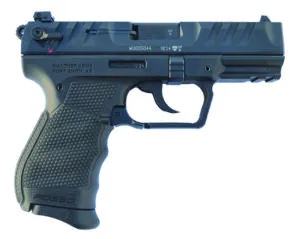
Walther PD380 No. 5050508 380 ACP,
$445
Gun Tests grade: B-
Reliable and accurate enough, if not the most accurate here. Has adjustable sights and holds one more round than the others. We did not like the safety, and the absence of a slide lock made handling more difficult.
| Action | Double action to single action, locked breech |
|---|---|
| Overall Length | 6.5 in. |
| Overall Height | 5.5 in. |
| Maximum Width | 1.3 in. |
| Weight Unloaded | 20.5 oz. |
| Weight Loaded | 22.6 oz. |
| Barrel Length | 3.7 in. |
| Magazine | 9-rd detachable box |
| Magazine Price | $31 |
| Slide | Dark matte steel |
| Slide Retraction Effort | 10.5 lbs. |
| Frame | Black polymer |
| Frame Front Strap Height | 2.0 in. |
| Frame Rear Strap Height | 3.5 in. |
| Grips | Checkered polymer |
| Grip Thickness Maximum | 1.15 in. |
| Grip Circumference | 5.4 in. |
| Front Sight | Post |
| Rear Sight | Adjustable |
| Trigger Pull Weight Single Action | 5.7 lbs. |
| Trigger Pull Weight Double Action | 12.3 lbs. |
| Trigger Span Single Action | 2.25 in. |
| Trigger Span Double Action | 2.6 in. |
| Safeties | Lever, firing-pin block |
| Warranty | Limited lifetime |
| Telephone | (479) 242-8500 |
| Website | WaltherArms.com |
The Walther PD380 is an upgrade of the Walther PK380, a similar but plainer handgun. The PK380 was made for more than a decade and was regarded as a reliable handgun. Handguns this size are a counterpoint to the many pocket-size 380 ACP pistols. While larger and more difficult to conceal, they are easy-shooting handguns with high hit probability and friendly handling. It isn’t usually given the recognition, but the PK380 was a frontrunner in the easy-to-rack-and-handle-size 380 ACP pistol. The PD380 borrows quite a lot from the PK380, but it also brings new features to the table.
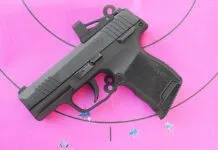
The PD380 is a double-action-first-shot hammer-fired handgun, but it is redesigned to closely resemble the full-size Walther PDP 9mm handgun. The frame is polymer, and this allows innovative styling without a weight penalty. The intent was also to improve the ergonomics of a rather plain PK380. The pistol is hammer fired. The trigger is pressed to transfer energy to the hammer by means of a trigger bar. The hammer is raised and then falls, firing the pistol. The slide recoils and cocks the hammer for subsequent single-action shots. Walther designed the performance duty grip for the company’s full-size 9mm pistol, and this feature, as well as SuperTerrain forward cocking serrations, are part of the PD380 design. The forward cocking serrations, which the other pistols lack, were nice to have. Racking force was the easiest of the three pistols, although none are stiff or difficult to rack. Elsewhere, we liked the feel of the grip handle a great deal and thought the Walther’s grip frame was the best of the test.
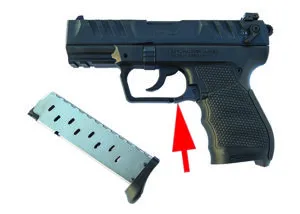
Magazine capacity is nine rounds, one more than the other handguns, and the +1 in the chamber gives you 10 rounds in the gun, adequate for personal defense, we believe. The PD380 is 6.5 inches long and 5.5 inches tall. Weight is 20.5 ounces. The Walther features a 3.7-inch barrel. As a result of this weight and the mild 380 ACP cartridge, recoil is modest.
One tester called the Walther action a delayed blowback operation, but most of us would call it a locked breech. The barrel and slide are not locked in travel for a relatively long distance, but it isn’t a blowback design. This may lower recoil and improve reliability compared to a blowback. A straight blowback design requires a heavy recoil spring and sometimes a heavier slide. This locked-breech action allows using a recoil spring that doesn’t strain the wrist. The magazine release is a paddle type fitted in the back of the trigger guard. The raters are split on this feature. Whether or not it works just fine, it is different, and folks trained on another type will have a learning curve. We conducted speed-load drills to confirm the paddle magazine catch’s viability and didn’t mind it.
The double-action trigger isn’t the smoothest of the trio, but it is the heaviest at 12.3 pounds. Single-action break started out at 6 pounds, measuring 5.7 pounds at the end of the test.
The sights are good for the type, a post front and a rear sight adjustable for elevation and windage. The sights feature three-dot white inserts. They were the best of the test, we thought. As a bonus, these sights may be changed out with Glock sights if you desire, and we would consider adding Glock night sights.
The magazines are stainless-steel units, and two are supplied with the pistol. These are nicely finished and not difficult to load, in fact, they were the easiest of the test to fill. The Walther magazines feature base pads that offer a nice grip.
The safety is something that makes you wonder why it is designed the way it is, considering how advanced the appearance of the PD380 is, and it is a carry over from the PK380. The safety may be placed on or off easily with its ambidextrous levers. The safety does not block the trigger. When put on Safe, the safety lever moves a block over the firing pin. If you pull the trigger, the hammer drops normally, but the pistol does not fire. To decock to carry safely with the gun on Safe, you may theoretically press the trigger and the hammer will fall and the handgun will not fire. We do not recommend this. It is too easy to make a mistake. We recommend putting the lever on Safe and then carefully lowering the hammer by hand. We don’t like this safety, and we scored the gun down because of it. Many shooters feel that a safety/decock lever is an advantage of the DA/SA-type handgun. Even the 1929 Walther had a functional decock lever.
Another element we didn’t like was the lack of a slide lock. The pistol is loaded by inserting a magazine and then racking the slide. The slide locks open on the last shot and remains locked until you remove the magazine, press the slide to the rear, and let it fly forward. This doesn’t allow the shooter to lock the slide to the rear and load the chamber in the manner we have found best for reliable chambering.
At the range, the Walther was fast on target and handled well. While the double-action trigger is the heaviest of the test, its travel seems shorter than the other pistols. Once we transitioned to single-action fire, results were very good. We began each firing string with a double-action shot, and this opened up the groups. However, we also ran combat groups in rapid fire, cocking the hammer first. When handled in this manner, the Walther is easier to get hits with, but it was not the most combat capable of the three handguns, in our estimation. The smoother trigger action of the Rock Island pistol was an advantage marginalized by poor sights, and the Bersa was also smoother. While the Walther isn’t significantly heavier than the other pistols, it was noticeably more comfortable to fire, probably due to the locked-breech action. Also, the polymer frame of the Walther allows for a large, comfortable grip without a weight penalty. Recoil was efficiently spread out around the larger grip frame of the Walther.
Bench results were good. Most groups were in a nice 3-inch cluster. That’s fine, but they were not the most accurate of the test.
For maintenance, we give the Walther top marks. Takedown is the simplest and easiest of the test. Make certain the pistol is unloaded, remove the magazine, and pull the takedown lever straight downward. Run the slide off the frame forward. Pull the recoil-spring assembly out and remove the barrel — simple as that.
Our Team Said: The Walther is reliable, without any failures to feed, chamber, fire, or eject. Combat accuracy is good, but it was limited by a heavy double-action trigger. We did not like the safety, and we were split on the absence of a slide lock. One rater noted this is a simple concealed-carry gun, and the absence of a slide lock makes it snag free, and that’s one less thing to worry about. Takedown was our favorite. The sights were best of the test. So was the grip. In the end we rated the Walther down a half grade each on the safety and slide lock. Only one of the three handguns’ safety levers were ambidextrous, and that was the Walther. All three may be safely carried on Fire and shot well by righties or lefties. The pistols with slide locks are not ambidextrous. In the end, the Walther is ambidextrous, and as such, it’s the only choice for left-handed shooters, who would have to make do with the Bersa. Also, the Walther is the easiest pistol to use, with easy-to-load magazines and low slide-racking effort.
| 380 ACP RANGE DATA | |||
|---|---|---|---|
| Lehigh Defense XD 68-grain Fluted | Rock Island LI380 | Bersa Thunder 380 | Walther PD380 |
| Average Velocity | 1045 fps | 1060 fps | 1089 fps |
| Muzzle Energy | 165 ft.-lbs. | 170 ft.-lbs. | 179 ft.-lbs. |
| Best Group | 2.9 in. | 2.2 in. | 2.5 in. |
| Average Group | 3.5 in. | 2.6 in. | 2.9 in. |
| Remington UMC 88-grain JHP | Rock Island LI380 | Bersa Thunder 380 | Walther PD380 |
| Average Velocity | 888 fps | 884 fps | 916 fps |
| Muzzle Energy | 154 ft.-lbs. | 153 ft.-lbs. | 164 ft.-lbs. |
| Best Group | 3.0 in. | 2.4 in. | 2.6 in. |
| Average Group | 4.2 in. | 2.8 in. | 2.9 in. |
| Hornady American Gunner 90-grain XTP 90104 | Rock Island LI380 | Bersa Thunder 380 | Walther PD380 |
| Average Velocity | 890 fps | 900 fps | 911 fps |
| Muzzle Energy | 158 ft.-lbs. | 162 ft.-lbs. | 166 ft.-lbs. |
| Best Group | 3.2 in. | 2.0 in. | 2.4 in. |
| Average Group | 4.0 in. | 2.8 in. | 2.8 in. |
We fired groups double action at 15 yards from a bench using an MTM Case-Gard K-Zone Pistol Rest. We measured velocities with a Competition Electronics Pro Chrony. The first screen of the chronograph was 10 feet from the muzzles.
Written and photographed by Robert Campbell, using evaluations from Gun Tests Team members. GT