












When it comes to personal defense, no one should be priced out of the market. Yet with both young and old on a tight budget and struggling to stay afloat, a $1000 gun simply isn’t in the cards. If readers could purchase a handgun at a fair price and have funds left over for training, ammunition, and holsters, it would be a good thing. We wondered if it were possible to purchase a $300 handgun that provides the same degree of protection as a pistol costing twice as much. If you don’t need a box full of backstraps and multiple MOS red-dot mounting plates, you probably can get by just fine with spending less money. So we went shopping for 9mm Luger handguns.
Our first gun was a GForce RPX9 Exodus TAC GFRPX3C9BNZ, $314. GForce Arms is a relatively new importer located in Reno, Nevada. There are dozens of firearms listed on the company’s website, including several versions of the Exodus. Our pistol was available at Bud’s for $275. At Guns.com, the price was $341. A plainer handgun, all black without the bling of the burnt bronze model tested, costs $235 at Bud’s. We counted eight separate models for sale at Bud’s, all with different pricing. We paid $314 retail for the test pistol, which seems fair considering we would have paid shipping and FFL fees for an online order. With careful shopping, you may be able to obtain a GForce Exodus for less than $300, perhaps much less.
The Canik Mete SF Two-Tone HG5367, $475, seemed a perfect counterpoint to the GForce Exodus and the Glock 19 Generation 5, landing in the middle range of their prices. The pistol cost about $200 more than the Exodus, a hefty sum, but also costs $65 less than the Glock 19 Gen 5 tested alongside them. While also a striker-fired handgun with a polymer frame, the pistol differs from the others, primarily in trigger action. The striker load when the Canik is cocked is much greater than the two Glock-type handguns.
The third gun was the control, a Glock 19 Gen5 FS Black/FDE -PA195S203DE, $539. We have tested Glock 19 variants against several handguns. The reason is that the Glock 19 is a nicely-sized pistol for concealed carry. The Glock is also a striker-fired polymer-frame handgun. The slide is angular and features forward cocking serrations. The front of the slide is slightly beveled. All of the handguns tested feature this slight bevel; neither bevel is better than the others. The big difference in the Glock Generation 5 pistol is the Modular Optics System. The Glock is supplied with four plates that allow mounting practically any reflex sight. Specialty plates such as the ACRO are available from XS Sights and others. This versatility makes the Glock the number-one choice here for optics mounting, while the others work fine with the limited choice of direct-mount optics. If you are not using optics or you are not particularly picky considering the choice of red-dot sight, the MOS option doesn’t matter.
To test fire the three pistols, we originally intended to fire a 50-round box of CCI Blazer 115-grain FMJs and 20 rounds of Black Hills Ammunition 115-grain EXP jacketed hollow points. For accuracy testing, we used the CCI Blazer load, the Black Hills EXP, and Fiocchi 124-grain Covert X. We ran over the original allotment of ammunition, as we often do, to answer questions that came up.
Canik Mete SF Two-Tone HG5367 9mm Luger,
$475
Gun Tests grade: A [BEST BUY]
The Canik Mete SF is a well-designed, reliable pistol. The Mete SF handled all loads and came out of the box running. The pistol made the best showing in both combat shooting and in bench accuracy.
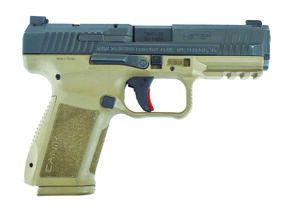
| Action | Semi auto recoil operated locked breech striker fired |
| Trigger | Single Action |
| Overall Length | 7.3 in. |
| Overall Height | 5.0 in. |
| Maximum Width | 1.39 in. |
| Barrel Length | 4.1 in. |
| Weight Unloaded | 25.4 oz. |
| Weight Loaded | 34.6 oz. |
| Slide | Phosphate-finished steel |
| Slide Retraction Effort | 17.0 lbs. |
| Receiver | Polymer |
| Front Strap Height | 2.25 in. |
| Rear Strap Height | 3.25 in. |
| Grip | Replaceable grip inserts |
| Grip Thickness | 1.2 in. |
| Grip Circumference | 5.3 in. |
| Magazines | (2) 15 round |
| Magazine Price | $30 for 15 round |
| Rear Sight | Fixed white two dot |
| Front Sight | Fixed white dot |
| Trigger Pull Weight | 4.5 lbs. |
| Trigger Span | 3.1 in. |
| Sight Radius | 6.5 in. |
| Safety | Trigger lever |
| Warranty | Limited lifetime |
| Telephone | (800) 527-1252 |
| Website | CanikUSA.com |
| Made In | Turkey |
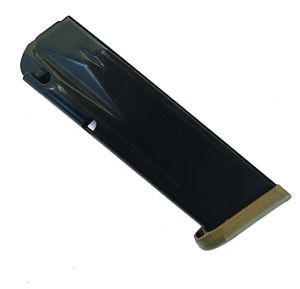
The Canik is actually a single-action pistol similar to the Walther PDP or Springfield XD. It is not a double action like the Glock. As such, the Canik may feature a lighter, crisper trigger action, and this gun’s trigger breaks at a clean 4.5 pounds. Reset is mushier than the other handguns, but not bad. The pistol is supplied with two backstraps, two 14-round magazines, a Kydex holster, and a locking hard case.
The Canik is more slide heavy. The larger slide and thinner grip are fine for concealed carry, but they could have caused the pistol’s handling to suffer. As it turned out, our prediction was off, and the pistol handled well in speed shooting.
The slide is well finished and features forward cocking serrations. The sights are drift-adjustable white-insert three-dot types. The sights proved properly regulated for 115-grain ammunition. The slide is milled for a direct-mount red-dot sight. The frame, like the other two pistols, features a light rail for mounting combat lights.
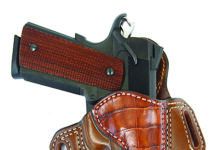
The frame is polymer with light stippling on the grip sides and pebbling on the back strap and front strap. A considerable area is left without any type of texture. The pistol’s balance is okay, but the METE SF isn’t as well balanced as the Glock 19 and Exodus handguns. We felt this when executing rapid-fire drills from the Crossbreed belt slide holster used during the tests.
The cocking force to rack the slide of the Canik METE SF was the least of the three pistols tested. Not by a great margin over the Glock, but the Canik’s longer slide provided good leverage when racking the slide. Take down is the same as the Glock as far as mechanics, but we preferred the Canik’s larger take-down knobs. The Canik is easily field-stripped, but the Canik slide doesn’t simply run forward off the frame. The rear of the slide must be tilted up and over to clear the trigger bar. If you get into the familiar Canik hang up with the slide stuck on the frame, simply depress the internal trigger bar and the situation is alleviated.
There are things we really like about the Canik. When the pistol is cocked, the striker protrudes from the rear of the slide, providing both a tactile and visual alert. The trigger guard features an indent in the bottom that makes for a good finger rest when firing. The metal magazines are easily loaded and proved reliable. The trigger action is also very good. Some raters felt that the action was too light and short for a carry gun, but most disagreed. They stressed familiarity with the pistol. Practice and you will be able to control the trigger.
In the firing tests, the Canik proved to be a good-shooting pistol. It is the heaviest pistol tested, so that and the relatively heavy recoil spring made for a good shooting experience. The Canik METE SF also proved to be an effective handgun in combat drills. Combat groups were ahead of the GForce Exodus pistol by the greatest margin and slightly ahead of the Glock 19. There were no failures to feed, chamber, fire or eject. In bench accuracy, the Canik proved to be the most accurate handgun tested, with some groups smaller than 2.0 inches at 25 yards.
Our Team Said: We were considering rating the pistol down half a grade for its lack of grip texture in some areas, but this would not have been appropriate because the Canik METE SF performed very well. The pistol’s ambidextrous slide locks were praised by all raters. This really helped the pistol with left-hand shooters. The slide-lock levers are large but never snagged on the draw or when the pistol was worn in concealed carry. We think the Canik METE SF is a Best Buy.
| 9MM LUGER RANGE DATA | |||
|---|---|---|---|
| Black Hills Factory New 115-grain EXP JHP | GForce Exodus | Glock 19 Gen 5 | Canik Mete SF |
| Average Velocity | 1169 fps | 1178 fps | 1186 fps |
| Muzzle Energy | 349 ft.-lbs. | 354 ft.-lbs. | 359 ft.-lbs. |
| Smallest Group | 3.5 in. | 2.0 in. | 1.6 in. |
| Average Group | 4.5 in. | 2.7 in. | 2.5 in. |
| CCI Blazer 115-grain FMJ | GForce Exodus | Glock 19 Gen 5 | Canik Mete SF |
| Average Velocity | 1130 fps | 1145 fps | 1156 fps |
| Muzzle Energy | 326 ft.-lbs. | 335 ft.-lbs. | 341 ft.-lbs. |
| Smallest Group | 3.5 in. | 2.0 in. | 1.9 in. |
| Average Group | 4.1 in. | 2.7 in | 2.4 in. |
| Fiocchi Covert X 124-grain JHP | GForce Exodus | Glock 19 Gen 5 | Canik Mete SF |
| Average Velocity | 1090 fps | 1119 fps | 1095 fps |
| Muzzle Energy | 327 ft.-lbs. | 345 ft.-lbs. | 330 ft.-lbs. |
| Smallest Group | 2.5 in. | 2.3 in. | 1.6 in. |
| Average Group | 3.6 in. | 2.7 in. | 2.4 in. |
To collect accuracy data, we fired five-shot groups from a bench using an MTM Case-Gard K-Zone rest. Distance: 25 yards. We measured velocities with a Competition Electronics Pro Chrony with the first screen 10 feet from the muzzles.
Written and photographed by Robert Campbell, using evaluations from Gun Tests Team members. GT