







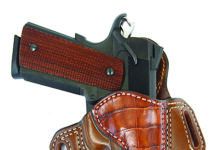




Here we are looking at two 1911-type handguns generally known as Commander types. A Commander, as originally introduced in 1950, is a 1911 pistol with a shorter barrel and slide but a full-size firing grip. The original was an aluminum-frame handgun. Beginning in 1970, a steel-frame option was offered, and today, the heavier Commander is the more-popular variation among shooters.
Our test guns are two high-end Commanders, the Springfield Tactical Response Pistol Carry Contour and the Dan Wesson Specialist Commander. They are similar pistols as far as sights and finish go, and are reasonably close in selling price. Neither handgun is commonly found in gun shops and are often a special order. The primary difference is that the Springfield features an aluminum frame and the Dan Wesson is a steel-frame handgun. This results in a significant amount of weight difference.
How We Tested
Test procedure was the same for each of the 1911 45 ACP Commanders. We lubricated the pistols along the long bearing surfaces, slide rails and slide ways, barrel hood, and cocking block. In addition to the two supplied magazines for each gun, we added four Wilson Combat magazines and used them in each pistol. There were no issues in either gun.
In this case we did a side-by-side rapid-fire shooting comparison of the aluminum-frame Springfield and the steel-frame Dan Wesson to gauge control. We fired 50 rounds of Black Hills Ammunition 230-grain FMJ ammunition in the combat-shooting test. We also fired 50 rounds of the same ammunition firing at maximum speed on the edges of control to evaluate recoil and its effect on the shooter. We fired these 100 rounds in each pistol in the same range session.
For bench accuracy, we fired from a solid bench-rest firing position at 25 yards with three 230-grain jacketed hollow-point loads. The Black Hills Ammunition was the Factory New kind, Federal’s brand was the Punch fodder, and Speer’s entry was the Gold Dot HPs.
We drew and fired quickly, emptying a magazine, executing a speed load, and firing several rounds at man-sized silhouettes at 7, 10, and 15 yards.
Is one best for carry and the other best for shooting? Would an aluminum-frame Commander pound our metacarpals raw? Would the steel-frame handgun drag our trousers down? The shooter wishing to own a solid, reliable Commander 45 will find one among these two. As it turns out, the pistols perform similarly on many points, but we had a favorite.
Dan Wesson Specialist Commander 01795 45 ACP,
$2279
Gun Tests grade: A
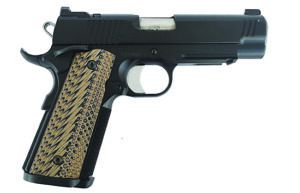
The Dan Wesson is an extremely well-made handgun, and that has some value in itself. We are shooters and find the Dan Wesson Specialist Commander to be a great-shooting handgun as well. But we think it is heavy for daily carry.
| Action Type | Short recoil-operated locked breech, single action |
| Overall Length | 8.0 in. |
| Overall Height | 6.0 in. |
| Maximum Width | 1.4 in. |
| Weight Unloaded | 40.0 oz. |
| Weight Loaded | 44.4 oz. |
| Slide | Forged steel, nitride finish, optics ready |
| Slide Retraction Effort | 16.0 lbs. |
| Receiver Material | Steel, nitride finish |
| Front Strap Height | 2.6 in. |
| Back Strap Height | 3.2 in. |
| Barrel Length | 4.25 in. |
| Grip Thickness Maximum | 1.35 in. |
| Grip Circumference Maximum | 5.5 in. |
| Magazines | (2) 8 round |
| Magazine Price | $36 |
| Rear Sight | Fixed with tritium insert |
| Front Sight | Dovetailed post with tritium insert |
| Sight Radius | 5.8 in. |
| Trigger Pull Weight | 4.75 lbs. |
| Trigger Span | 2.7 in. |
| Safeties | Ambi slide lock, grip |
| Warranty | Surface finish 1 year, parts 5 years |
| Telephone | (607) 336-2622 |
| Webstie | DanWessonFirearms.com |
| Made In | U.S. |
The Dan Wesson Specialist Commander features a nice, hard finish brighter than the Springfield’s. This is the Duty Finish, a tough and attractive nitride finish. The all-stainless Specialist is available for an average price up to $200 less than our test gun.
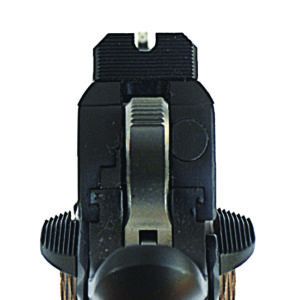
This handgun features forward and rear cocking serrations and a rib that runs between the sights. In this case, the rib was truncated because the Specialist is an optics-ready pistol with a removable sight plate. We did not rate either pistol up or down on being optics ready because the TRP CC we had isn’t optics ready, but there is an optics-ready AOS TRP. The Dan Wesson front sight features a single tritium dot, while the rear sight is serrated on the back and features a U-notch sight, but no rear tritium dots.
The ejection port is nicely scalloped and finished. The pistol features excellent slide-to-frame fit, noticeably tighter than the TRP, and the TRP is a tight handgun. This fitting results in less eccentric wear. There is no slop for wear to begin, and as the pistol is used, wear on metal parts will be even. Elsewhere, the steel frame features a light rail out front. In the back there’s an ambidextrous slide-lock safety, which is positive in operation. The safety operates fine when in the Safe position and you are moving to the Fire position. The indent is sharp and crisp. We have tested many 1911 handguns with mushy fit and feel in the safety, but the Dan Wesson is not one of those. However, some of the raters felt that too much effort was needed to place it on Safe. Some high-end 1911s are set for this level of effort to prevent the safety from moving to Safe during a firing string. This type of fitting is an acquired taste and not one all of the raters found inviting. Others demand this type of fitting. We noted this, commented on it, and did not apply a rating.
Next, the trigger action is excellent, breaking cleanly at 4.75 pounds. While only a quarter-pound lighter than the Springfield’s, we felt the DW’s break was cleaner.
The pistol features superbly designed grips with an excellent balance of adhesion and abrasion. The 25-lpi front-strap checkering is more comfortable than the TRP’s 20-lpi checkering, but the Specialist’s was just as grippy when it counts during firing, we thought. The grip safety compares well to the Springfield TRP CC’s — there is no real difference between these two beavertail-type grip safeties.
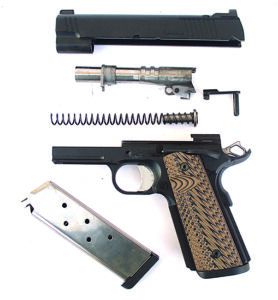
The Dan Wesson features a ramped barrel. This is a nicely polished feed ramp that makes for excellent feed reliability. The Dan Wesson barrel is tight in the locking lugs and barrel bushing. This handgun requires a barrel bushing wrench for disassembly. We have no need for a speed strip, but just the same, some will find this an unwelcome complication. This type of fitting adds to absolute accuracy, so we like it.
On the bottom, the pistol features a removable magazine funnel. This enlarged magazine well is an aid in administrative handling and speed loads. In rapid reloading drills, the Dan Wesson Specialist was faster from slide lock to firing again due to the magazine well and conventional mainspring housing. This magazine well requires the shooter use magazines with a padded base pad. Flush-fit magazines may be used if the shooter presses them home with a finger. Overall, this is a well-made and well-fitted handgun.
At the range, the Dan Wesson Specialist fired a 50-round combat course and 50-round high-speed control test. In firing the first combat run, the DW had a slight advantage over the Springfield. This was not apparent with every rater, and it depends on how fast the pistol is pushed. We fire, allow the trigger to reset, and then get back on target.
In the high-speed combat run, the difference was more noticeable. The steel-frame pistol was downright comfortable to fire. At 40 ounces, the Dan Wesson Specialist Commander weighs more than some Government Model handguns, primarily due to the extra weight of the light rail and magazine funnel. This is 12 ounces heavier than the Springfield TRP CC, meaning there is less felt recoil and less pistol movement. In the high-speed run, we did something you should never do in training, and that is not concentrating on accuracy. We simply got a coarse sight picture of a rapidly reciprocating slide and front sight. But we kept the shots on the target with each run. The Dan Wesson showed better results, and after the test, all the testers agreed the pistol was more comfortable to fire.
Likewise, in bench accuracy, the Dan Wesson was impressive — largely due to the excellent trigger and its stabilizing weight. Some groups were smaller than 2.0 inches at 25 yards. During the drills and accuracy testing, neither handgun exhibited a single failure to feed, chamber, fire or eject. We could find nothing to rate either of the handguns down on. The Dan Wesson was more accurate by a margin, but it should be because it costs more.
As far as left-hand use goes, the handguns both get a B. Each features an ambidextrous slide-lock safety, but the slide lock is not ambidextrous. The DW’s magazine release isn’t left handed either, but a lefty may handle it well with the forefinger. A left-handed shooter is left to grasp the end of the slide and release it during speed load drills.
Next up, we tested each handgun in a concealed-carry role. We wore the handguns on a good gun belt with two types of holsters, the Galco Concealable and the 4Brothersinc.com IWB. These, we judged from a recent test of optics-ready holsters, are among the best available. The Galco is an OWB, and the 4Brothers will be worn IWB. Each rater’s assignment was to wear the handgun a day in concealed carry under a covering garment. Switching the guns in each holster, we checked for printing and snagging. The results were interesting.
Bending at sharp angles, such as when checking out the bottom shelf at the meat market, our shooters said the Springfield CC cut printed less on the outer garment and is viable for IWB carry under a heavy-cotton T-shirt. The Dan Wesson’s standard grip and magazine were more of a challenge. Also, half of the test team and our lone female tester felt that the CC cut is better suited to small hands. For concealed carry then, the CC cut is an advantage.
Also, we found that carrying the Dan Wesson pistol posed some difficulty because of its weight. In this age of 20-ounce polymer-frame carry guns, a 40-ounce 1911 — more when loaded — is a formidable weight on the belt. Our former cop tester found the weight reassuring, but he pointed out that if either gun is carried concealed, you absolutely must deploy use a proper heavy gun belt and a well-made holster.
Our Team Said: In the end, a diehard Government Model 1911 45 shooter who has carried the type for years will find the Dan Wesson viable for concealed carry, but many other shooters will not like the weight.
| 45 ACP RANGE DATA | ||
| Black Hills Factory New 230-grain JHP | Springfield Armory 1911 TRP CC | Dan Wesson Specialist Commander |
| Velocity | 841 fps | 856 fps |
| Muzzle Energy | 361 ft.-lbs. | 374 ft.-lbs. |
| Small Group | 2.0 in. | 1.6 in. |
| Average Group | 2.5 in. | 1.95 in. |
| Federal Punch 230-grain JHP PD45P1 | Springfield Armory 1911 TRP CC | Dan Wesson Specialist Commander |
| Velocity | 822 fps | 834 fps |
| Muzzle Energy | 345 fps | 355 ft.-lbs. |
| Small Group | 2.5 in. | 2.0 in. |
| Average Group | 2.9 in. | 2.25 in. |
| Speer Gold Dot 230-grain GDHP 23966GD | Springfield Armory 1911 TRP CC | Dan Wesson Specialist Commander |
| Velocity | 770 fps | 794 fps |
| Muzzle Energy | 303 ft.-lbs. | 322 ft.-lbs. |
| Small Group | 1.85 in. | 1.7 in. |
| Large Group | 2.35 in. | 2.1 in. |
To collect accuracy data, we fired five-shot groups from a bench using an MTM Case-Gard K-Zone rest. Distance: 25 yards. We measured velocities with a Competition Electronics Pro Chrony with the first screen 10 feet from the muzzles.
Written and photographed by Robert Campbell, using evaluations from Gun Tests Team members. GT