




Second-Generation Cap & Ball Colt Sixguns in 36 and 44 Cal.
The collecting of really old Colt revolvers can easily threaten the bank account, or even shatter it. Not only is collecting the early Colts a costly pastime, you end up with guns not many would want to shoot, especially the black-powder percussion handguns from the Civil War or earlier periods. Of course there are many modern cap-and-ball guns made to satisfy the cravings of those who want to make lots of noise and smoke. But with most of them there's something missing, as I'm sure many will tell you. The modern guns just are not Colts, though they may look the same. Our Technical Editor Ray Ordorica used to own an original Colt 1860 which, as might be expected, he shot on a regular basis. He shot a six-shot group at 15 yards with the gun that measured 1.4 inches center to center of the widest two, and four of ‘em made a hole less than half an inch between centers. Who says the old guns won't shoot? The load was 29 grains of FFFg Goex, loaded as described below, using Remington caps, but the full load of the original 1860 was 40 grains, quite a bit more than the 2nd-Gen. will hold. That gun was traded off, but because he very much liked the 1860, Ray bought a genuine Colt Second-Generation (2nd-Gen.) 1860, and went happily on his way.
Today the 2nd-Gen. Colts are scarce, but do turn up from time to time at gun shows. They are not cheap, but sell for a fraction of the cost of the original models, and are considered to be "real" Colts. The 2nd-Gen. Colts took up where the old serial numbers left off, and were in most respects real hand-fitted Colts, though the manufacture of the parts may have been done by a different company. Shooters recognize the differences in the aura of the gun in their hand. And it goes beyond that. For instance, the original 1851 Navy had the identical grip to that on the famous 1873 Frontier Six Shooter. Some modern versions of the 1851 that don't bear the Colt name have an abomination of a grip that in the words of one old cowboy, "just ain't right." The backstrap flares out and generally looks as wrong as it feels.
The 2nd-Gen. Colts are classified as antiques, so they can be purchased online without the need to go through a dealer. Occasionally they are found in unfired condition, and those can be expected to bring higher prices. The prices for used ones vary all over the place, as do their condition, as we've noticed over the years. These guns were made in the 1970s or a bit earlier. There will never be any more Second-Generation Colts made. A batch was made with a signature on the rear grip strap, and these were called Third-Generation Colts. The few we've seen are not quite as satisfying to the eye as the 2nd-Gen. ones, or so we think.
In this report we look at three 2nd-Gen. Colts, a Second Model Dragoon, an 1860 Army, and an 1851 Navy, all bearing the Colt name and appropriate Colt serial numbers. Here in Idaho we loaded them all the same way, with either Goex or KIK black powder and occasionally with Elephant Brand powder, which doesn't seem to give the performance of the other two. The powder is put into the chamber with a dispensing measure, which gives the correct volume or weight of charge. For the 1851 Navy we use 25 grains of FFFg. For the 1860 it's 30 grains of FFg. For the Dragoon, the charge is 50 grains of FFg. Over the powder we put a single Ox-Yolk Wonder Wad, pre-lubricated at Ox Yoke's factory with their Wonder Lube 1000 Plus yellow grease. A Speer swaged lead ball is rammed down on top of the wad with nothing over the ball. We used 0.375-inch balls for the Navy and 0.457-inch balls for the other two. For several decades now, that is how we load the old boomers and we've never had any crossfires. Cleanup is very pleasant with Ox-Yoke's Liquid Wonder Competition Bore Cleaner, followed by doping with Wonder Lube 1000 Plus. We used CCI percussion caps mostly, but occasionally Remington's. These latter didn't light Pyrodex reliably in past tests, but do a bang-up job of lighting real black powder.
The prices given are best guesses, because we could not find many of these for sale online. Also, all three of the guns tested here have been shot extensively and slightly modified to please the owner, as noted below. It must be said, in today's great gun-buying frenzy when you just can't find any suitable modern handgun, any of these old percussion-cap firearms can still be valuable as protectors of the household. While a quick reload is not easy, a second gun might well suffice. Here are our findings.
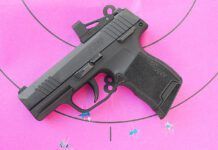
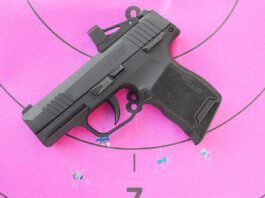
Springfield Armory Enhanced Micro Pistol 9mm, $1253
Production Ends on Arsenals SLR-106 Rifles; Kahr Moving
After nearly a decade since its initial introduction into the firearms marketplace, production on Arsenal's SLR-106 series has officially ended. The SLR-106 rifle and pistol series was Arsenal's answer to the 5.56 caliber as the company looked to compete in that arena. The major selling point of the line was its chrome-lined and hammer-forged barrel. The current stock of SLR-106 5.56 caliber rifles and pistols will continue to be sold until supply runs out. Arsenal's availability list is displayed in the nearby photo. Additional SLR-106 products can be found by checking with Arsenal's distributors and various dealers.
CZ MODEL 83 380 ACP, ~$550
We tested two 380 ACP handguns in the April 2013 issue. Here's an excerpt of that report.
If you have a handgun for what some consider to be a sub-caliber round, it might be comforting to have lots of shots on hand, because you just might need them. Taking our tongues out of our cheeks now, the 380 can be an effective self-defense handgun cartridge, particularly with today's hotter JHP loads — if you can find any. There are zillions of good used 380s out there, though in today's market you might have the devil of a time finding one. We managed to acquire two, both slightly used, just like what you might have to consider in today's super-tight gun market. Our test pistols were a Beretta Model 84 ($600-$650) and a CZ Model 83 ($550 on up).
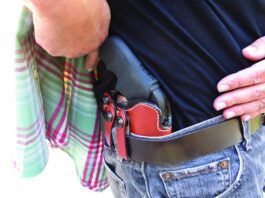
Links for ‘Inside The Waistband Holsters: Kydex, Leather and Hybrid Style
Springfield Armory XD40 Pro Carry XD9302HCSP06 40 S&W
Do I really have to let the dog bite me?
Charter Arms Pitbull 9mm No. 79920 9mm Luger, $465
Tossed By A Tornado,S&W Handgun Survivesand Its Lasergrip Powers Up
Kimber Custom Shop Raptor II 45 ACP: Where Does It Rank?
Three More Midsize Forties: SIG, FNH-USA, and Walther
To expand the coverage of 40 S&W semi-automatics we have tested recently, our test team recently looked at three midsize pistols we thought would be worthy challengers to the Glock 23 Gen4 40 S&W, $650, evaluated in the May 2013 issue. In that test, our team gave the G23G4 an A grade, effectively setting a standard for other pistols in this category to try to reach. So we threw an array of other pistols at it, going from a budget discontinued model (the FNH-USA FNP-40 No. 47832, $450), to a longtime competitor (SIG Sauer's SP2022 No. E2022-40-B, $570), to a model introduced in 2011, about a year after the Gen4 was released (Walther PPQ No. 2776481, $680.)
The latest three polymer test pistols have similar stats for size and weight, but fit, feel, function, and design varied greatly, with the last consideration playing more of a role than we initially expected. To recap why we graded the Glock so highly two months ago, we noted that the different back-strap contours allow the owner to easily find the best fit for his or her hands. The grips allowed good control. The Glock had a minimum of controls, rivaled in this test only by the PPQ, which had a trigger safety like the Glock and just ambi slide releases beyond that. The Glock's magazine release was reversible, a feature duplicated on the FN and SIG guns, and possibly topped by the two trigger guard mag-release levers on the PPQ. The Glock sights had a wide, square, U around the rear notch and a white dot on the front, while the newest guns all had three-white-dot sight arrays.
Dimensionally, the guns were close in size. In overall length, the numbers were 7.2 inches for the Glock, 7.4 inches for the SIG, 7.25 inches for the PPQ, and 7.4 inches for the FN. Overall heights (measured from the top of the sights to the bottom of the magazine or magazine extension) were Glock 5.0 inches, FN and PPQ (5.4 inches), and SP 5.5 inches. The barrels were all right at 4.0 inches (Glock, Walther, FN), or nearly so, 3.9 inches for the SIG. Loaded weights were 32.1 ounces for the 13+1 Glock, 33.6 ounces for the 12+1 Walther, 37.0 ounces for the 12+1 SIG, and 37.2 ounces for the FN, which partially reflects its larger capacity of 14+1. Functionally, during our shooting, we had perfect reliability from all the pistols.
Elsewhere, the Glock had a tactile loaded-chamber indicator in the form of a slight step on the extractor that could be easily felt with the (right-hand) trigger finger, with a similar feature duplicated on the PPQ and FN. On top of the G23, the slide was smooth enough not to cut the hands during clearance drills, and the new guns were likewise dehorned, except for their sharp sights. Takedown was simple, and likewise easy on the FN and SIG, but much more complicated on the PPQ. Workmanship inside all three guns was excellent, just as it was on the outside. Thus, these midsize guns were more than a match physically for the Glock, but would they bring positive individual differences to the fray and overcome the Austrian? We find out below.