




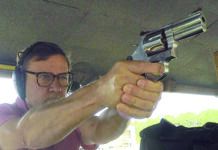


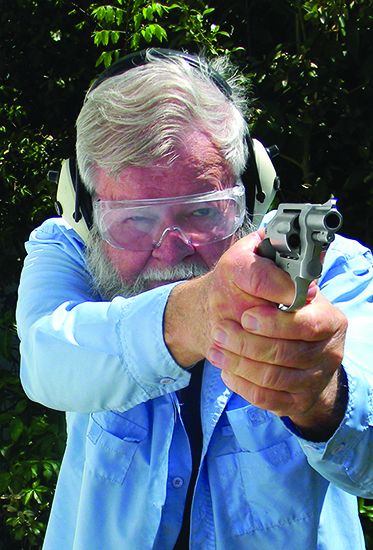
We have tested several 38 Special snubnose revolvers over the past few decades. As a direct result of this experience, we have isolated areas of the greatest import in making the 38 snub most effective. The trigger action must be smooth, the sights useful, and the stocks should be hand-filling grips that limit recoil. The role of the 38 Special as a backup handgun must be considered as well. This is a light, but formidable, firearm carried just in case. The snubnose revolver will easily survive in an ankle holster, where other types may not ride in this carry position and come up shooting. Whether in a primary carry role on the belt or in a pocket, or as a backup on the lower leg, a concern with nearly every snubbie is capacity. While the snubnose 38 usually has five cartridges, five rounds isn’t very many, so being able to put them where they’re needed is paramount.
A Gun Tests reader and Smith & Wesson fan recently asked us to help him winnow down his choices for a snubbie stainless carry gun. He had read our coverage of the Smith & Wesson Performance Center Pro Series Model 640 178044 38 Special/357 Magnum in the July 2023 issue, which we called Our Pick, and wondered how the gun stacked up against other S&W short-barrel choices. So we added two other stainless choices from S&W, the Ultimate Carry Model 642 13995 38 Special, $699; and the Model 642 103810-2 38 Special, $515. All are J-frame types, but there are considerable differences in features and price. So we took them to the range and shot them side by side. Here’s what we thought:
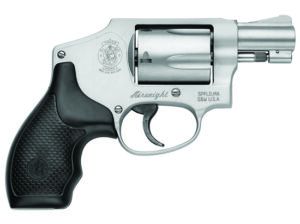
Smith & Wesson 642 103810-2 38 Special
$515
Gun Tests grade: B
The 642 snubnose is affordable and enjoys a good reputation. It was bested here by more expensive revolvers with better sights and features. We would recommend the 642 as a backup and for general use.
| Action Type | Double-action-only revolver |
|---|---|
| Overall Length | 6.31 in. |
| Overall Height | 4.3 in. |
| Maximum Width | 1.31 in. |
| Weight Unloaded | 14.4 oz. |
| Weight Loaded | 16.8 oz. |
| Barrel | 1.88 in. long, matte stainless steel |
| Frame | Matte aluminum alloy, J frame; no internal lock |
| Cylinder | Matte stainless steel |
| Cylinder Gap | 0.06 in. |
| Capacity | 5 rounds |
| Grip | Pebbled rubber |
| Grip Frame Front Strap Height | 2.2 in. |
| Grip Frame Rear Strap Height | 3.8 in. |
| Grip Thickness (Maximum) | 1.2 in. |
| Grip Circumference (Maximum) | 5.0 in. |
| Rear Sight | Integral groove, receiver top |
| Front Sight | Integral fixed post |
| Sight Radius | 3.5 in. |
| Trigger Pull Weight Double Action | 13.5 lbs. |
| Trigger Span Double Action | 3.0 in. |
| Safety | Internal rebound |
| Warranty | 1 year |
| Telephone | (800) 331-0852 |
| Website | Smith-Wesson.com |
| Made In | U.S. |
This is a model without the controversial internal lock. We recommend you avoid double-action revolvers with the internal lock. While a full discussion of the internal lock’s cons is beyond the scope of this article, we don’t feel they are useful, and they have failed often enough for us to shun them. One of our raters reports two incidents of students with different makes of guns showing up without the key for their locked guns during a training class. That put a crimp in the class’s progress. It could have been fatal in a home-defense situation. We are leery of them, to say the least.
The 642 is a double-action-only revolver, and in common with the other Smith & Wesson revolvers tested, the hammer is internal. This revolver features an aluminum-alloy frame. Weight is only 14.7 ounces. Based on the original J-frame Chief’s Special, the 642 is less expensive than many exposed-hammer types, and in our opinion, a concealed-carry snubnose 38 should be a hidden-hammer design. The humpbacked grip frame renders the revolver snag free as it is drawn from concealed carry, an ankle holster, or from a pocket. This design also seems to make the revolver more comfortable to fire. This grip frame spreads weight out in the hand and slightly lowers the revolver’s bore axis, resulting in straight-to-the-rear recoil. The revolver is only 6 inches in length, shorter than some handgun barrels. This handgun features an anodized aluminum frame. The frame finish doesn’t quite match the stainless-steel barrel, crane, and cylinder. The cylinder contains five chambers. The 17⁄8-inch barrel is marked “38 S&W SPL+P.” Of course, +P ammunition doesn’t blow guns up, at least not quality revolvers such as the S&W 642. But small parts may take a beating with +P rounds. One rater has been shooting snubnose revolvers more than 50 years. He has seen some well-worn revolvers but only two damaged aluminum-frame J-frame revolvers. One frame was cracked around the forcing cone, but it still functioned. Another frame was stretched from firing +P+ ammunition to the point the firing pin only occasionally cracked off a primer in the wobbly cylinder. In two other cases in his experience, through no fault of the guns, a revolver was put out of service. A J-frame revolver stopped firing because a cartridge case had separated in the chamber. The broken case was punched out with a punch and hammer, and the revolver restored to function with no further work needed. A Smith & Wesson Bodyguard, a revolver with a shrouded hammer but that allows cocking the hammer by virtue of an opening in the frame, locked up because a grain of some type of material had found its way into the mechanism. In short, the 642 concealed-hammer types seem the best choice for reliability among small Smith & Wesson revolvers. As for extended +P use, the shooter will be complaining and rubbing his palms and wrists before the gun gives out, in all probability.
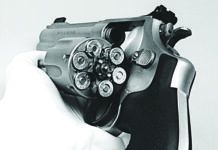
The sights are a serrated ramp front and simple groove rear. The ramp front sight is far superior to the half-moon type found on original Model 36 and Model 37 revolvers. The ramp is serrated and rises to a flat spot at the top of the ramp. While some shooters paint the sight with nail polish, we did not, leaving the piece as issued during the firing test. There is no ejector rod shroud. The action is simple enough. Press the trigger to the rear and the trigger both cocks and drops the hammer. To open the cylinder, press the cylinder release forward as you press the cylinder open. With the muzzle downward, load each cartridge into the chambers, making certain each is seated properly. To unload the revolver, tilt the muzzle upward. If the muzzle is not elevated, the revolver may suffer a cartridge case rim falling under the ejector star. This is a difficult stoppage to clear, in some cases requiring the ejector star to be raised as the case is forced out of the cylinder. Be certain to study how to handle the revolver. It is simpler than a semi-automatic but demands attention to detail.
One of the most praiseworthy features of the 642 is the Hogue rubber grip. These grips offer good pebbling, making for an ideal mix of abrasion and adhesion, with light abrasion and a lot of adhesion. They seem to give a little during recoil, which is an aid in controlling the snubnose 38 Special. Most important, the grips separate the grip frame from your hand. This means that while you feel recoil in your hand, metal edges do not abrade the skin.
We fired the guns in two stages. First was combat firing at 5, 7, and 10 yards, the last of which is a maximum shooting distance, in our opinion, for this type of revolver. Using the Federal American Eagle 158-grain round-nose lead loading, we fired 20 shots each at 5 and 7 yards and a final 10 shots at 10 yards. The 642 comes on target quickly and feels good in the hand. Most of the firing was done at an indoor range. In outdoor conditions, the sun’s glint on the front blade may affect firing. In this case, the sight’s matte finish was dull enough that this reflection was minimal.
Elsewhere, the revolver is smooth and handles well. If you concentrate on the sights and trigger action you will be able to deliver good hits out to 7 yards. Ten yards is a little more difficult. Also, going too fast results in a miss. The cadence of fire was slow and steady. One rater noted that 5 yards would be plenty for practice, because in 25 years, his agency had only one or two shootings beyond 7 yards. Just the same, you should be capable of hitting targets at longer ranges during practice.
After good results in the combat shooting drill, we fired for accuracy from a bench rest at 10 yards. The revolvers are doubtless capable of far better mechanical accuracy than they exhibited. Firing a short-sight-radius revolver double action from a rest isn’t a recipe for precision. The loads were not difficult to control, even the +P loading, due to using the proper technique, but also due to the excellent Hogue grips. Using concentration on the front sight is the key — don’t jerk the sights around, but be certain the front sight is centered on the target when the hammer falls. Results were decent for this type of revolver in DAO mode. The smallest group was 2.5 inches and the largest, 3.6 inches, well within expectations and the nature of the beast. This is a reliable revolver.
Our Team Said: Snubnose 38s are expected to ride light and come up shooting, so the stock 642 is a good choice. It is lightweight and reliable. The shortcomings are found in the sights. They are minimal, and if the snubnose 38 is considered a daily carry rather than an occasional carry or backup gun, then you may need to look at a different revolver. The action and the grips cannot be faulted.
| 38 SPECIAL RANGE DATA | |||
|---|---|---|---|
| Federal Punch 120-grain JHP +P | Smith & Wesson Model 642 Airweight | Smith & Wesson Model UC 642 | Smith & Wesson Model 640 Pro |
| Average Velocity | 899 fps | 907 fps | 918 fps |
| Muzzle Energy | 215 ft.-lbs. | 219 ft.-lbs. | 225 ft.-lbs. |
| Smallest Group | 2.5 in. | 2.4 in. | 2.1 in. |
| Average Group | 3.2 in. | 2.9 in. | 2.4 in. |
| Hornady American Gunner 125-grain XTP 90324 Model | Smith & Wesson Model 642 Airweight | Smith & Wesson Model UC 642 | Smith & Wesson Model 640 Pro |
| Average Velocity | 903 fps | 891 fps | 905 fps |
| Muzzle Energy | 226 ft.-lbs. | 220 ft.-lbs. | 209 ft.-lbs. |
| Smallest Group | 2.25 in. | 2.0 in. | 1.6 in. |
| Average Group | 3.0 in. | 2.5 in. | 2.25 in. |
| Federal American Eagle 158-grain LRN AE38B | Smith & Wesson Model 642 Airweight | Smith & Wesson Model UC 642 | Smith & Wesson Model 640 Pro |
| Average Velocity | 730 fps | 755 fps | 770 fps |
| Muzzle Energy | 187 ft.-lbs. | 200 ft.-lbs. | 208 ft.-lbs. |
| Smallest Group | 2.5 in. | 1.5 in. | 1.25 in. |
| Average Group | 2.9 in. | 2.0 in. | 1.85 in. |
We fired groups double action at 10 yards from a bench using an MTM Case-Gard K-Zone Pistol Rest. We measured velocities with a Competition Electronics Pro Chrony. The first screen of the chronograph was 10 feet from the muzzles. JHP = jacketed hollow point. XTP = eXtreme Terminal Performance jacketed hollow point. LRN = lead round nose.
Written and photographed by Bob Campbell, using evaluations from Gun Tests Team members. GT

I do not like double action only revolvers with 13 lb trigger pulls. Guarantees a part time shooter will miss the whole target in self defense mode. This is why striker fired semi autos are so popular – much easier trigger pulls.