






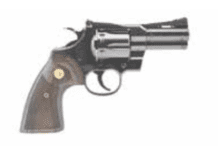
We have tested several 38 Special snubnose revolvers over the past few decades. As a direct result of this experience, we have isolated areas of the greatest import in making the 38 snub most effective. The trigger action must be smooth, the sights useful, and the stocks should be hand-filling grips that limit recoil. The role of the 38 Special as a backup handgun must be considered as well. This is a light, but formidable, firearm carried just in case. The snubnose revolver will easily survive in an ankle holster, where other types may not ride in this carry position and come up shooting. Whether in a primary carry role on the belt or in a pocket, or as a backup on the lower leg, a concern with nearly every snubbie is capacity. While the snubnose 38 usually has five cartridges, five rounds isn’t very many, so being able to put them where they’re needed is paramount.
A Gun Tests reader and Smith & Wesson fan recently asked us to help him winnow down his choices for a snubbie stainless carry gun. He had read our coverage of the Smith & Wesson Performance Center Pro Series Model 640 178044 38 Special/357 Magnum in the July 2023 issue, which we called Our Pick, and wondered how the gun stacked up against other S&W short-barrel choices. So we added two other stainless choices from S&W, the Ultimate Carry Model 642 13995 38 Special, $699; and the Model 642 103810-2 38 Special, $515. All are J-frame types, but there are considerable differences in features and price. So we took them to the range and shot them side by side. Here’s what we thought:
Smith & Wesson Performance Center Pro Series Model 640 178044
38 Special/357 Magnum
$909
Gun Tests grade: A
This revolver isn’t as light as the other two Smith & Wessons, but neither is it a heavyweight. The 640 Pro’s weight and heavier barrel, coupled with the rubberized grips, make for a light-kicking revolver. Add in the moon-clip option, and you have a formidable revolver. A fine choice for concealed carry.

| Action Type | Double-action-only revolver |
|---|---|
| Overall Length | 6.6 in. |
| Overall Height | 4.3 in. |
| Maximum Width | 1.4 in. |
| Weight Unloaded | 22.0 oz. |
| Weight Loaded | 24.1 oz. |
| Barrel | 2.13 in. long, 2.13 in. long, Matte and fluted stainless steel |
| Frame | Matte stainless steel, J frame |
| Cylinder | Matte stainless steel |
| Cylinder Gap | 0.045 in. |
| Capacity | 5 rounds |
| Grip | Synthetic |
| Grip Frame Front Strap Height | 1.8 in. |
| Grip Frame Rear Strap Height | 3.8 in. |
| Grip Thickness (Maximum) | 3.1 in. |
| Grip Circumference (Maximum) | 5.0 in. |
| Rear Sight | Tritium night sight, dovetailed base |
| Front Sight | Tritium night sight, dovetailed base |
| Sight Radius | 3.75 in. |
| Trigger Pull Weight Double Action | 11.6 lbs. |
| Trigger Span Double Action | 3.0 in. |
| Safety | Internal rebound, hammer block |
| Warranty | 1 year |
| Telephone | (800) 331-0852 |
| Website | Smith-Wesson.com |
| Made In | U.S. |
We keep testing this wheelgun against various competitors, and it keeps coming up a winner. In the July 2023 issue, our first look at it put it against two vastly cheaper wheelguns, the Charter Arms Boxer 38 Special, $349, and the Taurus Defender 605, a 357 Magnum like the 640 Pro. The Pro was a Grade A Our Pick, which was no surprise because it cost nearly twice as much as the Defender. Still, we liked it the best in that test conducted in South Carolina. More recently, in the March 2025 issue, the North Carolina team looked at the same model but against tougher competitors, customized guns from Ruger and Taurus. That 640 Pro earned an A- grade. So this time, the South Carolina team looks at the 640 Pro against two of its stainless stablemates to see how it does. The 640 Pro was tested as an alternative to the other Smith & Wesson revolvers and a comparison in steel-frame versus aluminum-frame arguments. The stainless-steel 640 Pro is also a double-action concealed-carry revolver, but it is chambered in 357 Magnum. We feel that 38 Special ammunition is a better choice for this 22-ounce revolver, and we only tested with 38 Specials. The 640 Pro’s synthetic grips are well designed for recoil control.
This revolver features a smooth double-action trigger similar to the 642 that breaks at 13 pounds. None of the revolvers have any grit, sluggishness, or a hitch in the action. The 640 revolver features a nicely done stainless-steel finish. The barrel is longer than the 1.88-inch barrel of the more compact revolvers. This barrel at 2.13 inches in length would offer more velocity with heavy loads than the others. The fluted barrel is a solid stainless type rather than the shrouded UC 642. The barrel also shrouds the ejector rod. The sights are excellent by any standard, well suited to combat use.
On top are high-visibility three-dot self-luminous tritium sights. The three-dot sight picture makes for good sight alignment in precise shooting. These sights are superior for precision shooting and combat shooting at all ranges compared to the other two revolvers, while the UC 642’s big dot is faster to a hit at short range. These sights are superior to most every other revolver sight commonly used in small revolvers. The Kimber KS6 is similar, most are not.
The 640 Pro is heavier than the aluminum-frame revolvers, but it is still light. The revolver weighs 22.5 ounces compared to 16.7 for the UC 642. This weight is noticeable on the hip. The difference is noticeable in a good way when firing during combat shooting. The 640’s steel frame dampens recoil, and the hand-filling Hogue grips helped in controlling 38 Special recoil. The 640’s combat groups were good, tighter than the other revolvers, but not by a huge margin. In bench accuracy, the 640 Pro is an accurate revolver. Despite the short sight radius and double-action-only trigger, the revolver did well on all counts in precision shooting. The groups were tight at 1.25 to 2.4 inches, excellent for a DAO revolver. The trigger action is half an ounce lighter than the UC 642.
An additional advantage of the 640 Pro is that the cylinder is faced off to accept moon clips. Moon clips are much faster for most shooters to reload. Another advantage is that when you dump the spent cases, all types of malfunctions are avoided because the moon clips make certain that the cartridge cases are ejected together. Cartridge-rim-under-the-ejector malfunctions are impossible with this system. Speed loaders may be used if you prefer.
Our Team Said: The 640 Pro is a great revolver, an elevated J frame well worth its price. However, that price is stiff. If you want to shoot 357 Magnum as well as 38 Special, then pick the 640 Pro.
| 38 SPECIAL RANGE DATA | |||
|---|---|---|---|
| Federal Punch 120-grain JHP +P | Smith & Wesson Model 642 Airweight | Smith & Wesson Model UC 642 | Smith & Wesson Model 640 Pro |
| Average Velocity | 899 fps | 907 fps | 918 fps |
| Muzzle Energy | 215 ft.-lbs. | 219 ft.-lbs. | 225 ft.-lbs. |
| Smallest Group | 2.5 in. | 2.4 in. | 2.1 in. |
| Average Group | 3.2 in. | 2.9 in. | 2.4 in. |
| Hornady American Gunner 125-grain XTP 90324 Model | Smith & Wesson Model 642 Airweight | Smith & Wesson Model UC 642 | Smith & Wesson Model 640 Pro |
| Average Velocity | 903 fps | 891 fps | 905 fps |
| Muzzle Energy | 226 ft.-lbs. | 220 ft.-lbs. | 209 ft.-lbs. |
| Smallest Group | 2.25 in. | 2.0 in. | 1.6 in. |
| Average Group | 3.0 in. | 2.5 in. | 2.25 in. |
| Federal American Eagle 158-grain LRN AE38B | Smith & Wesson Model 642 Airweight | Smith & Wesson Model UC 642 | Smith & Wesson Model 640 Pro |
| Average Velocity | 730 fps | 755 fps | 770 fps |
| Muzzle Energy | 187 ft.-lbs. | 200 ft.-lbs. | 208 ft.-lbs. |
| Smallest Group | 2.5 in. | 1.5 in. | 1.25 in. |
| Average Group | 2.9 in. | 2.0 in. | 1.85 in. |
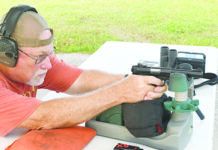
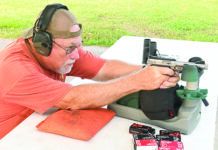
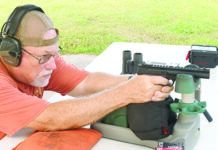
We fired groups double action at 10 yards from a bench using an MTM Case-Gard K-Zone Pistol Rest. We measured velocities with a Competition Electronics Pro Chrony. The first screen of the chronograph was 10 feet from the muzzles. JHP = jacketed hollow point. XTP = eXtreme Terminal Performance jacketed hollow point. LRN = lead round nose.
Written and photographed by Bob Campbell, using evaluations from Gun Tests Team members. GT