




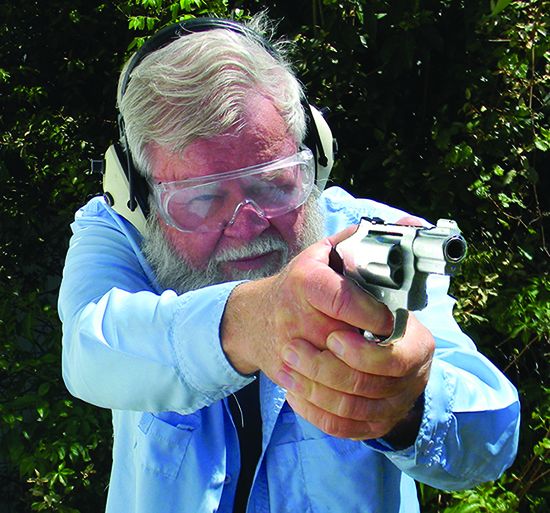
We have tested several 38 Special snubnose revolvers over the past few decades. As a direct result of this experience, we have isolated areas of the greatest import in making the 38 snub most effective. The trigger action must be smooth, the sights useful, and the stocks should be hand-filling grips that limit recoil. The role of the 38 Special as a backup handgun must be considered as well. This is a light, but formidable, firearm carried just in case. The snubnose revolver will easily survive in an ankle holster, where other types may not ride in this carry position and come up shooting. Whether in a primary carry role on the belt or in a pocket, or as a backup on the lower leg, a concern with nearly every snubbie is capacity. While the snubnose 38 usually has five cartridges, five rounds isn’t very many, so being able to put them where they’re needed is paramount.
A Gun Tests reader and Smith & Wesson fan recently asked us to help him winnow down his choices for a snubbie stainless carry gun. He had read our coverage of the Smith & Wesson Performance Center Pro Series Model 640 178044 38 Special/357 Magnum in the July 2023 issue, which we called Our Pick, and wondered how the gun stacked up against other S&W short-barrel choices. So we added two other stainless choices from S&W, the Ultimate Carry Model 642 13995 38 Special, $699; and the Model 642 103810-2 38 Special, $515. All are J-frame types, but there are considerable differences in features and price. So we took them to the range and shot them side by side. Here’s what we thought:
Smith & Wesson Ultimate Carry 642 13995 38 Special
$699
Gun Tests grade: A (Our pick)
A lightweight revolver chambered in a serious cartridge, so recoil is present. The grips go a long way in handling recoil. The action is smooth. Reliability is a given. The XS sights are by far the best addition to the J-frame.

| Action Type | Double-action-only revolver |
|---|---|
| Overall Length | 6.3 in. |
| Overall Height | 4.3 in. |
| Maximum Width | 1.4 in. |
| Weight Unloaded | 16.3 oz. |
| Weight Loaded | 18.1 oz. |
| Barrel | 1.88 in. long, stainless steel shrouded |
| Frame | Satin aluminum alloy, J frame; no internal lock |
| Cylinder | Satin stainless steel, beveled front edge, chamfered charge holes |
| Cylinder Gap | 0.05 in. |
| Capacity | 5 rounds |
| Grip | VZ G10, high horn style, left side relieved for speedloader use |
| Grip Frame Front Strap Height | 2.0 in. |
| Grip Frame Rear Strap Height | 3.5 in. |
| Grip Thickness (Maximum) | 1.2 in. |
| Grip Circumference (Maximum) | 4.85 in. |
| Rear Sight | Black serrated U notch, dovetailed base |
| Front Sight | Tritium XS Dot |
| Sight Radius | 3.5 in. |
| Trigger Pull Weight Double Action | 12.5 lbs. |
| Trigger Span Double Action | 3.0 in. |
| Safety | Internal rebound |
| Warranty | 1 year |
| Telephone | (800) 331-0852 |
| Website | Smith-Wesson.com |
| Made In | U.S. |
We found our revolver in a well-stocked local shop for $725. Online prices are consistent, but you must add shipping and FFL fees. The S&W UC 442 is available in a blued finish as well for the same price. In size and operation, the UC 642 is very similar to the 642. The action is identical in operation; however, the UC 642’s action is a full pound lighter than the 642, measuring a smooth 12.5 pounds.
The UC 642 features what must be termed a heavy barrel compared to the 642. It is a modern design with an inner barrel and a sleeve over the barrel. The outer barrel features flats on each side, and in another plus move, the barrel features a shroud for the ejector rod.
Perhaps most important, the UC 642 features a high-visibility dot front sight. The tritium center is surrounded by a brilliant green ring. This sight is mated with a high-visibility U notch rear. The sights are exceptionally well designed for a snubnose 38 or any other revolver. They are far superior to the 642 revolver sights.
The finish of the UC 642 is good, matte and non reflective. There is little contrast between steel and aluminum parts. The curved trigger is identical to the 642 trigger. The frame/receiver of the Smith & Wesson Ultimate Carry features titanium strengthening pins. Considering that aluminum-frame revolvers are lightweight and +P loads accelerate wear, these pins are a good touch. The chambers of the cylinder are slightly chamfered to make loading easier.
We could detect no difference in practical handling, but certainly no harm is done. The G10 grips have a good appearance and fit well, with no overlap. There is a slight roughening of the backstrap and some abrasion on the grip. This grip separates metal from flesh well. The trigger guard undercut is filled in and there are slight finger grooves. The grips are designed to offer maximum concealment. They are not as comfortable when firing as the Hogue grips of the 642, but they are not uncomfortable. One of the four raters preferred these in recoil control, and all felt that the chances of a snag on clothing were minimal. Concealment is better because the grips are more compact than either Hogue types tested on the other revolvers. In firing the Ultimate Carry 642, the shooting experience was similar to the Smith & Wesson 642. You may say the feeling is enhanced performance, as intended. The trigger action is improved. The grips are a good fit for most hands.
The huge difference is in the sights. The improvement is not incremental, but overwhelming, compared to the 642. The sights, if aligned in the usual manner, fire as much as 3 inches low at 10 yards. If aligned properly as outlined by XS Sights, the front dot should be held up and over the rear sight. This makes for dead-on-the-dot hits and among the fastest and most effective sight sets we have ever tested of any type. Speed is brilliant. The Ultimate Carry 642 is simply a great-shooting snubby.
During the test we drew and re-holstered often and made speed loads. We could not really tell the difference in the chamfered cylinders or slightly beveled cylinder. The UC 642 proved to be a better performer than the 642 in combat shooting. It took some adjustment to learn the best grip for the VZ grips. But the combination of a super-compact grip no taller than skinny issue grips found on early snubnose revolvers but which absorbs recoil well was worth the effort.
In bench accuracy, the UC 642’s results were pronounced in their accuracy over the stock 642. The smoother action is partly responsible. We found we could fire much more accurately with the well-defined sights of the UC 642. Some of our efforts were very good, with one sterling effort putting five shots into 1.5 inches at 10 yards.
Our Team Said: The spur to begin this report was the introduction of the Smith & Wesson Ultimate Carry 642. The UC 642 address issues of larger hand-filling grips that work well in controlling recoil, but the grips result in a taller revolver. The UC 642 features the best combat sights of the test.
| 38 SPECIAL RANGE DATA | |||
|---|---|---|---|
| Federal Punch 120-grain JHP +P | Smith & Wesson Model 642 Airweight | Smith & Wesson Model UC 642 | Smith & Wesson Model 640 Pro |
| Average Velocity | 899 fps | 907 fps | 918 fps |
| Muzzle Energy | 215 ft.-lbs. | 219 ft.-lbs. | 225 ft.-lbs. |
| Smallest Group | 2.5 in. | 2.4 in. | 2.1 in. |
| Average Group | 3.2 in. | 2.9 in. | 2.4 in. |
| Hornady American Gunner 125-grain XTP 90324 Model | Smith & Wesson Model 642 Airweight | Smith & Wesson Model UC 642 | Smith & Wesson Model 640 Pro |
| Average Velocity | 903 fps | 891 fps | 905 fps |
| Muzzle Energy | 226 ft.-lbs. | 220 ft.-lbs. | 209 ft.-lbs. |
| Smallest Group | 2.25 in. | 2.0 in. | 1.6 in. |
| Average Group | 3.0 in. | 2.5 in. | 2.25 in. |
| Federal American Eagle 158-grain LRN AE38B | Smith & Wesson Model 642 Airweight | Smith & Wesson Model UC 642 | Smith & Wesson Model 640 Pro |
| Average Velocity | 730 fps | 755 fps | 770 fps |
| Muzzle Energy | 187 ft.-lbs. | 200 ft.-lbs. | 208 ft.-lbs. |
| Smallest Group | 2.5 in. | 1.5 in. | 1.25 in. |
| Average Group | 2.9 in. | 2.0 in. | 1.85 in. |
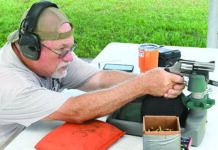
We fired groups double action at 10 yards from a bench using an MTM Case-Gard K-Zone Pistol Rest. We measured velocities with a Competition Electronics Pro Chrony. The first screen of the chronograph was 10 feet from the muzzles. JHP = jacketed hollow point. XTP = eXtreme Terminal Performance jacketed hollow point. LRN = lead round nose.
Written and photographed by Bob Campbell, using evaluations from Gun Tests Team members. GT