







Three of the Houston test group’s members regularly tote somebody’s version of the Colt 1911 Officer’s Model as an everyday carry pistol. The “O” Model is the same width as its big brothers but has a shorter slide, allowed by a 3.5-inch (sometimes 3.0-inch) barrel. But in today’s environment, we are a bit concerned about the ammo capacity. One of the concessions made to concealability was the reduction of the grip by a length equal to one round. Accordingly, the O Model utilizes a single-stack magazine that will carry six rounds of 45 ACP and seven when chambered in 9mm. A number of very good magazines made by folks like Rodgers and Wilson allow one additional round. The three Houston testers figure if they can’t carry much, they’ll carry big, and all wore O Models chambered in 45 ACP. At least until recently.
The high-capacity 1911 frames first produced by Para-Ordnance in the 1990s and dramatically improved upon by STI (currently known as Staccato) are now available in an Officer’s Model format — shorter barrel, shorter magazine — and these new versions carry 15 rounds of 9mm. We grabbed two 9mm Luger chamberings examples for review.
The first is the Springfield Armory Prodigy 3.5″ with AOS PH9115AOS, $1400. Announced just before the 2025 SHOT Show, this Prodigy offers the smaller O Model size with a double-stack magazine and does so with virtually the same grip diameter as the single-stack predecessors. Then Springfield added in great night sights, ambi safeties, and the outstanding Agency Optic System (AOS) system for the easy mounting of a red-dot sight.
Our second test sample is a Staccato 2011 CS, $2500. Rebranded in 2020, this company used to be known as STI, and we used their competition model 2011s for a decade. STIs were superbly accurate in our experience, and we wanted to find out if the new versions had maintained their quality, and whether current-production pistols were worth more than $1000 above the Springfield Prodigy’s sticker price.
Springfield Armory Compact Prodigy 3.5″ PH9115AOS 9mm Luger
$1400
Gun Tests grade: A- (Our Pick)
The Prodigy pistol won the accuracy tests — barely. It came in second place on the speed drills — barely. The majority of our testers felt the Prodigy essentially equaled the performance of the Staccato CS at a lower price.
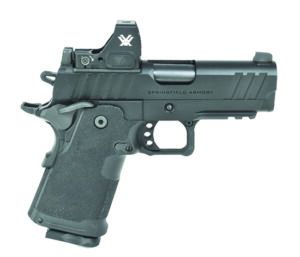
| Action Type | Semi auto, hammer fired |
|---|---|
| Overall Length | 7.0 in. |
| Overall Height | 5.1 in. |
| Maximum Width | 1.50 in. |
| Weight Unloaded | 25.44 oz. |
| Weight Loaded | 34.88 oz. |
| Slide Material | Carbon steel |
| Slide Retraction Effort | 12.7 lbs. |
| Receiver Material | 7075-T6 aluminum chassis and polymer grip |
| Finish | Black Cerakote |
| Front Strap Height | 2.6 in. |
| Back Strap Height | 2.9 in. |
| Barrel Length | 3.5 in. |
| Grip Thickness (Maximum) | 1.32 in. |
| Grip Circumference (Maximum) | 5.7 in. |
| Magazines | (2) 15-round |
| Rear Sight | Drift adjustable, black |
| Front Sight | White dot with tritium insert |
| Sight Radius | 5.2 in. |
| Trigger Pull Weight | 3.4 lbs. |
| Trigger Span | 3.0 in. |
| Safety | Ambidextrous manual thumb |
| Warranty | Limited lifetime for original owner |
| Telephone | (800) 680-6866 |
| Website | Springfield-Armory.com |
| Made In | U.S. |
We first had the chance to look at the Springfield Armory Prodigy in the late summer of 2023. We liked what we saw, awarded the 4.25-inch version an A- grade, and named it Our Pick in a test with two other very nice pistols. We mentioned a 3.5-inch model as an obvious line extension, to which Springfield made no response. We, in turn, waited for the inevitable and were very pleased to see Springfield announce the shorter-barreled version just before SHOT Show 2025. In doing so, they followed the same conventions that Colt originally did. John Moses Browning’s first 1911 design was called the Government Model, because that is who originally bought it, and deployed a 5-inch barrel.
The Commander Model was introduced in the 1950s (both with a steel frame and a lightweight aluminum frame) and used a shorter, handier 4.25-inch barrel. The General Officer’s Model with a 3.5-inch barrel was revealed in 1985. Those three sizes still dominate the 1911 market today, though you will find some offerings as short as 3.0 inches or hunting-centric designs that offer 6-inch tubes.
Two Canadian designers, Ted Szabo and Thanos Polyzos, took the design to the next level. They realized that when your primary competition is a six-shot revolver, a 7+1 semi-auto presents a huge advantage. Not so much when being compared to a 17-round polymer 9mm. As great as the 1911 design was/is, ammo capacity was a major concern. But Szabo and Polyzos engineered a double-stack magazine and a steel frame that would fit around it, while managing to leave the good parts of the original 1911 design alone. With their frame mated to a conventional 1911-style top end, the world now had a 14-shot 45 ACP. Chambered in 9mm or 38 Super, the onboard capacity went as high as 18 rounds. It was also large, heavy, and, speaking from experience, had feeding issues.
The mid-1990s saw a little company from Central Texas raise the bar even higher. STI, now known as Staccato, introduced another innovation with their polymer-frame pistol attached to a steel cradle. Perhaps the forerunner of the modular pistol revolution that we see today, the STI 2011, as they called it, was lighter, easier to maneuver, and was extremely accurate. We’ll talk about their entry in the short-barreled 2011 market shortly.
Patents eventually expire, and smart businesses pay attention to those kinds of things. Just look at the new RXM introduced late last year as a cooperative effort between Ruger and Magpul. They figured out some great ways to upgrade the 3rd Generation Glock 19. Springfield is now making the same improvements to the 2011. The obvious niche for the Officer’s Model-sized pistol is for concealed carry and self-defense. When compared to the current crop of EDC pistols such as the SIG P365 and Glock 43s, the 3.5-inch Prodigy seems a bit big. Outstanding! There is more to hold on to, and it has as much ammo as both of those pistols combined. It is literally the same length and height as the single-stack Officer’s Model we’ve carried for more than a generation. Weight for the higher-capacity pistol is only 0.1 ounce greater than the single-stack SIG Sauer Ultra Compact we used as a baseline. The grip circumference is about 0.25 inch greater for the Springfield. Our hips and our hands could not tell the difference between an eight-shot and a 16-shot pistol.
The visible parts of this Prodigy are very similar to both the 4.25-inch and 5.0-inch versions. The flats of the slide match with the sides of the frame with only a short, sculpted section present near the muzzle. The dust cover sports two slots on a Picatinny rail, with plenty of room for a weapon light. Three slanted grasping grooves have been milled on the front of the slide and five more to the rear. They provide plenty of traction for racking the slide or press checks. The extra beef in the frame allows both sides of the slide stop to fit in recesses, leaving them well protected. The sights are suppressor-height versions that allow the sights to co-witness through an attached red-dot sight.
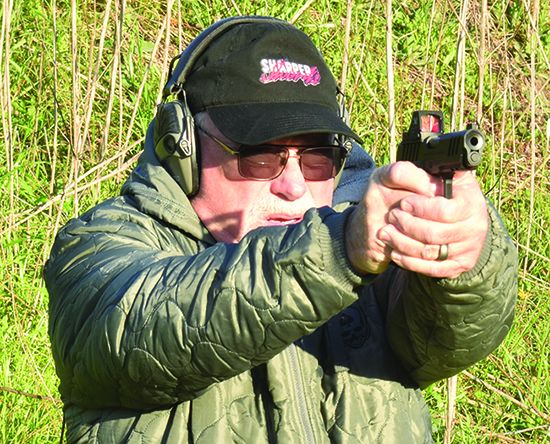
The rear sight is black, serrated, and drift-adjustable for windage. The front sight uses a white outline around a tritium vial, allowing for good visibility in the light or the dark. It is also mounted in a dovetail and pinned securely. This Prodigy was already milled for the Agency Optic System. Springfield offers several AOS plates from its website ($129 each) that match up with the footprint on various red dot systems. We got the 15B, which worked perfectly with the Vortex Defender-ST sight we installed. Mounting this sight was easy, the controls are easy to reach, the window is larger and easier to use than many, and the battery compartment is located on top, so nothing has to be dismounted to change it. In line with Vortex’s reputation and the guarantee for the company’s optics, the front face of the Defender-ST is checkered to provide greater purchase for when the shooter uses it as a lever to rack the slide. Remember, if you want your red-dot sight to stay on your carry gun, blue Loctite is your best friend.
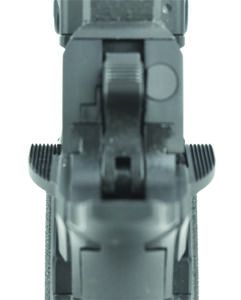
Controls are what we would expect on a 1911/2011. The trigger still has that magic 1911 quality and only required 3.4 pounds of pressure to activate. Take-up was short, as was the overtravel, and the break was very crisp. The thumb safety is ambidextrous and proved to be crisp and positive to activate with either hand. The magazine release was sightly extended and easy to manipulate. Both the hammer and the beavertail safety have been reduced in size from the larger models for easier concealment.
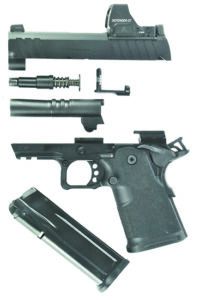
The polymer frame is attached to the aluminum cradle with screws through the grip and the front of the trigger guard. The grip proper is covered with Springfield’s two-level Adaptive Grip Texture. The first allows for a quick grip, and the second, deeper layer provides great control for a crush grip as we hit the go-fast button during speed tests. The trigger guard has been undercut to offer a higher grip, and the magazine well has been beveled for easier reloads.
The working parts show the attention to detail necessary to get a small semi-auto to run correctly. Firearms physics don’t just allow parts to be scaled down. The barrel has to unlock quickly since the slide doesn’t take very long to travel its full distance. Angles have to change, as do weights and springs. This Prodigy — actually all Prodigies — use a bull barrel, putting more of the weight toward the muzzle. But the short version tested uses a different recoil-spring set up. Two nested springs protrude through a reverse spring plug. Easy to remove via a standard disassembly process, it was a bear to reinsert until we read the manual (please read it). Springfield provides a small plastic piece that is used to capture the recoil spring, and which makes it much easier to reassemble.
As would be expected on a pistol in this price range, fit and finish were outstanding. The slide moves on the frame like it is on ball bearings, and then everything locks up solidly. We always check for movement of the barrel as a gauge of how tight the components are. The hood on the Springfield didn’t move at all, even with the hammer cocked. Have you ever shaken a 1911 and heard all the parts rattling around inside? Not this one.
There are reasons why so many people carry an Officer’s Model-sized pistol. The smaller, lighter versions may have a bit more muzzle flip than their larger brethren, but we find the faster slide speed brings us back on target very quickly. The Springfield Prodigy was no exception. As close as they appear in concept and size, the dimensions of the Prodigy and the Staccato are not identical, and we needed to order holsters accordingly. A Crucial Concealment Covert OWB kydex rig we purchased through the Springfield website worked well for both, even though it was designed for the 4.25-inch Prodigy. We also ordered a Defcon 4 leather holster from Simply Rugged holsters that fit the Prodigy perfectly (that is the pistol it was supposed to fit) but was just a bit small for the Staccato.
The trigger on the Prodigy was excellent, with little take-up, virtually no creep, and a pull weight of only 3.4 pounds. It did a great job with the Black Hills Honey Badger and shot groups as small as 0.78 and 0 .79 inch, respectively, with the Hornady Critical Defense and Speer Gold Dots. Function was perfect after we got some rounds downrange.
Each pistol was involved in three range sessions, with session numbers two and three being shot side-by-side. On the date of session two, a couple of members of the Houston test group were involved in some training for a tactical unit of a local law-enforcement agency. We asked the agency shooters to expand our testing and shoot the two pistols consecutively. Some liked the smaller grip of the Staccato, while others liked the slightly larger grip of the Prodigy. Some liked the recoil impulse of the Prodigy, some liked the Staccato. All found both to be very accurate.
Our Team Said: With more than a dozen experienced people shooting these pistols, a quick survey leaned toward the Prodigy as Our Pick based on very similar quality at a better price.
| 9MM LUGER RANGE DATA | ||
|---|---|---|
| Black Hills 100-grain Honey Badger | Springfield Prodigy 3.5″ | Staccato 2011 CS |
| Average Velocity | 1237 fps | 1208 fps |
| Muzzle Energy | 340 ft.-lbs. | 324 ft.-lbs. |
| Best Group | 1.42 in. | 1.42 in. |
| Average Group | 1.64 in. | 1.44 in. |
| Hornady Critical Defense 115-grain HP | Springfield Prodigy 3.5″ | Staccato 2011 CS |
| Average Velocity | 1116 fps | 1096 fps |
| Muzzle Energy | 318 ft.-lbs. | 307 ft.-lbs. |
| Best Group | 0.78 in. | 1.00 in. |
| Average Group | 1.07 in. | 1.22 in. |
| Speer Gold Dot 124-grain GDHP | Springfield Prodigy 3.5″ | Staccato 2011 CS |
| Average Velocity | 1091 fps | 1084 fps |
| Muzzle Energy | 328 ft.-lbs. | 324 ft.-lbs. |
| Best Group | 0.79 in. | 1.25 in. |
| Average Group | 1.10 in. | 1.38 in. |
We tested at American Shooting Centers in West Houston. We fired for accuracy at 15 yards by shooting multiple five-shot groups from a well-sandbagged Caldwell Pistolero Shooting Rest (MidwayUSA.com 517357, $28) assisted by a Mini DRC Fortune Cookie from Wiebad.com ($75, MINIFC). We recorded velocities with a Garmin Xero C1 Pro chronograph ($600).
| DRILL NO. 1 DATA | |
|---|---|
| Pistol | Single Shot Average Time |
| Springfield Prodigy | 0.88 |
| Staccato 2011 CS | 0.85 |
Process: Fire one shot from low ready at a 3-by-5-inch label placed on a USPSA target at 7 yards. Times in seconds are averages for ten reps.
| DRILL NO. 2 DATA | |||
|---|---|---|---|
| Pistol | 1st Shot | Split Average | Total Time |
| Springfield Prodigy | 0.93 | 0.21 | 1.375 |
| Staccato 2011 CS | 0.89 | 0.22 | 1.315 |
Process: Fire three shots from low ready at a 3-by-5-inch label on a USPSA target placed at 7 yards. Times in seconds are averages for three reps.
| DRILL NO. 3 DATA | |||
|---|---|---|---|
| Pistol | 1st Shot | Split Average | Total Time |
| Springfield Prodigy | 0.915 | 0.216 | 1.78 |
| Staccato 2011 CS | 0.915 | 0.223 | 1.805 |
Process: Fire five shots from low ready at a 3-by-5-inch label on a USPSA target placed at 7 yards. Times in seconds are averages for two reps.
Our speed tests are not designed to show how fast a firearm can be fired, but to use the same test on multiple guns fired by the same person to look for differences in their capabilities. These two were incredibly close.
Written and photographed by Joe Woolley, using evaluations from Gun Tests Team members. GT


My Prodigy 4.25. 3# trigger by Danforth gun works is a finest 2011 competition pistol & great value