





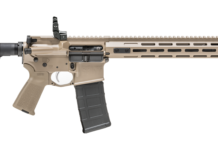


Staccato 2011 CS 14-1501-000012 9 MM Luger

0

Three of the Houston test group’s members regularly tote somebody’s version of the Colt 1911 Officer’s Model as an everyday carry pistol. The “O” Model is the same width as its big brothers but has a shorter slide, allowed by a 3.5-inch (sometimes 3.0-inch) barrel. But in today’s environment, we are a bit concerned about the ammo capacity. One of the concessions made to concealability was the reduction of the grip by a length equal to one round. Accordingly, the O Model utilizes a single-stack magazine that will carry six rounds of 45 ACP and seven when chambered in 9mm. A number of very good magazines made by folks like Rodgers and Wilson allow one additional round. The three Houston testers figure if they can’t carry much, they’ll carry big, and all wore O Models chambered in 45 ACP. At least until recently.

The high-capacity 1911 frames first produced by Para-Ordnance in the 1990s and dramatically improved upon by STI (currently known as Staccato) are now available in an Officer’s Model format  — shorter barrel, shorter magazine — and these new versions carry 15 rounds of 9mm. We grabbed two 9mm Luger chamberings examples for review.

The first is the Springfield Armory Prodigy 3.5 with AOS PH9115AOS, $1400. Announced just before the 2025 SHOT Show, this Prodigy offers the smaller O Model size with a double-stack magazine and does so with virtually the same grip diameter as the single-stack predecessors. Then Springfield added in great night sights, ambi safeties, and the outstanding Agency Optic System (AOS) system for the easy mounting of a red-dot sight.

Our second test sample is a Staccato 2011 CS, $2500. Rebranded in 2020, this company used to be known as STI, and we used their competition model 2011s for a decade. STIs were superbly accurate in our experience, and we wanted to find out if the new versions had maintained their quality, and whether current-production pistols were worth more than $1000 above the Springfield Prodigy’s sticker price.

Staccato 2011 CS 14-1501-000012 9mm Luger

$2500

Gun Tests grade: A-

Superbly accurate, the Staccato was very tight in the beginning — on purpose, we’re sure. Be prepared with some extra ball ammo for break-in purposes. We loved the pistol, but the price is steep.

Action Type Semi auto, hammer fired
Overall Length 7.1 in.
Overall Height 5.5 in.
Maximum Width 1.45 in.
Weight Unloaded 24.32 oz.
Weight Loaded 33.92 oz.
Slide Material 4140 billet steel w/DLC finish
Slide Retraction Effort 17.2 lbs.
Receiver Material Aluminum alloy
Finish Hardcoat anodized
Front Strap Height 2.5 in.
Back Strap Height 2.9 in.
Barrel Length 3.5 in.
Grip Thickness (Maximum) 1.31 in.
Grip Circumference (Maximum) 5.5 in.
Magazines (2) 15 round
Rear Sight Drift adjustable, black
Front Sight Green fiber optic
Sight Radius 5.25 in.
Trigger Pull Weight 4.3 lbs.
Trigger Span 2.9 in.
Safety Ambidextrous manual thumb
Warranty None
Telephone (512) 819-0650
Website Staccato2011.com
Made In Texas, U.S.

When we first held the CS model, like a great pair of boots or the right easy chair, this pistol just fit our hands. Different people look for different feel in their firearms. The CS was “it” for a couple of us. Similar in concept to the Prodigy (which hadn’t come along at that time), it took a while to save that many pennies, but it is here now.

Much of the concept is similar to the Prodigy, though there are obviously a number of differences in execution. The Staccato is slightly smaller than the Prodigy in a couple of places. The grips measure to be 1.32 inches maximum on the Prodigy and 1.31 inches on the Staccato. Let’s call that insignificant. That said, the Staccato tapers slightly toward the base of the grip and shows a max thickness of 1.2 inches where the little and ring fingers go. Only you would know if that is significant for you. The Prodigy measures a grip circumference of 5.75 inches, while the Staccato shows 5.5 inches. Again, significant? Some may like the more hand-filling size, or not. Up to you. The Staccato allows the difference in diameters via a redesigned magazine. It reminds us very much of the 15-round magazines that Shield Arms (ShieldArms.com) makes for the Glock 48. In fact, we used the same Comp-Tac magazine pouch for carrying spare mags on both pistols. Designed specifically for 9mm, it is not a reconfigured magazine built for a 45 ACP and fitted into a smaller space.

The same but different features continued in the top end of the Staccato. The slide and the frame are also full diameter almost all the way to the muzzle, where a beveled edge has been cut to aid in reholstering. The Staccato sports a 3.5-inch bull barrel with more cuts milled on the hood. These may trim just a little more weight off but should also help channel dirt and debris away from the slide and the locking lugs. Lock up was superb. The barrel just did not move at all when we pushed on it, something that bodes well for accuracy. Slanted grasping grooves have been milled fore and aft. The extractor on the Staccato is a pivoting, external type. The Staccato CS, like the Prodigy, uses a Series 70-type system for safety in the event of a dropped pistol. This older, and we think much better system uses a lightweight firing pin along with a heavy firing pin spring to prevent the firing pin from generating enough movement and energy to light off a primer if someone is unfortunate enough to drop the pistol on the muzzle.

Our CS model came to us with a green fiber-optic front sight and the factory rear sight installed. Staccato uses a plate that wedges into the front of the milled slot and then locks down via a screw at the rear. The optics plate even has a couple of small O-rings mounted into the underside to maintain tension. Mounting the Dawson Precision optical plate is a great time to read the manual, if you haven’t already. The screw located deep in the rear sight must be removed for the optical plate can be installed. The instructions point out that the screw has been securely Loctited in and must be removed carefully. We eventually had to secure the top end in a padded vise and gently tap the provided Allen key into the screw completely and then provide slow, steady pressure — a lot of it — before the screw would release. They obviously do not intend the rear sight to come off accidentally. The Dawson Precision plate system came with all the correct screws needed to mount the red-dot sight, which we really appreciated.

This is the Staccato. Standard 1911 disassembly protocol is used for both pistols, though the recoil springs need to be handled differently.

The grip frame is similar to the Prodigy, just slightly thinner. The aluminum cradle is milled for a Picatinny rail with a single slot. As with the Prodigy, there just isn’t enough room on the dust cover to mount the Streamlight TLR-1 we normally use. We tend to run our EDC guns clean and then carry a hand-held light, but if you want to use a weapon-mounted light you’ll have to find a model that’s a bit shorter. The texturing pattern is present everywhere it is needed and smooth where it should be as well, making for a secure, but comfortable, grip. The thumb safety is an ambidextrous switch, once a left-handed user learns to activate the magazine release with his strong-hand index finger. That makes the 1911/2011 platform work very well for a southpaw shooter. Sorry though, the recessed slide stop is left side only. Keeping the width to a minimum, the magazine well was beveled, while not flared. Changing magazines was snap. The recoil spring was a captured unit that pivots at the front, making disassembly and reassembly a snap. Patented by Dawson Precision, we loved the concept, and fit and finish were outstanding.

Just like precision rifle barrels require a break-in period, so do many precision pistol barrels. Staccato includes a printed piece that says “Read Before You Shoot,” reminding the shooter that it is a match-fit handgun and that it needs to be lubricated properly. We are going to add that, as with all pistols, it should be shot for proof of function before being carried for self-defense. Not at all surprised, we were prepared with extra practice ammo as we started the first range sessions for each of the pistols. The SIG Sauer 115-grain FMJ worked from the beginning for the Prodigy as well as the Staccato.

Defensive ammo told a little different story. Both pistols settled in quickly with the Black Hills Honey Badger and the Hornady Critical Defense. The Prodigy was digesting everything within the first 50 rounds, while the Staccato required about 200 rounds. Both, however, had trouble handling the Speer Gold Dot with that big hollow point. Most of the problems came in loading the chamber, with the Gold Dots hanging up on the feed ramp when we cycled the slide by hand. Most of those problems went away when we locked the slide back, inserted a new mag, and then dropped the slide using the slide release.

These makers executed the fit and feel of some parts differently. Try to lay hands on both of them to see which one feels better.


We tried the Prodigy again at about 200 rounds, and the Gold Dot fed fine. The Staccato was still having an occasional hang-up at 400 rounds, but seemed to have worked out its problems by about 500 rounds downrange. We expected the pistols to be tight. We didn’t expect the Staccato to be quite this tight. The magazine springs were tight. Even the magazine release button was tight, though by range session three everything had loosened up to a tight-but-acceptable state. We also remembered that tight often equals accurate.

The Staccato averaged 1.35 inches for five-shot groups across three different kinds of defensive ammunition at 15 yards. It showed a slight preference for the Hornady Critical Defense, though the other two were less than 0.2 inch off the pace. The Prodigy averaged about 1.27 inches for the same exercises. The total delta between the two pistols was less than eight hundredths of an inch. We did not deem that to be statistically significant. 

The Staccato won the one-shot drills by 0.03 seconds and the three-shot drills by 0.06 seconds, while running second place to the Prodigy on the five-shot drills by 0.025 seconds. Again, we did not find any of these time differences to be statistically significant. Both pistols were superbly accurate and quick to shoot.

Our Team Said: We mentioned above that we had several tactical police shoot the two pistols consecutively. Though we gave the nod to the Prodigy for its better price-to-performance ratio, several of the police shooters said they would still buy the Staccato, even at $1000+ more. We think that both are outstanding pistols we would be happy to carry every day.

 9MM LUGER RANGE DATA 
Black Hills 100-grain Honey Badger Springfield Prodigy 3.5″ Staccato 2011 CS
Average Velocity 1237 fps 1208 fps
Muzzle Energy 340 ft.-lbs. 324 ft.-lbs.
Best Group 1.42 in. 1.42 in.
Average Group 1.64 in. 1.44 in.
Hornady Critical Defense 115-grain HP Springfield Prodigy 3.5″Staccato 2011 CS
Average Velocity 1116 fps 1096 fps
Muzzle Energy 318 ft.-lbs. 307 ft.-lbs.
Best Group 0.78 in. 1.00 in.
Average Group 1.07 in. 1.22 in.
Speer Gold Dot 124-grain GDHP Springfield Prodigy 3.5″ Staccato 2011 CS
Average Velocity 1091 fps 1084 fps
Muzzle Energy 328 ft.-lbs. 324 ft.-lbs.
Best Group 0.79 in. 1.25 in.
Average Group 1.10 in. 1.38 in.

We tested at American Shooting Centers in West Houston. We fired for accuracy at 15 yards by shooting multiple five-shot groups from a well-sandbagged Caldwell Pistolero Shooting Rest (MidwayUSA.com 517357, $28) assisted by a Mini DRC Fortune Cookie from Wiebad.com ($75, MINIFC). We recorded velocities with a Garmin Xero C1 Pro chronograph ($600).

DRILL NO. 1 DATA
Pistol Single Shot Average Time
Springfield Prodigy0.88
Staccato 2011 CS 0.85

Process: Fire one shot from low ready at a 3-by-5-inch label placed on a USPSA target at 7 yards. Times in seconds are averages for ten reps.

DRILL NO. 2 DATA
Pistol 1st Shot Split Average Total Time
Springfield Prodigy0.930.211.375
Staccato 2011 CS 0.890.221.315

Process: Fire three shots from low ready at a 3-by-5-inch label on a USPSA target placed at 7 yards. Times in seconds are averages for three reps.

DRILL NO. 3 DATA
Pistol 1st ShotSplit Average Total Time
Springfield Prodigy 0.9150.2161.78
Staccato 2011 CS 0.9150.2231.805

Process: Fire five shots from low ready at a 3-by-5-inch label on a USPSA target placed at 7 yards. Times in seconds are averages for two reps.

Our speed tests are not designed to show how fast a firearm can be fired, but to use the same test on multiple guns fired by the same person to look for differences in their capabilities. These two were incredibly close.

Written and photographed by Joe Woolley, using evaluations from Gun Tests Team members. GT