








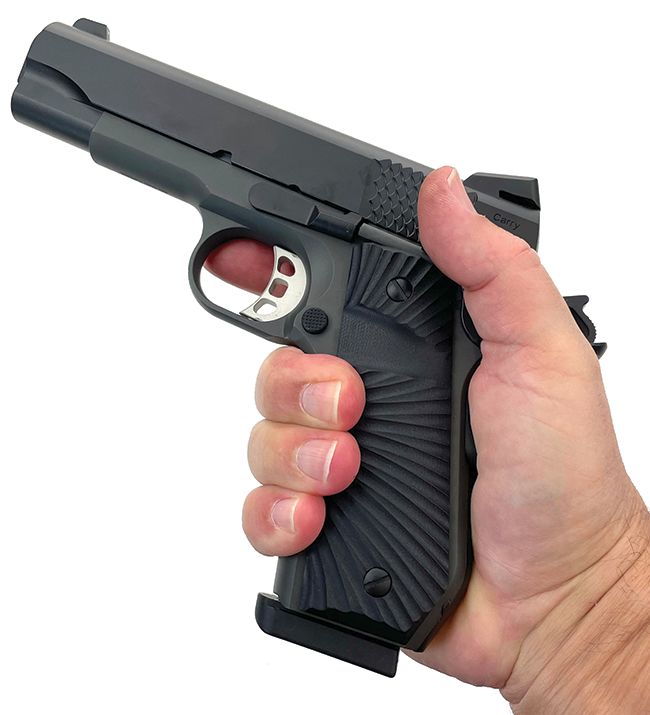
The Tisas 1911 Stingray Carry is the least expensive bobtail in the match up, yet it did not disappoint in the long run. The Stingray comes in a hard case with two steel 8-round magazines with rubber bumper pads and a muzzle bushing wrench. The finish was a nice two-tone Cerakote with a grey frame and black slide. The G10 grips have a sunburst-style texture that is not too grippy. The front grip strap was smooth, as was the mainspring housing. The lack of checkering in these critical spots helps keep the cost of the Tisas at a tolerable level. It also made the Tisas move in our grip during recoil. There are only rear slide serrations with a scalloped or fish-scale texture, which offered plenty of traction. We missed the front slide serrations. The slide is domed like a GI-style 1911. Sights are Novak-style three-dot items, which worked well, offering a large-sight picture for fast shooting. The front-sight base is dovetailed in place. The rear can be adjusted for windage via a set screw and is flush with the rear of the slide to provide maximum sight radius. It was dead on, as we found out.
The frame had a slight undercut below the trigger guard, which provides a slightly higher grip for better recoil management. The ambi thumb safety has extended paddles that operated with confident clicks. The grip safety had a nice beavertail and a tall speed bump, so the safety was deactivated with every grasp. The speed groove in the grip and the smoothness of the grip ensured the pistol was fast to twist in our right shooting hand to press the mag release and drop the mag during a reload. A single recoil spring is used, so the Tisas cycled a lot like a GI 1911, meaning not as smoothly as the other 1911s with dual springs and a full-length recoil guide rod. It took 21 pounds of effort to rack the slide.
At 15 yards, the best five-shot group with the 230-grain ball ammo ranged from 2.69 inches with Armscor rounds to 3.47 inches with Remington and 2.89 inches with Blazer. Average accuracy was 3.02 to 3.56 inches. The Hornady Critical Duty +P with a 220-grain FlexLock bullet had a best group of 2.90 inches and averaged 3.05 inches. Definitely not a target 1911, but very capable for defense. Across all ammo, the Tisas averaged 3.24 inches, which was the worst accuracy of all pistols tested. More troublesome, we initially had a few FTF jams, but as we stated, those worked themselves out, and by the end of the test, the Tisas was running flawlessly.
The trigger broke at 6 pounds, which is heavy, in our opinion. There is about an eighth of an inch of take up before the trigger releases the shot, with 6 agonizing pounds of pressure. For a EDC gun, the trigger is serviceable. Not the best, but okay. The trigger is serrated so your finger has some traction on the blade during recoil. The rubber bumper pad on the magazine extends out from the frame, increasing the height. We’d carry the bobtail Tisas with a flush-fit magazine for maximum concealability.
During the failure drill, we had to pay attention to our grip because of the slick front grip strap and smooth-ish grips. The pistol moved in our hand during recoil if we didn’t pay attention. We threw a few head-A-zone shots due the heavy trigger and our speed to fire off the round. When we slowed down, hits were more surgical. The magwell had a slight bevel to aid in reloads.
Our Team Said: Consider the Tisas Stingray Carry a budget bobtail that performs well after break in, has decent accuracy, and looks great. We missed front slide serrations and grip- strap checkering. We didn’t miss the accessory rail. Buy this gun if you want to try out a bobtail without paying custom gun prices. Shoot the Tisas Stingray Carry a lot to break it in before you carry it concealed.