























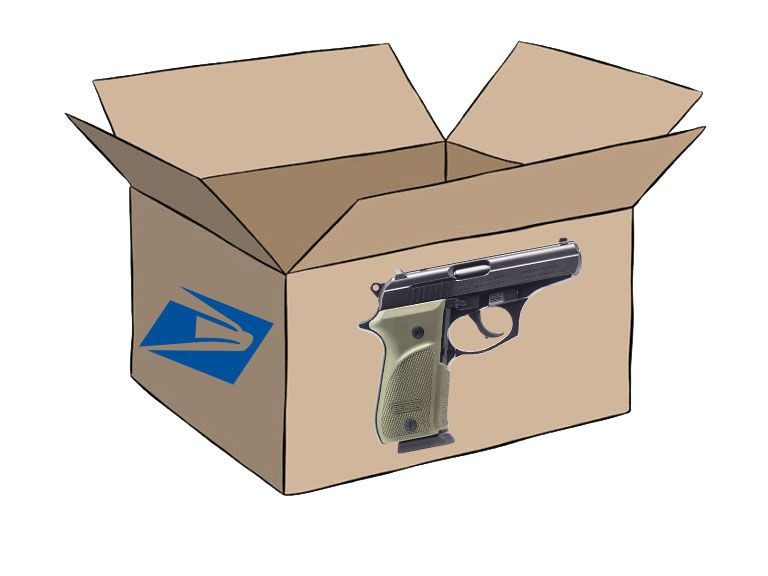
A landmark opinion from the Department of Justice’s Office of Legal Counsel (OLC) declared on January 15, 2026 that the federal statute prohibiting the mailing of concealable firearms such as pistols, revolvers, and other handguns (18 U.S.C. § 1715) is unconstitutional under the Second Amendment as applied to Second Amendment protected arms.
The DOJ determined the restrictions on handguns are unenforceable because they “fall within the core of the ‘arms’ protected by the Second Amendment,” the memo said.
The DOJ memo continued, “Consequently, so long as Congress chooses to run a parcel service, the Second Amendment precludes it from refusing to ship constitutionally protected firearms to and from law-abiding citizens, even if they are not licensed manufacturers or dealers.”
In its memorandum opinion for the Attorney General, the OLC concluded that the U.S. Department of Justice may not enforce the statute against law-abiding citizens seeking to ship or receive handguns used for lawful purposes, including self-defense, target shooting, and hunting. The opinion directs the Postal Service to modify its regulations accordingly to align with the Constitution. And it recommends that the statute not be criminally enforced.
The opinion said, “Section 1715 substantially burdens the right to bear arms protected by the Second Amendment. An individual cannot mail himself a handgun for core constitutionally protected activity, such as self-defense, target shooting, or hunting” or other lawful pursuits.
The opinion applied a historical analysis under the Supreme Court’s landmark decisions in District of Columbia v. Heller, McDonald v. Chicago, and especially New York State Rifle & Pistol Association v. Bruen, finding no relevant historical tradition justifying a ban on shipping protected arms. OLC also concluded that the statute was designed to serve an illegitimate purpose: suppressing traffic in constitutionally protected firearms.
Erich Pratt, senior vice president of Gun Owners of America (GOA), said, “This opinion is a direct rebuke to decades of federal overreach that has unlawfully restricted Americans’ ability to acquire, maintain, and transport their firearms. For too long, law-abiding gun owners have been forced to navigate expensive, burdensome workarounds involving federal firearms licensees, just to ship a handgun—even for perfectly lawful purposes. The DOJ now recognizes what we’ve always known: the Second Amendment protects the right to keep and bear arms, and that includes the rights to acquire and transport them.”
GOA had filed suit back in July 2025 (Shreve v. U.S. Postal Serv.) seeking to have this Postal Service ban declared unconstitutional.
John Velleco, executive vice president of Gun Owners Foundation, said, “When the government enforces a prohibition on guns and gun owners with no historical foundation and no constitutional support—like the USPS ban on mailing handguns at issue in our case—it is acting outside the law.”
However, the opinion also found the Postal Service is not required to carry ammunition or gunpowder, despite those being constitutionally protected, because the existing restriction on explosives “serves legitimate postal needs to prevent injury to postal employees and property.”
Epic Merchant Systems published a short FAQ on the decision and its effects:
Q: Can FFLs mail handguns through USPS right now?
A: Not yet. USPS policies have not been updated. Continue following current USPS rules until official guidance changes.
Q: Does this opinion apply to rifles and shotguns?
A: The opinion focuses on handguns and other concealable firearms. Long guns are governed by separate USPS rules.
Q: Is this the same as a Supreme Court ruling?
A: No. This is an Office of Legal Counsel opinion that guides federal enforcement but is not a court decision.
Q: Does this force USPS to accept handgun shipments immediately?
A: No. The opinion recommends regulatory changes, but USPS must update its policies before operational changes occur.
Q: Does this affect UPS or FedEx policies?
A: No direct effect. Private carriers can still set their own rules, though the opinion weakens the legal foundation behind government shipping bans.