










Tikka T3X Varmint JRTXH312 223 Remington

0

   Few cartridges are as popular in this country as the 223 Remington. Much, if not most, of the ammo shot by rifles so chambered will be sent downrange by Modern Sporting Rifles. The 223 Remington round is easy to find, is relatively inexpensive, produces low recoil, and can be accurate, especially in a good bolt gun. Turnbolts tend to be more innately accurate and have longer barrels than gas semi-autos, and many have great triggers few semi-autos can match, which can also make them easier to shoot more accurately.

We decided to grab four samples of great bolt guns chambered in 223 Remington to see what they could do. The first is the Ruger Hawkeye Predator 17122, $1125, with a gorgeous laminated-wood stock, Ruger integral scope rings, and controlled-round feed. The second is the Savage Model 110 Varmint 57066, $775, complete with an AccuTrigger and adjustable AccuStock that makes it easy to adjust length of pull and comb height. Next is a Tikka T3x Varmint JRTXH312, $800, with a heavy 23.7-inch barrel, Tikka’s sturdy mount for a Picatinny rail, and the company’s superb trigger. Last is the much lighter and somewhat more affordable Winchester XPR 535700208, $640, with its composite stock and standard-profile barrel.

Tikka T3x Varmint JRTXH312 223 Remington,

$800

Gun Tests grade: A (OUR PICK)

A bit heavy for all-day carry in the field, the Tikka Varmint is perfect for a bench or  tripod. We find their actions incredibly smooth with great factory triggers

Action Type Bolt
Overall Length 43.9 in.
Barrel Length, Twist 23.7 in., 1:8
Overall Height w/o Scope Mount 6.75 in.
Weight Unloaded 8.25 lbs.
Weight Loaded 8.56 lbs.
Sight Radius NA
Receiver Finish Black carbon steel
Receiver Scope-Base Pattern Tikka
Barrel Finish Black
Magazine Capacity 6
Magazine Type Detachable box
Stock Material Synthetic
Stock Drop at Comb 0.25 in.
Stock Drop at Heel 0 in.
Stock Bedding None, recoil lug
Stock Buttplate Soft rubber
Stock Length of Pull 14.0 in.
Trigger Pull Weight 1.16 lbs.
Safety 2-position rocker
Warranty 2-year limited
Telephone (800) 237-3882 (Beretta)
Website choose.tikka.fi/usa
Made In Finland

Most of the rifle world is familiar with Sako and the excellent long guns that company produces. Now owned by Beretta, Sako also designs and builds Tikka rifles in the same factory and even uses some of the same processes. That said, the “price brand” Tikka is still a heck of a rifle.

Part of what Tikka does to create a less-expensive product is to limit options on several models. Some of that may be changing a bit. We see quite the variety of new polymer stocks mated to Tikka rifles, now in a mix of camo patterns. However, our T3x Varmint version is a plain-black selection. Also, we see some mini-actions, like the one from Howa, scaled specifically to the 223. Still, most companies just use a standard short action, as did the Ruger and Winchester rifles in this test. Tikka provides a large selection of cartridges choices, all of them in long actions.

Our T3x Varmint starts off with a 23.7-inch barrel that doesn’t know if it going to mounted on a Sako or a Tikka — the same barrels are used for both. The standard varmint profile measures right at 0.870 inch at the muzzle and sports a recessed target crown. That profile pushes the weight and the balance point further forward on the rifle than most, leaving it not the most comfortable to carry in the hand. It also means that the rifle is stable on the bench with a bag or on a tripod. 

Rifled with a 1-in-8-inch twist, the Tikka is capable of handling most of the bullet weights popular for the 223. We tested 53- to 77-grain projectiles in the test and, outside the test, up to 80.5-grain bullets with the Tikka stabilizing everything we fed it. We did tend to bias toward the heavier weights specifically because of the fast twist. Early 223/5.56 barrels had a much slower 1:12-inch twist — sometimes even 1:14 inches. According to our computations, a bullet traveling at 2800 fps from a 1:8-inch twist barrel would rotate at 252,000 rpm. The numbers on a faster 40-grain bullet would be 324,000 rpm, enough to spin apart by centrifugal force. Buy your rifle accordingly. If all you want to do is hunt prairie dogs, stay with the more lightly constructed bullets and slower twists. We wanted to be able to reach out a little more, so we went the faster twist. Three of our four samples use a 1:8-inch twist, with the Savage being the exception at 1:9.

These rifles had different barrel weights, but all were well protected and shot well.

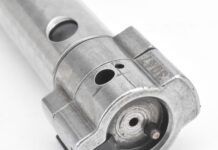
The Tikka action is a slab-sided unit with a right-side-only ejection port. The top of the receiver is machined to give you two different options for mounting a scope. The first is using a 16.5mm dovetail integral to the receiver. Rings for those, like many Tikka accessories, are available from locations such as MidwayUSA.com and, even better, MountainTactical.com — home of just about all things Tikka. Our preferred method is to mount a Picatinny rail instead. Note that a different rail is required for an older T3 model. The mount is solid and even provides holes for the recoil lugs protruding from the bottom of the mount. Also new to the upgraded T3x version is a metal bolt shroud and a steel recoil lug for the action. The safety is a two-position rocker to the right and rear of the bolt. Forward is Fire, while the rearward position locks both the sear and the bolt. The safety must be moved off Safe to open the bolt.

The working parts of the Tikka are exceptional. We are not sure that we have ever found a smoother bolt throw or better trigger on a production rifle. The bolt feels like it has ball bearings rolling on well-oiled glass. The trigger is crisp, light, and easily adjusted. With the trigger adjustment screw run out until it hit the stop, our sample required a mere 18 ounces of effort to compress — perhaps too light for some folks. The bolt head employs two lugs, a Sako-style extractor and a plunger ejector. The bolt handle is steel and is mounted in a dovetail. Different versions are available and easy to change out. 

The stock is polymer, as are the bottom metal and the magazine. But that description does not give justice to the stock. Foam-filled, the stock is rigid and quiet. Our Varmint model sports a cheek piece that helps bring the face up near the right height. The pistol grip can be changed from the more vertical type we prefer to a more slanted conventional-style piece. The fore end is slim, rounded, and easy to carry. A second, outer beavertail fore end is available from the Beretta that can be added to the rifle to create a flat piece great for shooting off bags. The fore end is relieved to allow a deep barrel channel and a free-floated barrel. We couldn’t even manually compress the stock enough to make it touch the barrel. 

The detachable box magazine holds six rounds and drops easily when a well-protected lever in front of the magazine is pulled to the rear. Given that the magazine must fit a long action, a spacer more than an inch long is built into the back of the mag to ensure proper feeding. 

In that area, feeding was perfect, though ejection was a little anemic unless we operated the bolt briskly — something we don’t normally do when we are trying to capture and inspect fired brass. The combined average group size was 0.732 inch, with the Federal Gold Medal Match and the Black Hills Mark 262 Mod 1C ammo virtually tied for first at 0.592 and 0.599 inch, respectively. Once again, the Speer Gold Dots came in last place, averaging more than 1.11 inches for the three-shot groups. We have found Speer Gold Dot handgun ammunition to be very accurate, so we were surprised the Speer rifle ammo was not achieving the same standards. With a 1.09-inch overall average, it was the only load we tested in this group that did not average under 0.8 inch. 

Our Team Said: We liked the operation, accuracy, and build quality of the Tikka. It was easily Our Pick from this quartet. 

223 REMINGTON RANGE DATA
Hornady Superformance 53-grain V-Max Ruger Hawkeye Savage 110 Varmint Tikka T3x Varmint Winchester XPR
Average Velocity 3396 fps 3467 fps 3420 fps 3420 fps
Muzzle Energy 1357 ft.-lbs. 1415 ft.-lbs. 1377 ft.-lbs. 1377 ft.-lbs.
Best Group 0.61 in. 0.67 in. 0.28 in. 0.79 in.
Average Group 0.82 in. 0.77 in. 0.62 in. 0.92 in.
Speer Gold Dot 62-grain Soft Point Ruger Hawkeye Savage 110 Varmint Tikka T3x Varmint Winchester XPR
Average Velocity 2924 fps 2922 fps 2809 fps 2904 fps
Muzzle Energy 1182 ft.-lbs. 1176 ft.-lbs. 1087 ft.-lbs. 1161 ft.-lbs.
Best Group 0.97 in. 0.32 in. 0.98 in. 0.76 in.
Average Group 1.26 in. 0.68 in. 1.12 in. 0.91 in.
Federal Gold Medal 69-grain MatchKing Ruger Hawkeye Savage 110 Varmint Tikka T3x Varmint Winchester XPR
Average Velocity 2847 fps 2846 fps 2735 fps 2837 fps
Muzzle Energy 1242 ft.-lbs. 1241 ft.-lbs. 1146 ft.-lbs. 1233 ft.-lbs.
Best Group 0.31 in. 0.69 in. 0.40 in. 0.47 in.
Average Group 0.63 in. 0.72 in. 0.59 in. 0.60 in.
Black Hills 77-grain OTM Ruger Hawkeye Savage 110 Varmint Tikka T3x Varmint Winchester XPR
Average Velocity 2885 fps 2910 fps 2796 fps 2884 fps
Muzzle Energy 1423 ft.-lbs. 1448 ft.-lbs. 1337 ft.-lbs. 1423 ft.-lbs.
Best Group 0.36 in. 0.48 in. 0.50 in. 0.59 in.
Average Group 0.71 in. 0.62 in. 0.60 in. 0.68 in.

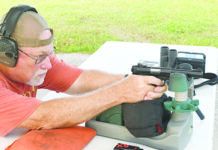
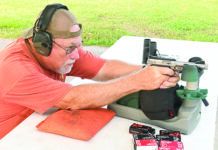
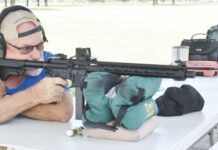
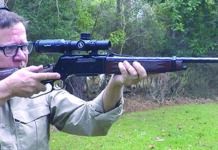
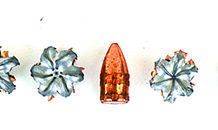
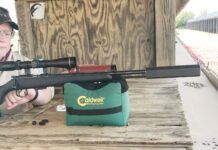
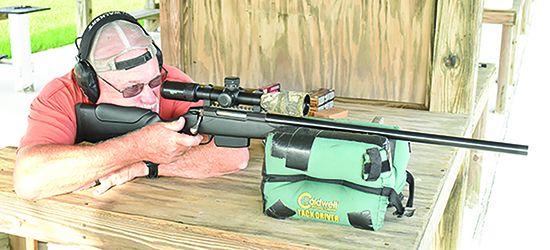
We tested with a variety of ammunition that would cover the spectrum of weights commonly used for varmint and long-range 223 Remington rifles: Hornady’s 53-grain V-Max, the 62-grain Speer Gold Dot, the 69-grain Federal Gold Medal Match, and finished up with the Mark 262 Mod 1C 77-grain OTM from Black Hills. We shot at American Shooting Centers in west Houston, using a well-sandbagged Caldwell TackDriver Pro (Brownells 100-027-023, $49), further supported by a large rear bag, heavy from Tab Gear (TabGear.com, $34). We measured velocities with a Garmin Xero C1 Pro chronograph (Garmin.com, $600). We used a well-proven Vortex Viper PSTII 3-15×44 scope from our battery for all the shooting.

Written and photographed by Joe Woolley, using evaluations from Gun Tests Team members. GT