

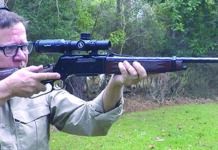
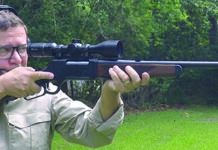







Few cartridges are as popular in this country as the 223 Remington. Much, if not most, of the ammo shot by rifles so chambered will be sent downrange by Modern Sporting Rifles. The 223 Remington round is easy to find, is relatively inexpensive, produces low recoil, and can be accurate, especially in a good bolt gun. Turnbolts tend to be more innately accurate and have longer barrels than gas semi-autos, and many have great triggers few semi-autos can match, which can also make them easier to shoot more accurately.
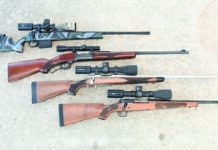
We decided to grab four samples of great bolt guns chambered in 223 Remington to see what they could do. The first is the Ruger Hawkeye Predator 17122, $1125, with a gorgeous laminated-wood stock, Ruger integral scope rings, and controlled-round feed. The second is the Savage Model 110 Varmint 57066, $775, complete with an AccuTrigger and adjustable AccuStock that makes it easy to adjust length of pull and comb height. Next is a Tikka T3x Varmint JRTXH312, $800, with a heavy 23.7-inch barrel, Tikka’s sturdy mount for a Picatinny rail, and the company’s superb trigger. Last is the much lighter and somewhat more affordable Winchester XPR 535700208, $640, with its composite stock and standard-profile barrel.
Winchester XPR 535700208 223 Remington,
$640
Gun Tests grade: A- (Best Buy)
The Winchester XPR did a great job, especially for what we initially thought might be a more entry-level rifle. This Winchester would be light and handy to carry afield.

| Action Type | Bolt |
|---|---|
| Overall Length | 42.25 in. |
| Barrel Length, Twist | 22.0 in., 1:8 |
| Overall Height w/o Scope Mount | 6.0 in. |
| Weight Unloaded | 6.85 lbs. |
| Weight Loaded | 7.16 lbs. |
| Sight Radius | NA |
| Receiver Finish | Perma-Cote |
| Receiver Scope-Base Pattern | 4-screw Winchester XPR |
| Barrel Finish | Perma-Cote |
| Magazine Capacity | 5 |
| Magazine Type | Detachable Box |
| Stock Material | Composite |
| Stock Drop at Comb | 0.5 in. |
| Stock Drop at Heel | 0.5 in. |
| Stock Bedding | None |
| Stock Buttplate | Inflex 1, rubber |
| Stock Length of Pull | 13.75 in. |
| Trigger Pull Weight | 3.32 lbs. |
| Safety | 2-position rocker, bolt release |
| Warranty | None written |
| Telephone | (800) 333-3288 |
| Website | WinchesterGuns.com |
| Made In | U.S. |
Winchester Repeating Arms is famous for the Model 70 rifle, and rightly so. We know that beauty is in the eye of the beholder, but in our humble opinion, the Model 70 Featherweight Stainless is one of the sexiest rifles we’ve ever seen. Looks aside, the history of that rifle and the features manufactured into it stand on their own. A decade or so ago, Winchester decided to offer another rifle — one not quite so feature rich — which would allow the company to sell at a lower price point. Still, rifles have to feed, fire, and hit what they are aimed at. We wondered how well the XPR Model would do those things.
This rifle starts off at 6.8 pounds. We knew that would likely not hold the bag as well for extending shooting, but if you’re going to walk all day carrying this rifle, that lighter weight could be an important selling point. Part of that weight savings is accomplished through the use of a Sporter-contour barrel instead of the heavier tubes on our other test samples. This 22-inch button-rifled barrel has a 1:8-inch twist and a black Perma-Cote finish, as does the action. It is attached to the receiver via a barrel nut system like the Savage that is designed to make sure everything is aligned concentrically. That system also allows for precise head spacing. Everything ends in a well-recessed target crown.
The action was designed for cost savings, but it still possessed some nice surprises. The receiver is tubular, which saves on machining costs, but we had to wait to shoot it to find out if it would still attach solidly enough for the required accuracy. The ejection port was small, though not as small as the Tikka’s, and we anticipated the receiver would be very stiff. It came drilled and tapped for the XPR base pattern. Model 70 bases absolutely would not fit. It was also set up for 8×40 screws, which are a good bit stronger than the more common 6×48 screws.

The working parts showed a few more pleasant surprises. The full diameter bolt — also easier to machine — sports three lugs, which allows a shorter 60-degree bolt throw. Then it provides a sliding-plate extractor and a plunger-style ejector. Even if it weren’t a more-price-conscious offering, we would have been pleased with how smoothly the bolt operated. The bolt handle is metal, though the shroud is a composite. The safety is a two-position rocker switch located just behind the bolt handle. Forward is Fire, while the rearward position locks everything. Depressing a tab just in front of the safety allows the bolt to be operated with the safety engaged. The bolt release is a lever that must be depressed to activate and is located on the left rear of the receiver.
The trigger was impressive. Apparently, while Winchester engineers were deciding how to build a good rifle less expensive than the Model 70, they understood that the trigger still needed to be very good. We’ve tested many good, bargain rifles whose triggers have tended to being less than optimum. In some cases, less than acceptable. Not so the XPR. Winchester is using the same M.O.A. trigger on the XPR as on the flagship Model 70. The trigger face is smooth, flat, and wide, making it easy to operate. The internal geometry uses an actuator system that doubles the leverage imparted by the trigger alone. The result on our test trigger was zero creep and zero overtravel. Pull weight was 3.3 pounds, but it felt much lighter.
The stock was composite but did its job well. Matte black in color, it showed stippling at the fore end and the pistol grip. The fore end was well reinforced and well relieved from the barrel. We could make the stock touch the barrel, but just resting it on a bench certainly wasn’t going to. The five-round magazine and the bottom metal were all composite. Two action screws hold everything together and settled the action down tightly on the steel recoil lug. The recoil pad is one of the Inflex 1 models and did just what it was supposed to do. Fit and inletting on all the parts were very good.
The XPR ended up in third place in the accuracy testing with a 0.777-inch average, where it showed a preference for the Federal Gold Medal Match 69-grain ammo and the Black Hills 77-grain Open Tip Match rounds. Ejection and operation were perfect. As with the other three rifles, we were pleased that the 53-grain Hornady V-Max rounds did well in these fast-twist rifles. Average accuracy across the four was 0.78 inch.
Our Team Said: Easily the best choice for a totable field rifle, the Winchester XPR was lighter in poundage and in cost. It’s a Best Buy.
| 223 REMINGTON RANGE DATA | ||||
|---|---|---|---|---|
| Hornady Superformance 53-grain V-Max | Ruger Hawkeye | Savage 110 Varmint | Tikka T3x Varmint | Winchester XPR |
| Average Velocity | 3396 fps | 3467 fps | 3420 fps | 3420 fps |
| Muzzle Energy | 1357 ft.-lbs. | 1415 ft.-lbs. | 1377 ft.-lbs. | 1377 ft.-lbs. |
| Best Group | 0.61 in. | 0.67 in. | 0.28 in. | 0.79 in. |
| Average Group | 0.82 in. | 0.77 in. | 0.62 in. | 0.92 in. |
| Speer Gold Dot 62-grain Soft Point | Ruger Hawkeye | Savage 110 Varmint | Tikka T3x Varmint | Winchester XPR |
| Average Velocity | 2924 fps | 2922 fps | 2809 fps | 2904 fps |
| Muzzle Energy | 1182 ft.-lbs. | 1176 ft.-lbs. | 1087 ft.-lbs. | 1161 ft.-lbs. |
| Best Group | 0.97 in. | 0.32 in. | 0.98 in. | 0.76 in. |
| Average Group | 1.26 in. | 0.68 in. | 1.12 in. | 0.91 in. |
| Federal Gold Medal 69-grain MatchKing | Ruger Hawkeye | Savage 110 Varmint | Tikka T3x Varmint | Winchester XPR |
| Average Velocity | 2847 fps | 2846 fps | 2735 fps | 2837 fps |
| Muzzle Energy | 1242 ft.-lbs. | 1241 ft.-lbs. | 1146 ft.-lbs. | 1233 ft.-lbs. |
| Best Group | 0.31 in. | 0.69 in. | 0.40 in. | 0.47 in. |
| Average Group 0 | .63 in. | 0.72 in. | 0.59 in. | 0.60 in. |
| Black Hills 77-grain OTM | Ruger Hawkeye | Savage 110 Varmint | Tikka T3x Varmint | Winchester XPR |
| Average Velocity | 2885 fps | 2910 fps | 2796 fps | 2884 fps |
| Muzzle Energy | 1423 ft.-lbs. | 1448 ft.-lbs. | 1337 ft.-lbs. | 1423 ft.-lbs. |
| Best Group | 0.36 in. | 0.48 in. | 0.50 in. | 0.59 in. |
| Average Group | 0.71 in. | 0.62 in. | 0.60 in. | 0.68 in. |
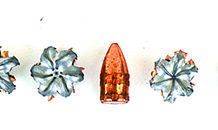
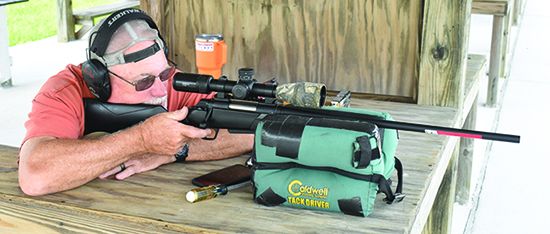
We tested with a variety of ammunition that would cover the spectrum of weights commonly used for varmint and long-range 223 Remington rifles: Hornady’s 53-grain V-Max, the 62-grain Speer Gold Dot, the 69-grain Federal Gold Medal Match, and finished up with the Mark 262 Mod 1C 77-grain OTM from Black Hills. We shot at American Shooting Centers in west Houston, using a well-sandbagged Caldwell TackDriver Pro (Brownells 100-027-023, $49), further supported by a large rear bag, heavy from Tab Gear (TabGear.com, $34). We measured velocities with a Garmin Xero C1 Pro chronograph (Garmin.com, $600). We used a well-proven Vortex Viper PSTII 3-15×44 scope from our battery for all the shooting.
Written and photographed by Joe Woolley, using evaluations from Gun Tests Team members. GT