








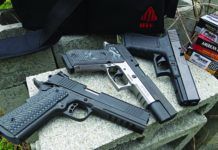
Full-Size 10mm Pistols from SIG, Glock, and Rock Island Arsenal
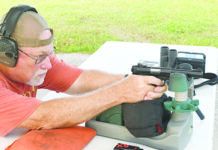
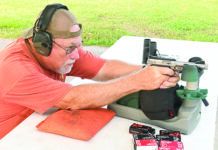
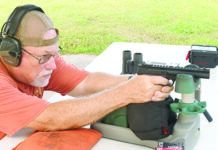
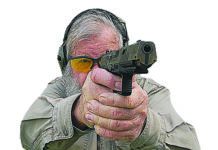
The 10mm Auto cartridge seems to be going through a renaissance. There is new ammunition being manufactured in velocities the 10mm was intended for, like in the newer SIG Elite Performance ammo, and firearms manufacturers such as Glock and SIG have offered new pistols chambered in the round, the G40 Gen4 MOS and P220-10, respectively. We wanted to take a look at the 10mm in a full-size pistol that we could easily open-carry on the back 40 or concealed under a jacket or coat for in town. Since there are numerous examples of 10mm pistols to test, we also wanted to see if a different platform favored the big-bore caliber.
As we tested, we gained renewed respect for the 10mm round. Some testers even thought the round may be a liability in a self-defense situation due overpenetration. If we were in a crowded mall and were able to get solid center-of-mass hits on an attacker, we wondered whether certain loads would overpenetrate and hit a bystander. We do think it is a good round to punch through vehicles with and to stop big bears, and we also feel it is an excellent hunting cartridge if kept to bow-hunting distances on feral swine, whitetails, and small black bears. Around bystanders, we would most likely stick with the 10mm Lite or 10mm FBI loads if we carried the 10mm concealed.
The 10mm Auto creates a maximum pressure in the range of 37,500 psi. Compare that to the 45 ACP, which has about 21,000 psi with 230-grain ball ammo. The round was the brainchild of Jeff Cooper and a few like-minded individuals who wanted better terminal ballistics than the venerable 45 ACP could produce. The 10mm Auto exceeds 357 Magnum power and is very close to that of the 41 Magnum. The 10mm Auto is a brute of a round with the type of recoil you would expect from a magnum revolver. The mythical Bren Ten was one of the first semi-automatic pistols chambered in the round. The pistol never really lived up to its expectations due to magazine difficulties and the 10mm Auto thoroughly trouncing the Bren Ten's mechanism. The 10mm Auto has such a fast-moving bullet that it tends wreak havoc with the pistol's recoil mechanism. Colt first chambered its 1911 Series 80 in the cartridge in 1987, and it caused receivers to crack where the slide stop fits into the receiver. A relief cut was made by Colt to fix the situation, and the company's pistols in 10mm ran fine thereafter. When the FBI adopted the round after the Miami-Dade shoot out in 1986 due to agents' underperforming handgun cartridges, the Bureau soon realized agents could not or had a hard time handling the recoil of the 10mm Auto. The Bureau had adopted the cartridge first, then adopted the S&W Model 1076, which was purpose-built for the round. The FBI's solution was to load the 10mm light, which made it more tolerable to agents. The 10mm loads became known as 10mm Lite or 10mm FBI. We all know the light 10mm load is nothing but a 40 S&W in a longer case. The 10mm Auto produces about 300 foot-pounds more energy than the 40 S&W when the 10mm Auto is loaded to its standard velocity, and it's even hotter with niche ammo like that from Buffalo Bore. The 40 S&W changed the way law enforcement looked at cartridges, and the 10mm Auto might have been forgotten if it were not for some diehard fans — one of whom is on theGun Testsstaff.
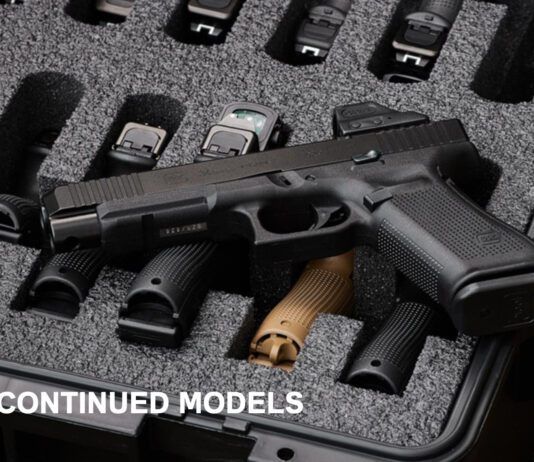
Our shooters chose three very popular platforms to test the 10mm Auto: a 1911 design from Rock Island Arsenal (RIA), the SIG P220 model, which custom gunsmiths have been converting to 10mm for years, and the large Glock frame, which has been chambered in 10mm since 1991. All of these pistols in other calibers, namely 45 ACP, have received high grades in the past from us, so our expectation was these pistols would perform, and they did. All the pistols ran exceptionally well, with no malfunctions or jams. That says a lot because some 10mm Auto pistols are finicky because factory ammo is loaded light, standard, and heavy. We used an assortment of ammo; two light loads from Federal and two standard 10mm Auto loads from SIG in the Elite Performance Ammunition line, that are much faster than the Federal's load. The Federal loads consisted of American Eagle 180-grain FMJs which clocked slightly over 1000 fps, and Personal Protection 180-grain Hydra-Shok JHPs, which had an average muzzle velocity of slightly under 1000 fps. The SIG ammo averaged well over 1200 fps, except for the V-Crown 180-grain JHP in the Glock. The Glock showed lower velocity across the board with all the ammos compared to the SIG and RIA. Note the Glock barrel is also half an inch shorter than the RIA and SIG barrels.
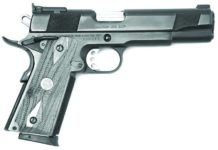
More Laments for Custom Guns
Like Grant said in last month's letters section, I, too, lament the passing of the pride of custom-gun ownership and the common look of the Ubiquitous Black Gun. But, as was said, black guns are cheap and proven reliable. Also, I cannot justify carrying a nice custom pistol on the off chance that I might have to use it. In that case, I would have to surrender it to the police, and then it would be months at a minimum to maybe get it back by jumping through their hoops.
Yes, I would rather carry a "Rolex"-quality sidearm, but I often think that if I had to give up my Valtro, I'd don't know what I'd do.
A black gun I can give up with no emotion, and go home and get another one. I always enjoy the magazine, from the editorial remarks to the last page. — Dave
New Handguns at SHOT Las Vegas 2016
At the 2016 SHOT Show in Las Vegas, Gun Testsstaffers ran across many dozens of new products that we're working to include in future tests. Following are some of the handguns, handgun ammunition, and handgun accessories we were interested in. Next month we'll look at new long guns and new options for them.
Given the growth of the AR-15 pistol market, aftermarket supplier ATI sees an opportunity to help users of the popular Ruger Charger get more enjoyment out of its use. The AR-22 Pistol Stock System features a polymer receiver chassis and a T2 pistol grip as well as a six-sided aluminum free-floating forend that sports an FS8 nose cone. The T2-style pistol grip lowers a shooter's hand to align the finger with the trigger, and the sure-grip texture helps reduce recoil. In addition, the stock also features a 16-inch aluminum Picatinny rail that runs the length of the receiver and forend for trouble-free optic and accessory mounting.
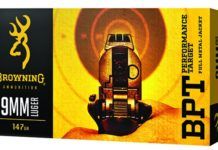
The biggest ammunition surprise might be the news that Browning is now offering, via licensing, a full line of ammunition manufactured by Olin-Winchester.
The BXP Personal Defense X-Point defensive handgun loads are loaded in black nickel-plated cases, with bullets utilizing the X-Point technology. There is also a line of Target Performance BPT loads for defensive handguns. The usual chamberings are represented in both lines, with one load each in 380 ACP, 9mm Luger, 40 S&W, and 45 Auto. Browning is also offering rimfire loads in 22 LR. They have a distinct black-oxide coating on the bullet and will be offered in 100- and 400-round packages.
Sturm, Ruger Rolls Out Significant New Pistols, Revolvers, and Rifles
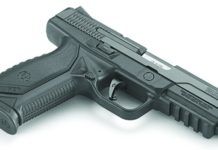
Sturm, Ruger & Co., Inc. has announced a new line of full-size duty pistols, new chamberings for its GP100 revolvers, new barrels for its 10/22 Takedowns, and new colors for its Lite rimfire pistols. Also, the company has added a Takedown rifle to its SR-556 line. The Ruger American Pistol will be available in 9mm Luger and .45 Auto. The two 9mms are Model Nos. 8605 (17+1) and 8607 (10+1) and the 45 is Model No. 8615, and all will list for $579 MSRP.
The Ruger American Pistol is built on a one-piece precision-machined stainless-steel chassis with integral frame rails and fire control housing. It has a black nitrided finish, Novak LoMount Carry three-dot sights, a stainless steel slide with non-reflective black-nitride finish, and a one-piece glass-filled nylon grip frame. The front accepts accessories on a mil-standard 1913 rail.
"The Ruger American Pistol is the most advanced semi-auto pistol we have ever produced," noted Ruger CEO Mike Fifer.
The 9mm weighs in at 30 ounces with a 4.2-inch barrel and the .45 weighs in at 31.5 ounces with a 4.5-inch barrel. Both ship in a hard case with replaceable grip modules and two, nickel-Teflon plated steel magazines. Capacities are 17 rounds for 9mm and 10 rounds for .45 Auto. 10-round magazines are also available for the 9mm for those states which restrict round counts.
CEO Fifer said that Ruger polled law enforcement and military trainers throughout the country to determine the form, function, and features of this firearm. The new pistol combines a recoil-reducing barrel cam to spread recoil over time, a low-mass slide, low center of gravity and a low bore axis to provide better balance, less felt recoil and less muzzle flip.
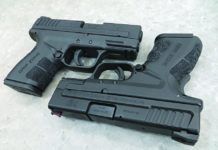
9mm and 45 ACP XD Mod.2 Subcompacts Go Head to Head
The compromise that shooters have to deal with in choosing a concealed-carry sidearm is this: A smaller pistol that is easier to conceal is usually more difficult to operate and shoot; and a larger pistol that is easier to operate and shoot is more difficult to conceal. A line of guns retailers have told us are popular carry pieces are the newest Springfield Armory XD variants, the XD Mod.2 series.
They are supposedly redesigned XD subcompacts that have better ergonomics, more useful sights, and slimmer profiles. If you are looking for a concealed-carry handgun that offers a super-slim profile, less weight, and better concealability, we suggest you stick with a single-stack pistol like Springfield's XD-S 3.3, which we reviewed in February 2015 (Grade A). On the other hand, if you want a pistol that is still concealed-carry friendly but has nearly double the magazine capacity with the feel of a full-size pistol, the Mod.2 pistols are supposed to fill that ticket. So we tested the two most-popular chamberings of the Mod.2 pistols in 9mm Luger and 45 ACP to see what all the fuss is about. The question that needed to be answered is, are these new guns so good that we would recommend you considering switching from your favorite carry piece? That is a super-high barrier for any handgun to scale, and, ultimately, each concealed-carrier has to make the decision to try them on his or her own.
The trend these days with law enforcement is to move to the 9mm cartridge, and many agencies we are acquainted with are using 147-grain ammo. So we selected 147-grain cartridges from Atlanta Arms as well as 115-grain rounds from Black Hills and Hornady. For the 45 ACP, we stuck with the most popular bullet-weight choice, 230 grains, selecting FMJs from Perfecta and Federal and hollowpoints from Atlanta Arms. We had no experience with Perfecta 45 ACP ammo, but found it at a big-box store and thought we'd try it.
We fired for accuracy at 25 yards using the provided flush-fit magazines and a rest. We also fired for speed at 15 yards with both magazines, and with the flush-fit magazines drew from concealed carry using the included belt holsters and a Fobus IWB holster that uses either a large or small universal shell. The flexible backing of the Fobus ensures the pistol stays secure when worn. We practiced dry-firing drills with both pistols using both holsters and progressed to live fire. By no means could these pistols be dropped in a pants pocket; they need a holster.

Downrange: Bad CHL News Come February 1
In a startling move, Virginia Attorney General Mark Herring announced on December 22 that Virginia will sever concealed handgun permit (CHP) reciprocity ties with 25 of 30 states. This will affect hundreds, maybe thousands, of Gun Tests readers who reside in Tennessee and other states bordering the Commonwealth, and perhaps millions of people nationwide.
Effective Feb. 1, 2016, — about the time this issue arrives in your mailbox —Virginia will no longer honor carry permits from the following states: Alaska, Arizona, Arkansas, Delaware, Florida, Idaho, Indiana, Kansas, Kentucky, Louisiana, Minnesota, Mississippi, Montana, Nebraska, New Mexico, North Dakota, North Carolina, Ohio, Pennsylvania, South Carolina, South Dakota, Tennessee, Washington, Wisconsin, and Wyoming. The following permits will continue to be recognized: West Virginia, Michigan, Oklahoma, Texas and Utah. The move also means several states will no longer recognize Virginia's concealed-carry permits because they require mutual recognition of permits. Those include Florida, Louisiana, North Dakota, Pennsylvania, South Carolina, and Wyoming.
Speaking about this audit and update, Attorney General Herring said, "Virginia, and nearly every other state in the country, have recognized that carrying a concealed handgun is a significant responsibility that should be extended only to those who have gone through a process to prove a level of competency and responsibility."
"The standards for proving competency and responsibility are up to each state," Herring said, "and the General Assembly has established Virginia's standards for whom it considers capable of safely carrying a concealed handgun. Those standards should be applied evenly, consistently, and fairly to anyone who wants to lawfully conceal a handgun in Virginia."
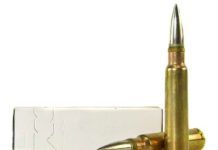
Range Data
To collect accuracy data, we fired five-shot groups off a solid bench rest. Distance was 5 yards. We recorded velocities with a Shooting Chrony Master Chronograph. The first sky screen was set 10 feet from the muzzle.
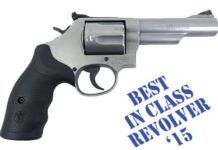
2015 Guns & Gear ‘A’ List
Toward the end of each year, I survey the work R.K. Campbell, Roger Eckstine, Austin Miller, Ray Ordorica, Robert Sadowski, David Tannahill, Tracey Taylor, John Taylor, Rafael Urista, Ralph Winingham, and Kevin Winkle have done in Gun Tests, with an eye toward selecting guns, accessories, and ammunition the magazine's testers have endorsed. From these evaluations I pick the best from a full year's worth of tests and distill recommendations for readers, who often use them as shopping guides. These choices are a mixture of our original tests and other information I've compiled during the year. After we roll high-rated test products into long-term testing, I keep tabs on how those guns do, and if the firearms and accessories continue performing well, then I have confidence including them in this wrap-up.— Todd Woodard
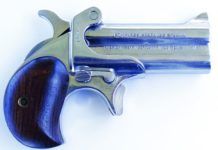
Handgun Stats: American Derringer Co. Standard Model 38 Special, $212 (used)
The American Derringer Company handgun is a very good upgrade of the original Remington design. The construction is robust, and the pistol is well polished. The grips fit well. The plunger to release the barrel lock is an excellent addition to the derringer design, and the hammer block really sold us on the pistol. While we question the viability of the derringer for personal defense, they are still popular handguns. If you must purchase a derringer, this is the one to have.
Within Range of California Gun Laws
See reader feedback on pistols, rifles, handguns and more! Reader John S. took our list of 380 ACPs to his local gun store in the Golden State, but his results were far from golden. Mare's Leg pistols are in fact legal for sale in California. Not all home building materials take bullets equally. And pistols that look like rifles. Lots of them.

Proposed Settlement Has Taurus Paying $30M
Gun maker Forjas Taurus SA has agreed to settle a $30 million class-action suit with plaintiffs who claim that some Taurus handgun safeties, even when engaged, may allow the gun to fire if it is dropped, according to a review of court documents.

California Bans Advertising of the Sale of Handguns
California has argued that a provision of California Penal Code section 26820 enacted in 1923 prevents the displaying of any "handgun or imitation handgun, or placard advertising the sale or transfer thereof" anywhere in or on their store that can be seen outside their store by passersby.